



































Content ITV PRO
This is Itvedant Content department
Learning Outcome
5
Identify hidden relationships among given clues
4
Apply logical deduction techniques
3
Develop verbal reasoning abilities
2
Solve linear and circular seating arrangement questions
1
Analyze and interpret arrangement-based information
Why Puzzels
Develop Logical Thinking
Improve Analytical & Decision-Making Skills
High-Weightage Topic in Placement Tests
Enhance Concentration & Structured Thinking
What are Puzzles and Arrangements
What are Arrangements?
In arrangement questions, you have to place people or objects in a specific order or position based on given conditions.
Think of it like arranging students in a classroom according to clues.
Types of Arrangements
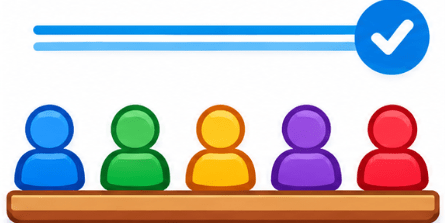
Linear Arrangement
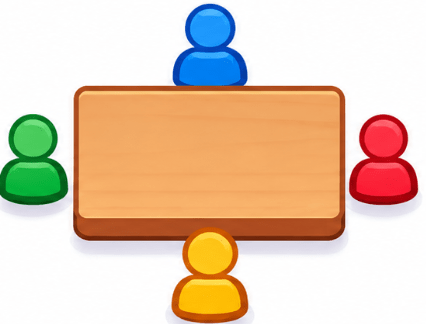
Rectangular/Square Arrangement
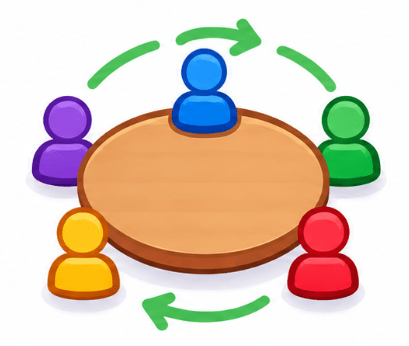
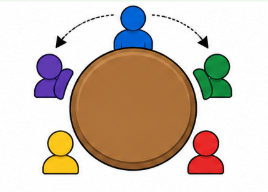
Circular Arrangement
People are seated in a straight line.
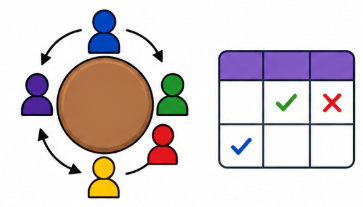
People sit around a table in a circle.
People sit around a square or rectangular table.
Types of Arrangements
Linear Arrangement
Example
A sits opposite B.
C sits to the immediate right of A.
D sits between B and E.
Find everyone's position.
Since there is no fixed start or end, these require careful direction tracking.
People sit around a square or rectangular table.
Questions may involve:
Corners
Sides
Facing inside or outside
Rectangular/Square Arrangement
Types of Arrangements
Circular Arrangement
People sit around a table in a circle.
Example
A sits opposite B.
C sits to the immediate right of A.
D sits between B and E.
Find everyone's position.
Since there is no fixed start or end, these require careful direction tracking.
What are Puzzles and Arrangements
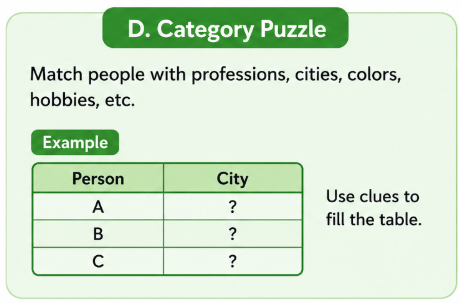
What are Puzzles?
A puzzle contains multiple pieces of information that must be connected logically.
Unlike arrangements, puzzles often involve several categories.
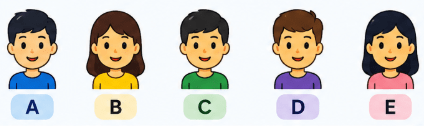
Five friends:
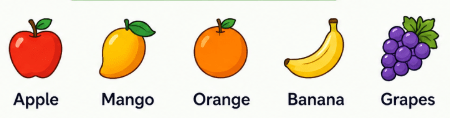
Each likes a different fruit:
What are Puzzles and Arrangements
Clues:
1
2
3
A likes Apple.
B does not like Mango.
The person who likes Orange sits next to C.
Solution
| Friends | Fruits |
|---|---|
| A | 🍎 Apple |
| B | 🥭 Mango |
| C | 🍊 Orange |
| D | Banana |
| E | 🍇 Grapes |
This is called a Logic Puzzle.
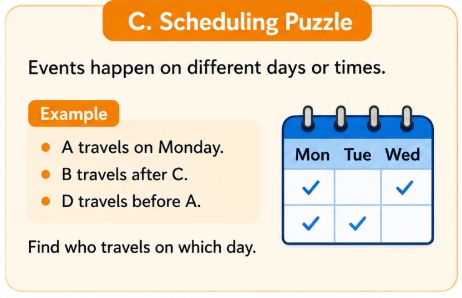
Types of Puzzles
Recall
Before We Begin...
Answer the following:
1
3
2
What is meant by a "constraint" in a puzzle?
How many neighbours does a person have in a circular arrangement?
Which is easier to solve first:
OR
A constraint is a rule or condition given in the puzzle that limits the possibilities and helps us find the solution.
A person has 2 neighbours in a circular arrangement -one on the left and one on the right.
Direct clues
Indirect clues
Clues that give clear and direct information.
Clues that need some other information to be understood.
Key Concepts
1
Read all clues carefully.
2
Start with definite information.
3
Use diagrams and tables.
4
Eliminate impossible positions.
5
Verify all clues before finalizing.
Linear Arrangement
People or objects are arranged in a straight line.
Common term
Immediate Left
Immediate Right
Second to the Left
Extreme Ends
Facing North/South
Strategy
Professional Language Usage
Choose the more professional statement:
A. "I can't do this."
B. "I may need additional guidance to complete this task."
Option B communicates respectfully and professionally.
B
Professional Language Usage
Which opening is more professional?
A. "Hey!"
B. "Dear Team,"
C. "What's up?"
Professional communication requires formal greetings.
B. Dear Team,
Practice Problems
Read the passage once completely before looking at the questions.
Underline important facts, names, numbers, and reasons.
For factual questions, find the exact line in the passage.
For inference questions, use clues from the passage rather than personal opinions.
Read all options carefully before choosing an answer.
Practice Problems
Solve the Following
Read a short paragraph and identify the main idea.
List two key points from a given passage.
Complete the analogy:
Pen : Write :: Brush : _____
Choose the most appropriate email closing:
● Thanks ● Regards ● Bye
Rewrite:
"I don't understand anything."
in a professional way.
Identify the most professional response to customer feedback.
Reading Comprehension
"Many organizations are adopting remote work models because they offer flexibility, reduce commuting time, and often improve employee satisfaction. However, remote work also requires strong communication and time-management skills."
1. What is the primary topic of the passage?
A. Office infrastructure
B. Remote work and its impact
C. Employee salaries
D. Technology trends
2. According to the passage, which skill is important for remote work?
A. Painting
B. Cooking
C. Time Management
D. Driving
Reading Comprehension
"Artificial Intelligence is increasingly being used in healthcare to assist doctors in diagnosing diseases, analyzing medical data, and improving patient outcomes."
3. What is the main benefit of AI mentioned in the passage?
A. Reducing hospital buildings
B. Improving patient outcomes
C. Increasing paperwork
D. Replacing doctors completely
4. Which field is discussed in the passage?
A. Agriculture
B. Education
C. Healthcare
D. Manufacturing
Paragraph Interpretation
5. Read the statement:
"A company's success depends not only on its products but also on customer service and employee satisfaction."
What can be inferred?
A. Products alone guarantee success
B. Customer service and employees contribute to success
C. Marketing is unnecessary
D. Only employee satisfaction matters
Paragraph Interpretation
6. Read the statement:
"Continuous learning helps professionals stay relevant in a rapidly changing industry."
What is the key message?
A. Learning ends after college
B. Industries never change
C. Continuous learning supports career growth
D. Experience is unnecessary
Verbal Reasoning
7. Complete the analogy:
Teacher : School :: Doctor : ______
A. Hospital
B. Library
C. Bank
D. Factory
8. Complete the analogy:
Keyboard : Typing :: Microphone : ______
A. Writing
B. Speaking
C. Reading
D. Drawing
9. Choose the odd one out:
A. Email
B. Presentation
C. Meeting
D. Bicycle
10. Choose the odd one out:
A. Communicate
B. Discuss
C. Collaborate
D. Ignore
Communication Skills
11. A customer complains about a delayed delivery.
What is the best response?
A. "It's not our problem."
B. "Please wait."
C. "We apologize for the inconvenience and will provide an update shortly."
D. "You should have ordered earlier."
12. During a meeting, a colleague shares an idea you disagree with.
What should you do?
A. Interrupt immediately
B. Ignore the idea completely
C. Listen first and share your viewpoint respectfully
D. Criticize the person
Communication Skills
13. Which statement demonstrates active listening?
A. Looking at your phone while someone speaks
B. Interrupting frequently
C. Asking clarifying questions and summarizing key points
D. Ignoring feedback
Professional Language Usage
14. Which is the most professional response?
A. "I don't know."
B. "That's impossible."
C. "I'll review the information and get back to you."
D. "Figure it out yourself."
15. Choose the best email opening:
A. Hi Team,
B. Yo Everyone,
C. What's Happening?
D. Hey Guys!!!
16. Choose the best email closing:
A. Bye
B. See Ya
C. Regards
D. Later
Workplace Communication Scenarios
17. You have made an error in a report.
What should you do?
A. Hide the mistake
B. Blame a colleague
C. Inform the concerned person and propose a correction
D. Ignore it
18. A team member is struggling with a task.
What is the most professional approach?
A. Ignore them
B. Offer support and guidance if possible
C. Criticize them publicly
D. Take over all their work
19. A client asks a question and you don't know the answer.
What should you say?
A. "No idea."
B. "That's not my job."
C. "I'll verify the information and get back to you."
D. "Ask someone else."
Business Communication
20. Which sentence is more professional?
A. "Send me the file ASAP."
B. "Could you please share the file at your earliest convenience?"
22. Which statement demonstrates constructive feedback?
A. "Your work is bad."
B. "The report is well-structured; adding more data could strengthen it further."
21. Which message communicates a delay professionally?
A. "The work isn't done."
B. "The task requires additional time and will be completed by tomorrow."
Key Takeaways
Reading comprehension improves understanding and analysis
Paragraph interpretation helps extract key information
Verbal reasoning strengthens logical language skills
Professional communication builds workplace effectiveness
Clear and confident communication enhances personal and professional success
Summary
5
Improve speed and accuracy in aptitude examinations
4
Identified hidden relationships among given clues
3
Applied logical deduction techniques
2
Solved linear and circular seating arrangement questions
1
Analyzed and interpreted arrangement-based information
Quiz
Who sits immediately right of C?
A. A
B. B
C. D
D. E
Quiz
Who sits immediately right of C?
A. A
B. B
C. D
D. E
By Content ITV