Introduction
Sean Willmot
Welcome to College Algebra, MAT 1340!
Meeting Times: Monday, Tuesday, Wednesday 1:00pm-2:50pm
Classroom: CP127
Instructor Name: Sean Willmot
Email: sean.willmot@frontrange.edu
Textbook:
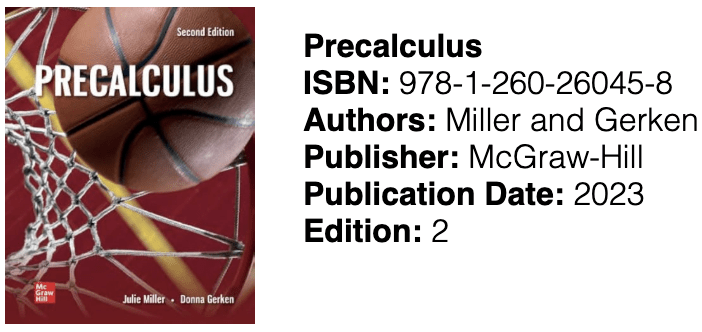
Welcome to College Algebra, MAT 1340!
Students will be required to complete homework assignments online through ALEKS, which can be accessed through MyCourses.
Please note that students are not required to purchase a hard copy of the textbook, as they will have access to the eText through ALEKS.
Students should have a TI-30XIIS (or similar) scientific calculator or have access to a Desmos Scientific Calculator (www.desmos.com/scientific) to use for homework assignments.
Students will have access to a classroom set of scientific calculators to use during classwork and exams.
Please note that students are not permitted to use graphing calculators during exams.
Welcome to College Algebra, MAT 1340!
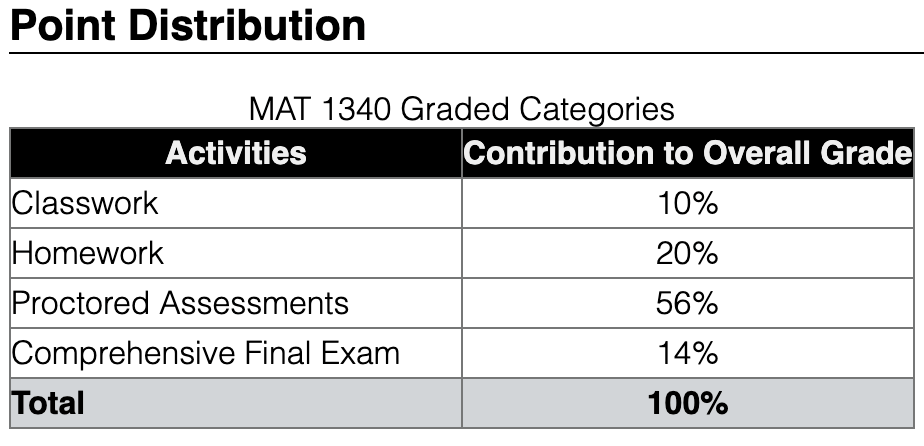
Welcome to College Algebra, MAT 1340!
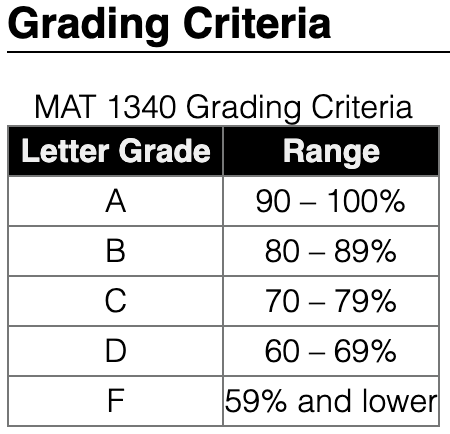
Students must earn a minimum grade of C in MAT 1340 in order to earn credit for the course, and in order to meet the prerequisite requirements for enrollment in their next math course.
Welcome to College Algebra, MAT 1340!
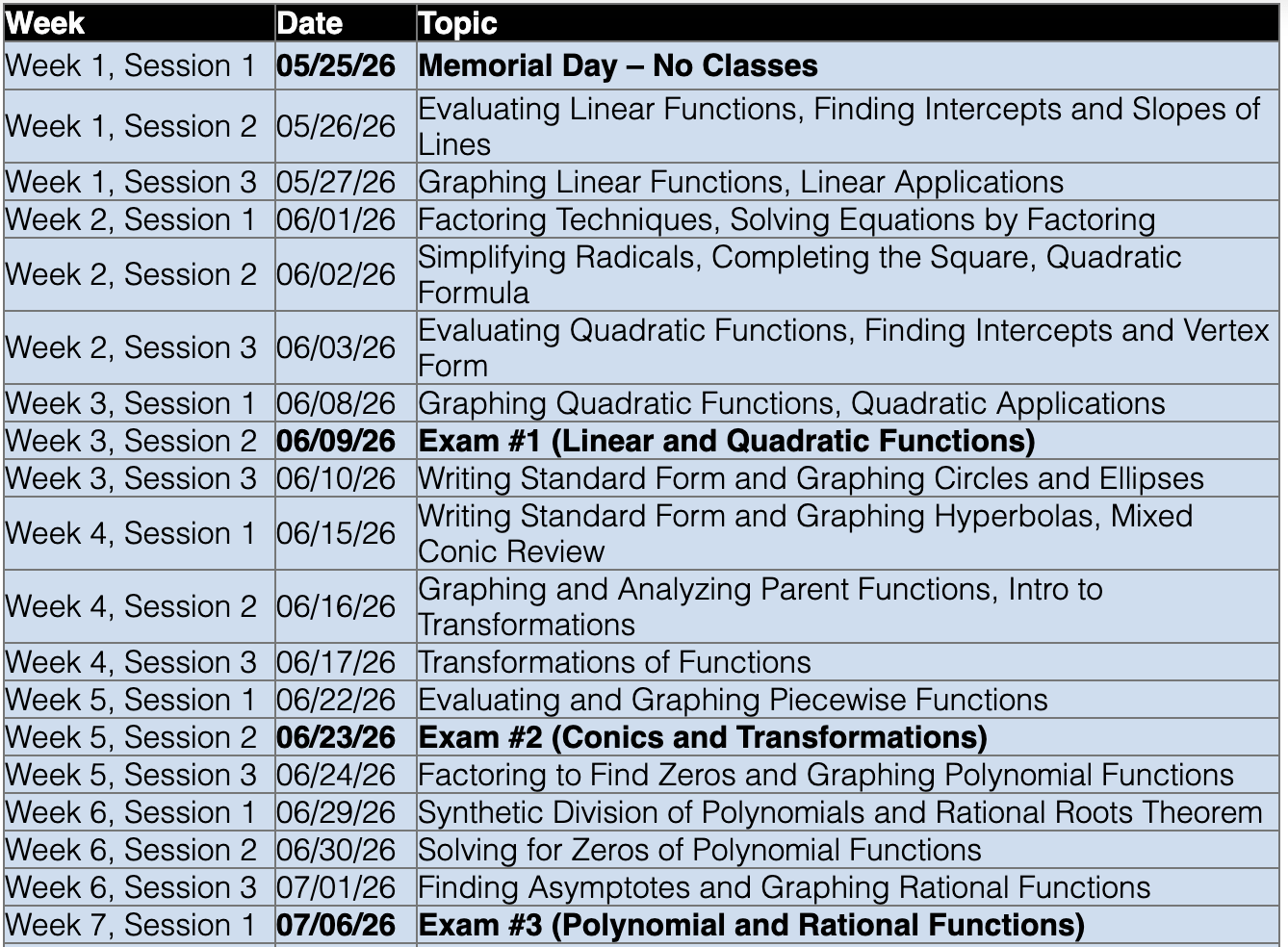
Welcome to College Algebra, MAT 1340!
Course Expections
Text
This is a COLLEGE LEVEL math course.

110min+110min+110min=330min=5.5hrs\(\Rightarrow\) 5.5\(\times\) 2= 11hrs of work outside of class per week
This time includes:
- Homework
- Studying
- Review/Practice
Decide right now what grade you want and how much work you're actually willing to put in to get it
If you are struggling with material, if you are not getting the grades that you want, DO NOT JUST SHRUG IT OFF
You have to stay engaged.
Use the resources at your disposal:
- Can you adjust your study habits?
- Are you giving yourself enough time to complete homework assignments?
- Are you working with your peers?
- Are you going to the Academic Success Center?
- Are signing up for online tutoring?
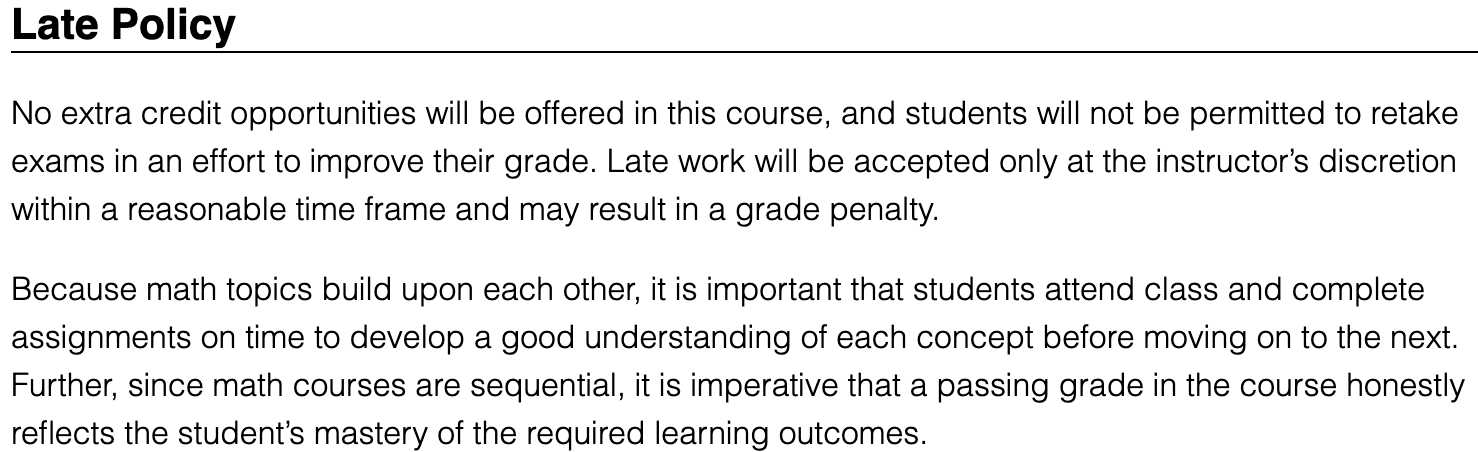
This course will involve a good deal of in-class work.
This work will be done in groups.
Each group can turn in one set of solutions with every member's name.
Classwork will be due at the end of each class period.
At the end of the semester, your lowest 2 classwork scores will be dropped
Classwork will count for 10% of your final grade.
What is Math?!
MATH IS NOT MAGIC!!!

Math plays by a fixed set of rules.
Getting good at math means getting good at using these rules.
You CANNOT only memorize specific examples and expect to do well on exams.
At a minimum, you HAVE to be able to apply general methods to problem types, not specific problems of that type.
If you are moving on to higher level classes, you aim to understand WHY these methods are used the way that they are.
Math is:
-
A Formal Language
-
A Set of Axioms
-
A Set of Inference Rules
Roughly, a formal language is:
- A set of symbols (the alphabet)
- Strings
- Formation Rules (what counts as a word)
- Grammer (What counts as a sentence)
Ex.:
The English Language:
- Alphabet: {A,a,B,b,C,c,D,d...,Y,y,Z,z}+{.,(,),/,\,...}
- Strings: adb, bad, dab, dba, bda, ...
- Words:
adb, bad, dab,dba,bda, ... - Sentences: That dab is bad,
is dab bad that, ...
Ex.:
Function Notation:
- Alphabet: {f,g,h,...} + {x,y,z,...}+ {(,),.,=,<,>,...}+\(\mathbb{R}\)
- Strings: xf/(=, x<>x, f(x), f(x)g, g(f(x)),...
- Words:
xf/(=,x<>x, f(x),f(x)g, g(f(x)),... - Sentences: =g(x)<f(x),
=f(x)+2,f(x)2+=3, f(x)+2=3,...
The point is, NOTATION MATTERS!!
Roughly, axioms are: statements that we take to be true without proof
Ex.:
- If \(a=b\), then \(b=a\) for all real numbers a and b
- \(a+b=b+a\)...
- \(d(a+b)=da+db\)...
First, note that these are all well-formed sentences (statements) in our mathematical language
Second, these are all properties we take as true without proof
Basically, we have to start somewhere
If I always need to prove the assumptions I use in a proof, I would get an infinite regress of proofs and I'd never prove anything
If \(2=3\), then \(3=2\)
\(2+3=3+2\)
\(4(2+3)=4\cdot 2+ 4\cdot 3\)
Roughly, an inference rule is a rule that lets us infer the truth of one statement from the truth of other statements.
Inference rules are how we actually prove things in math
Ex.:
1. It's true that: I have keys in my pocket and I have a cellphone in my pocket
Infer: I have a cellphone in my pocket
Inference Rule: Conjunction Elimination
2. It's true that: I have keys in my pocket or I have a cellphone in my pocket
I don't have a cellphone in my pocket
Infer: I have keys in my pocket
Inference Rule: Disjunction Elimination
Now, this is all a bit abstract so let's focus on the parts we will need for this class.
What we will be interested in this semester are:
- Constants
- Variables
- Terms
- Expressions
- Equations
- Inequalities
- Definitions
- Theorems
- Functions
These are all words that I will use and expect you to know
Again, this is a college level math class. We need to start understanding why the math works the way that it does.
A constant is a number or symbol whose value is treated as fixed in the current context.
Constants and variables are part of the alphabet of our language
So constants can be numbers like:
\(-2, \frac13, \pi,...\)
as well as symbols (usually near the beggining of the alphabet) like:
a, b, c,...
So a constant can be known, like 555, or unknown but fixed, like ccc.
A variable is a symbol whose value is allowed to change within the current context.
Constants and variables are part of the alphabet of our language
Variables are usually denoted by symbols from the end of the alphabet:
x, y, z...
although they can also be symbolized with greek letters like:
\(\alpha, \beta, \theta, \phi,...\)
Constants and variables are part of the alphabet of our language
Ex.:
\(f(x)=4x\)
\(4\) is a constant
\(x\) is a variable
Ex.:
In this equation, \(x\) could be equal to any real number.
\(y=mx+b\)
\(m\) and \(b\) are constants
\(x\) is a variable
We don't know which numbers they stand for, but whatever those numbers are, they can't change in the context of this equation
Terms are the atoms of mathematical sentences.
They can be constants, variables, or the product, quotient, or power of constants and variables
Ex.:
\(2, \quad x, \quad 2x, \quad 2x^2, \quad \frac{x^{\frac13}}{\pi},...\)
These are sort of the smallest units with which we build larger mathematical statements
The next largest part of a mathematical statement is called an expression.
An (algebraic) expression is a combination of terms using algebraic operations.
\(2+3\)
Ex.:
\(x^2-3y\)
\(\frac{\sqrt{z-x^2}}{7y+12}\)
\(x(5\theta^2-e)\)
A definition is really just telling us what a word or symbol means; its introducing terminology for a collection of statements in our math language.
When I say that something satisfies a definition, I'm saying that it makes all of the statements in the definition true
Ex.:
Def.: An even number is a number that can be expressed in the form \(2n\), where \(n\) is an integer.
Claim: 6 is an even numeber
Thus, I'm claiming that there exists an integer, n, such that \(6=2n\)
(In this case, \(n=3\))
A theorem is a set of statements that we can prove are true from our chosen axioms.
We wont prove any theorems in this class but we will use applications of them extensively
Ex.:
Th.: The sum of two even integers is even.
Th.: A quadratic equation can have at most two real solutions.
Th.: If ab=0ab=0ab=0, then a=0a=0a=0 or b=0b=0b=0.
Equations and inequalities are the statements of our math language.
Ex.:
\(2=1+1\)
Equations are expressions connected by an equality symbol
Inequalities are expressions connected by an inequality symbol
\(x=2\)
Unlike terms and expressions, they can have truth value
\(2<5\)
\(2+x\geq3\)
is an equation that is true
is an inequality that is true
is an equation that is neither true or false until we assign a value to \(x\)
is an inequality that is neither true or false until we assign a value to \(x\)
Often, when I ask students what math is, they say some version of "solving equations"
Basically, as with pretty much everything I've said so far today, this is a bit more complicated than what I'm letting on, but equality is what's called a congruence relation
This means that, amongst other things, it preserves various algebraic operations.
Ex.:
Solve the equation \(2x-3=0\) for \(x\)
\((2x-3)+3=0+3\) add 3 to both sides.
Since \(=\) is a congruence relation, it preserves addition. That is, both sides remain equal if we add the same thing to both sides
\(2x+(-3+3)=3\)
\(2x+0=3\)
\(2x=3\)
\(\frac12(2x)=\frac12(3)\)
\((\frac12\cdot 2)x=\frac32\)
\((1)x=\frac32\)
\(x=\frac32\)
addition is associative
\(3\) and \(-3\) are additive inverses
any number added to 0 is equal to itself
\(=\) preserves multiplication
multiplication is associative
\(\frac12\) and \(2\) are multiplicative inverses
any number multiplied by 1 is equal to itself
When we solve an equation, we start with a statement we assume is true, and then manipulate the equation in ways that preserve the equality
Tacitly, what we're doing is assuming this statement is true for some values of x
We are not claiming that the equation is true for all numbers
Each time we manipulate the equation, we get a new equation who's truth depends on the last equation
We do this until we arrive at a statement about the value of our variable that's true based on our original assumptions
For each item, identify as many of the following as apply:
Terms:
Constants:
Variables:
Expressions:
Equation or inequality, if any:
1. \(x=2\)
2. \(3x+7>19\)
3. \(5x^2-3x+8\)
4. \(y\leq ax^2+bx+c\)
1. \(x=2\)
Terms: \(x\), \(2\)
Constants: \(2\)
Variables: \(x\)
Expressions: \(x\), \(2\)
Equation or inequality: equation
2. \(3x+7>19\)
Terms: \(3x\), \(7\), \(19\)
Constants: \(3\), \(7\), \(19\)
Variables: \(x\)
Expressions: \(3x+7\), \(19\)
Equation or inequality: inequality
3. \(5x^2-3x+8\)
Terms: \(5x^2\), \(-3x\), \(8\)
Constants: \(5\), \(-3\), \(8\)
Variables: \(x\)
Expressions: \(5x^2-3x+8\), \(5x^2\), \(-3x\), \(8\)
Equation or inequality: neither; it is an expression
4. \(y\leq ax^2+bx+c\)
Terms: \(y\), \(ax^2\), \(bx\), \(c\)
Constants: \(a\), \(b\), \(c\), if treated as fixed parameters
Variables: \(x\), \(y\)
Expressions: \(y\), \(ax^2+bx+c\), \(ax^2\), \(bx\), \(c\)
Equation or inequality: inequality
Sets
In particular, the language of math uses sets
A set is just a collection of objects.
Amazingly, this simple idea is often used as the foundation of all of modern mathematics
Here is some notation:

Any particular object is either an element of a given set or it is not. We do not allow for an object to be partially contained in a set, nor do we allow for an object to appear multiple times in the same set.
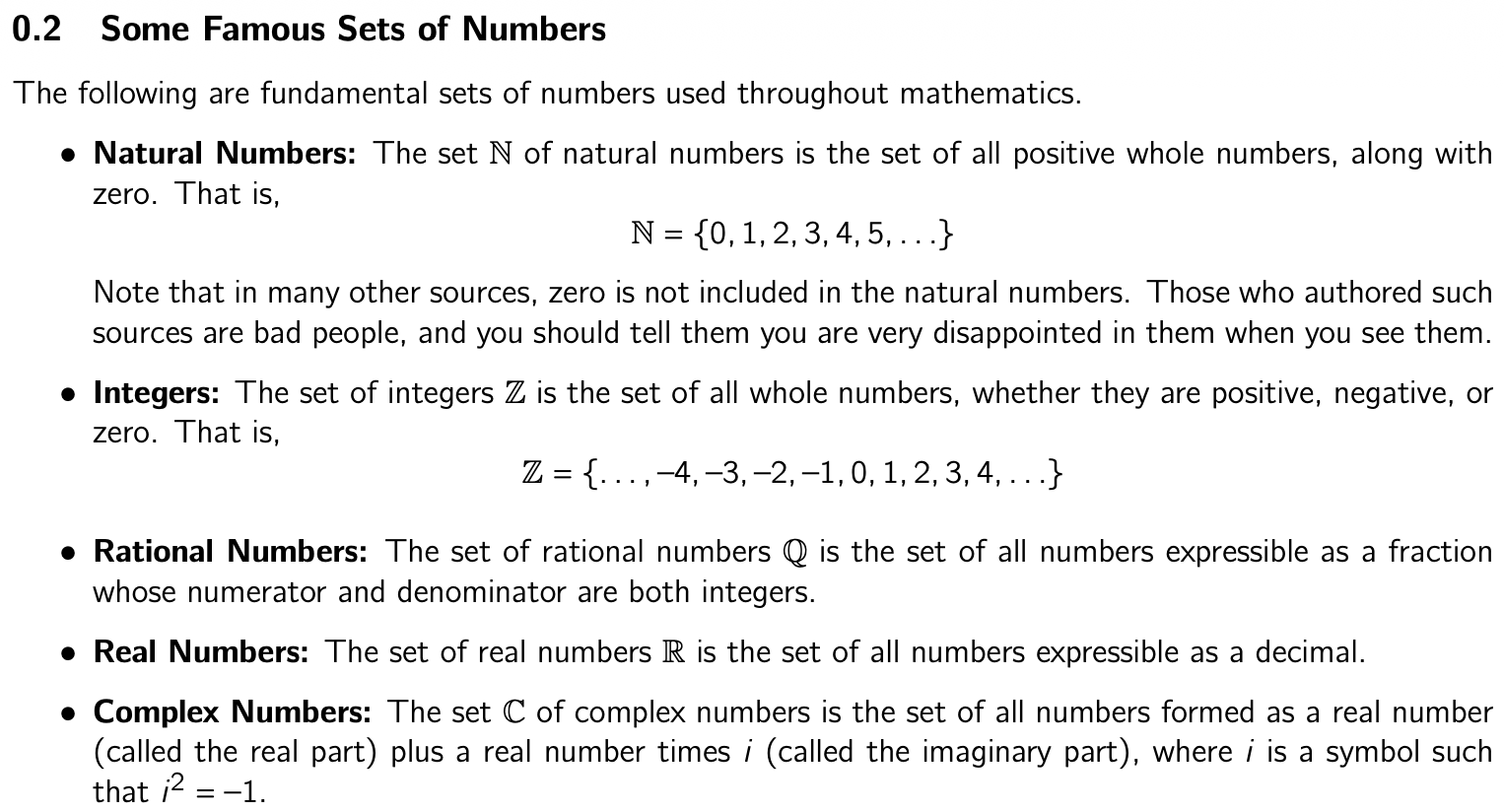
There are 3 main ways that we can denote a set:
1. By giving it a name
Usually a capital letter from the beggining of the alphabet like A, B, C, ...
2. By listing all of it's elements
Often we use curly braces around a comma-separated list to indicate what the elements are.

Elements DO NOT repeat
There are 3 main ways that we can denote a set:
3. Using set builder notation
Usually a capital letter from the beggining of the alphabet like A, B, C, ...

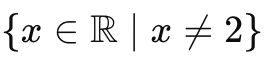
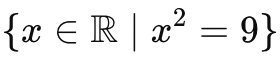
Ex.:

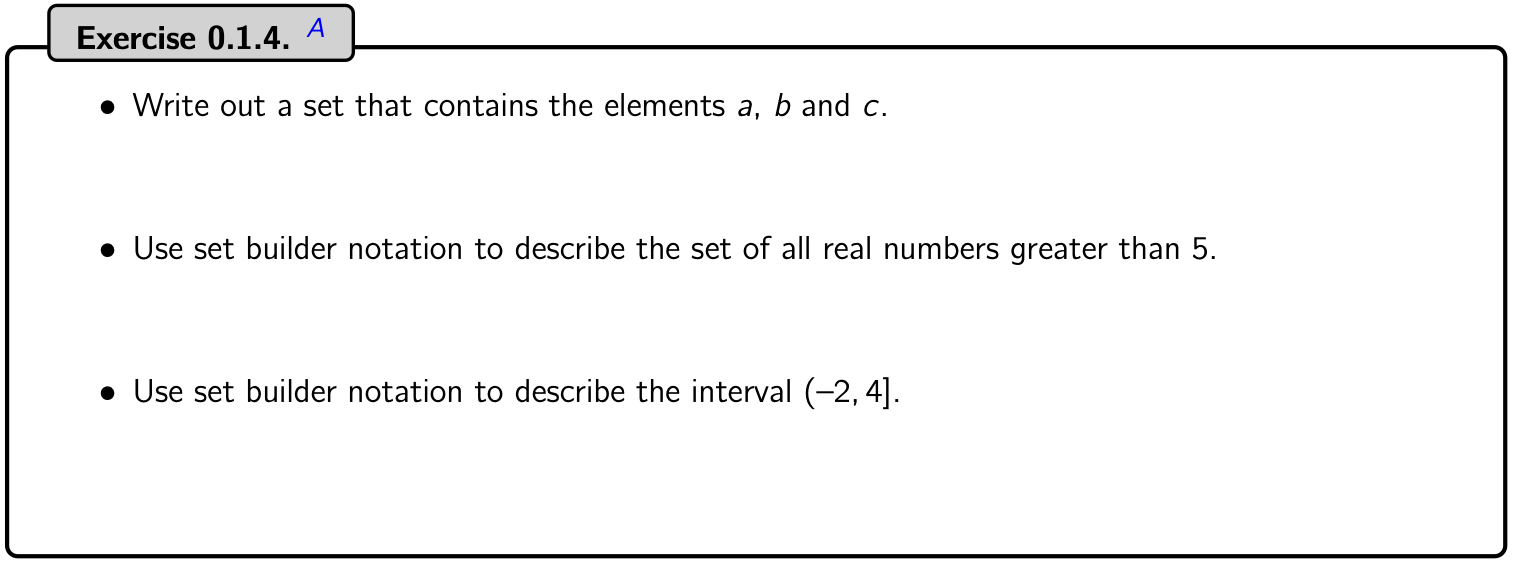
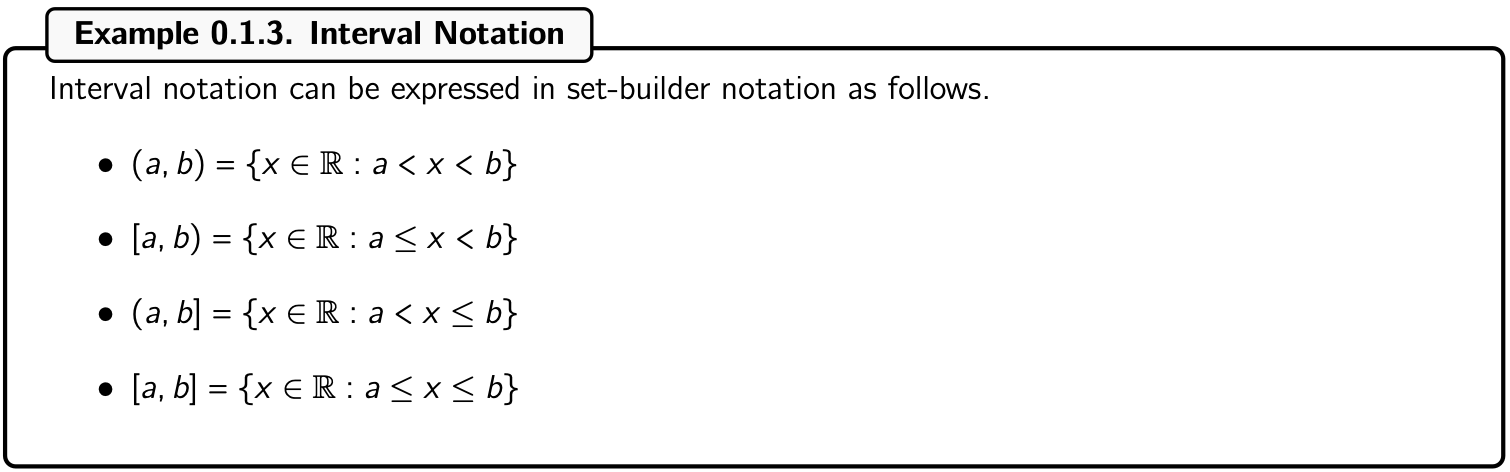
Solutions:
\(\{a,b,c\}\)
\(\{x\in\mathbb{R}\mid x>5\}\)
\(\{x\in\mathbb{R}\mid -2<x<4\}\)
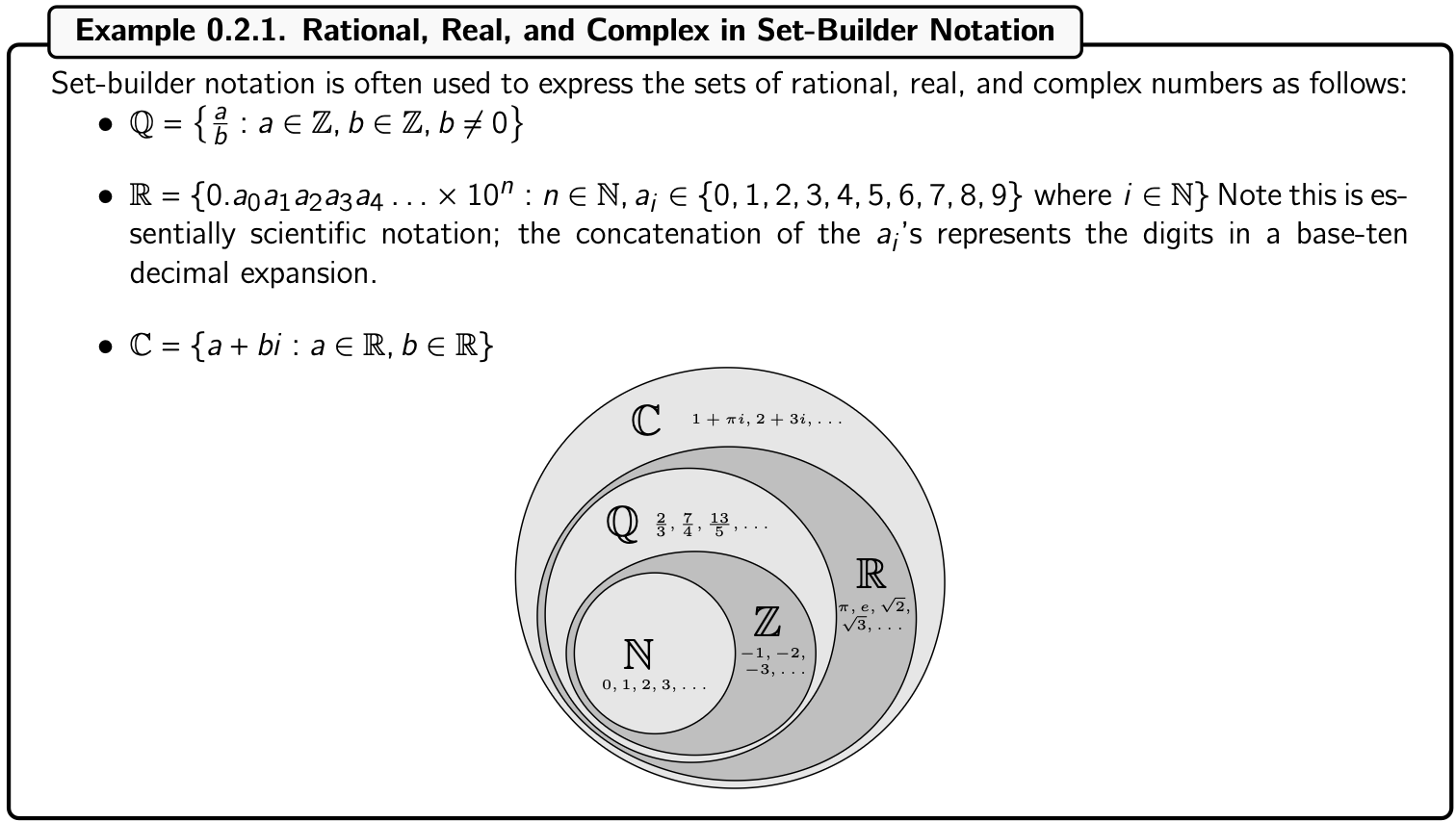



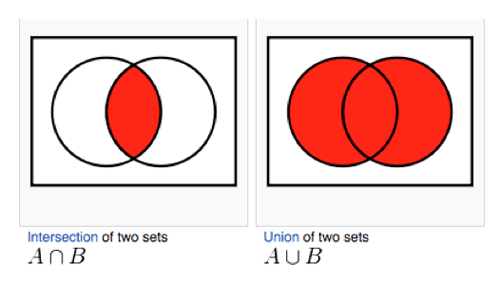
Ex.:
Consider the graph of the function \(f(x)=x^2-1\).
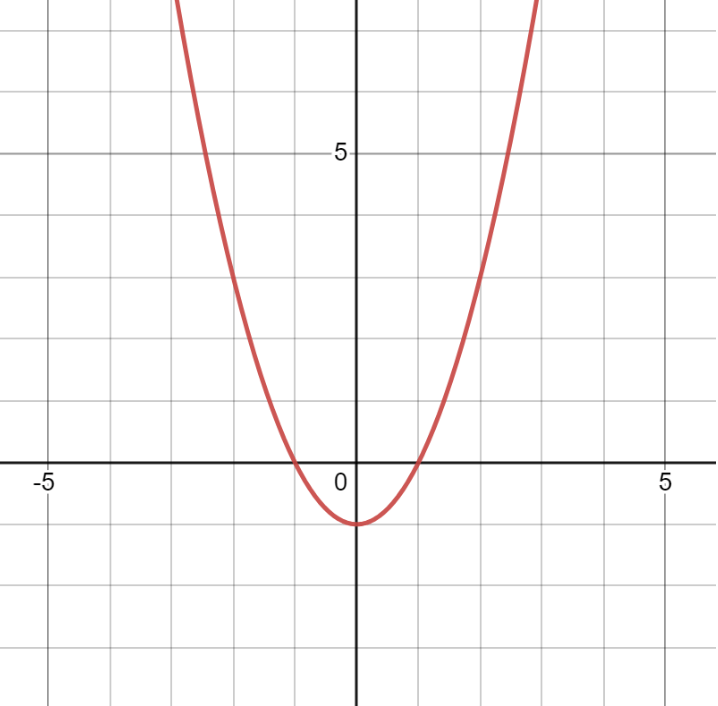
Define \(P\) to be the set of \(x\)-values for which \(f(x)\) is positive.
In set-builder notation, we can write:
\(P=\{x\in\mathbb{R}\mid x^2-1>0\}.\)
However, to really understand the set \(P\), we should solve or interpret the inequality: \(x^2-1>0.\)
Looking at the graph, one sees that \(f(x)\) is positive if x < –1 or if x > 1.
The first condition defines to the interval \(A = (–\infty,–1]\) and the second condition defines \(B = [1,\infty)\)
Thus we have that: \(P=A\cup B=(–\infty,–1]\cup [1,\infty)\)
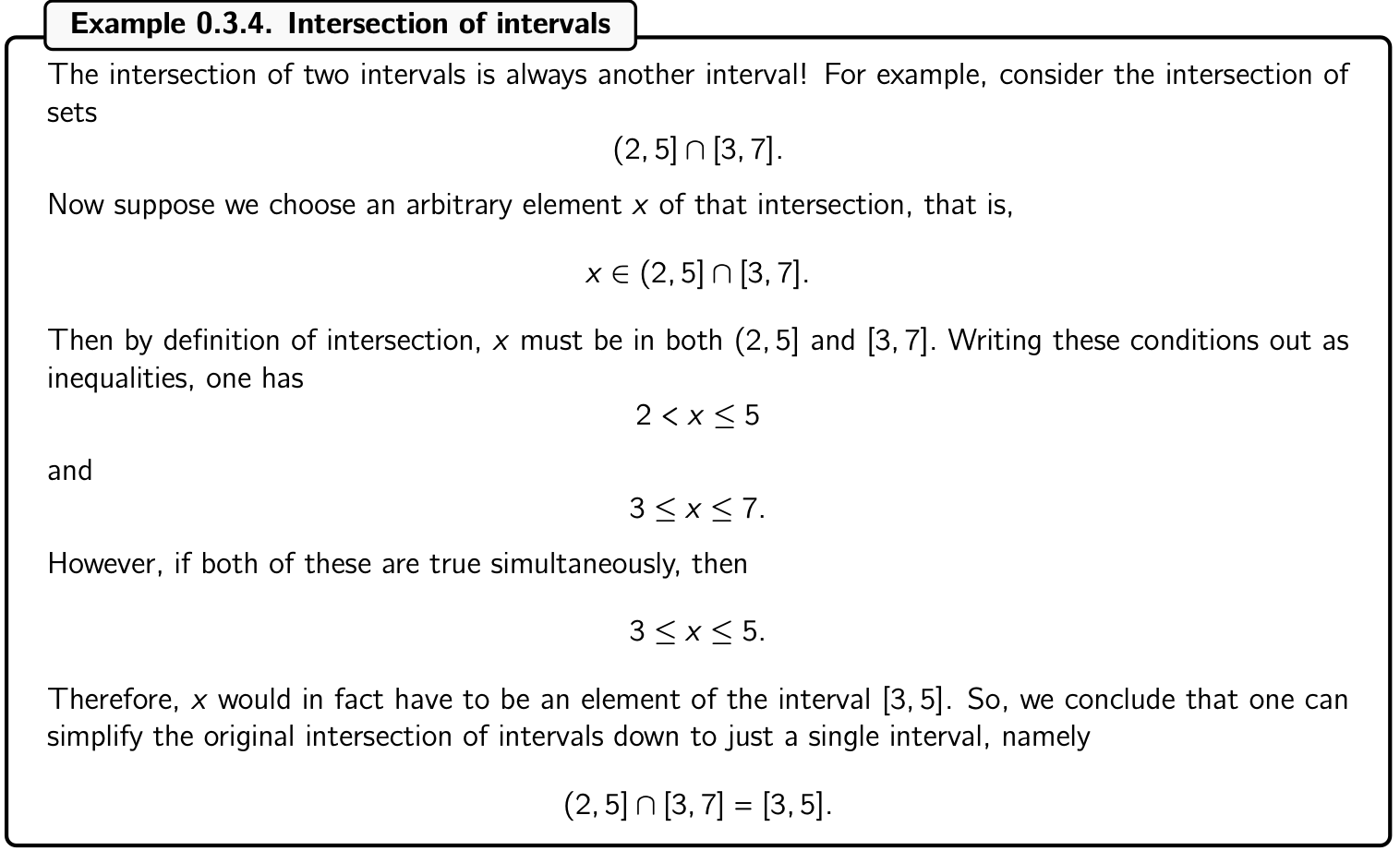

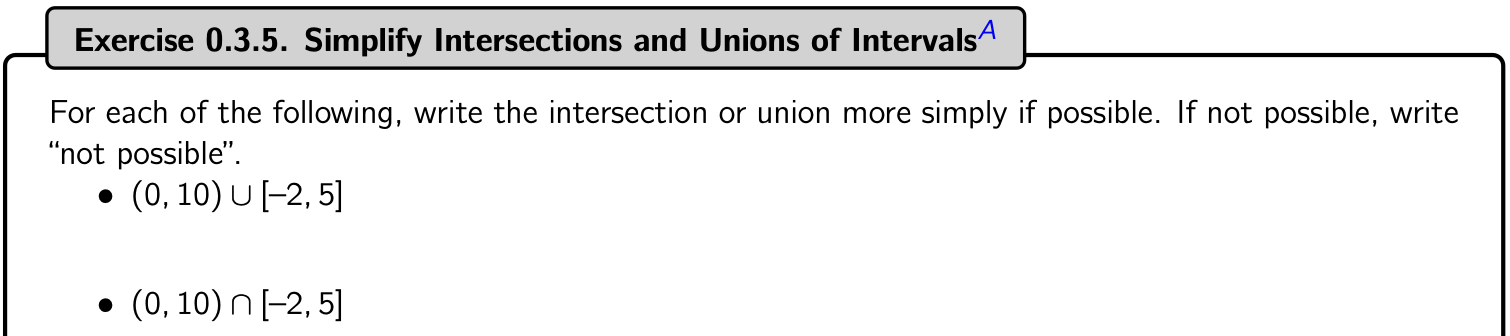
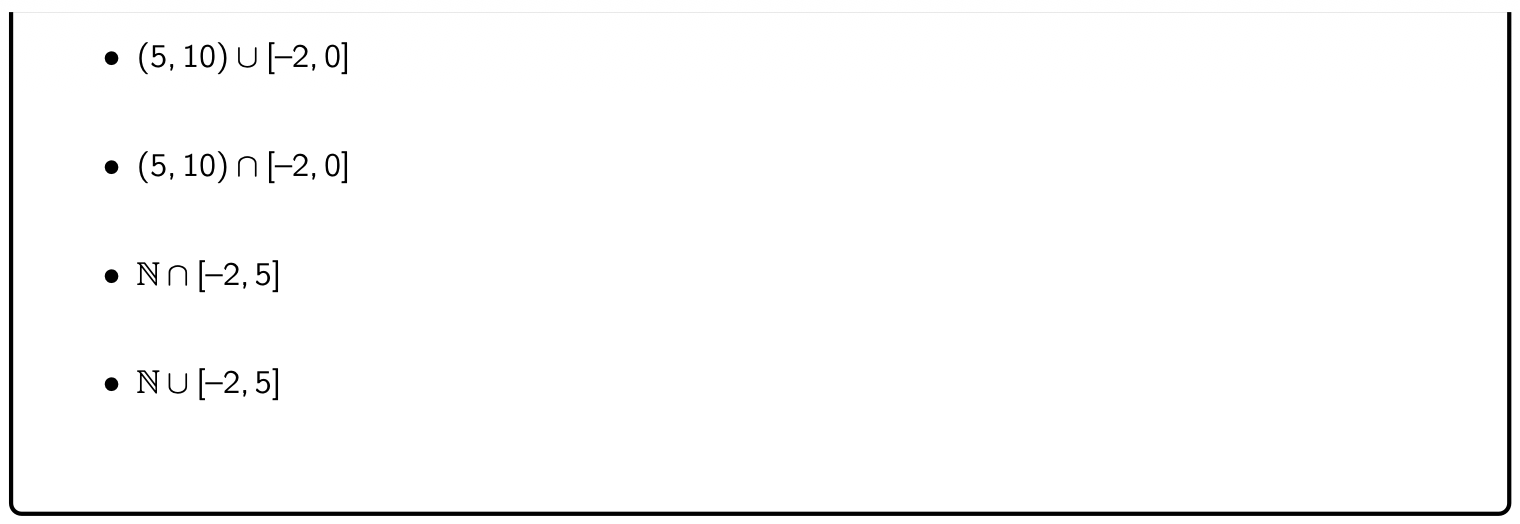
Solutions
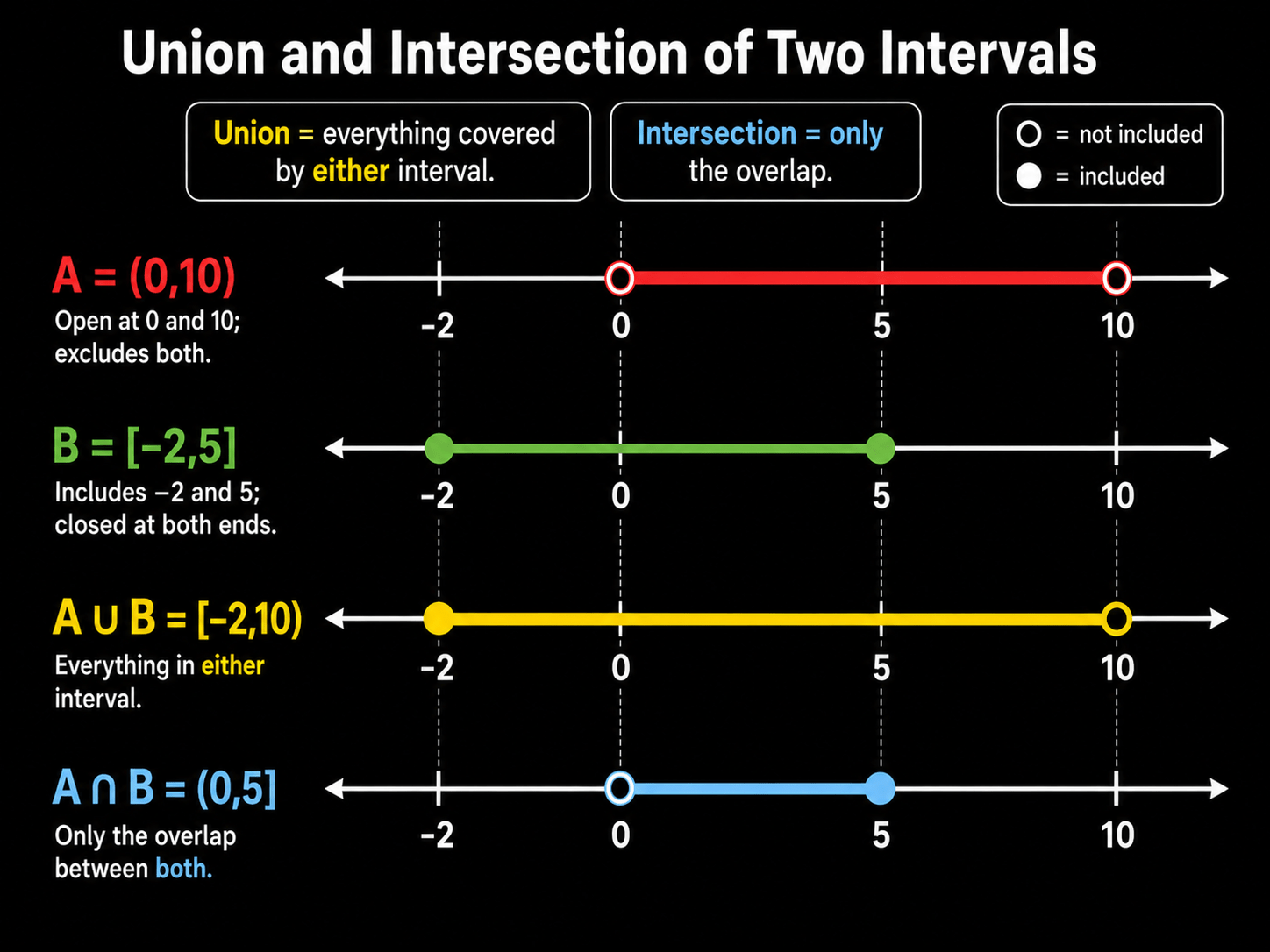
- \((0,10)\cup[-2,5]=[-2,10)\)
- \((0,10)\cap[-2,5]=(0,5]\)
- \((5,10)\cup[-2,0]\): not possible as one interval
- \((5,10)\cap[-2,0]=\varnothing\)
- \(\mathbb{N}\cap[-2,5]=\{1,2,3,4,5\}\)
- \(\mathbb{N}\cup[-2,5]=[-2,5]\cup\{6,7,8,\dots\}=[-2,\infty)\)
- Note: This assumes \(\mathbb{N}=\{1,2,3,\dots\}\).
- \(\mathbb{N}\cap[-2,5]=\{0,1,2,3,4,5\}\).
- If \(\mathbb{N}=\{0,1,2,3,\dots\}\)
Functions
Functions are a core concept in Algebra. Most of what we study are functions.
A function is essentially a transformation.
It takes some input value, does something with it, and returns an output value.
One way of formally defining functions is to use sets.
In order to do this, we must first define cartesian products and relations
Def.:
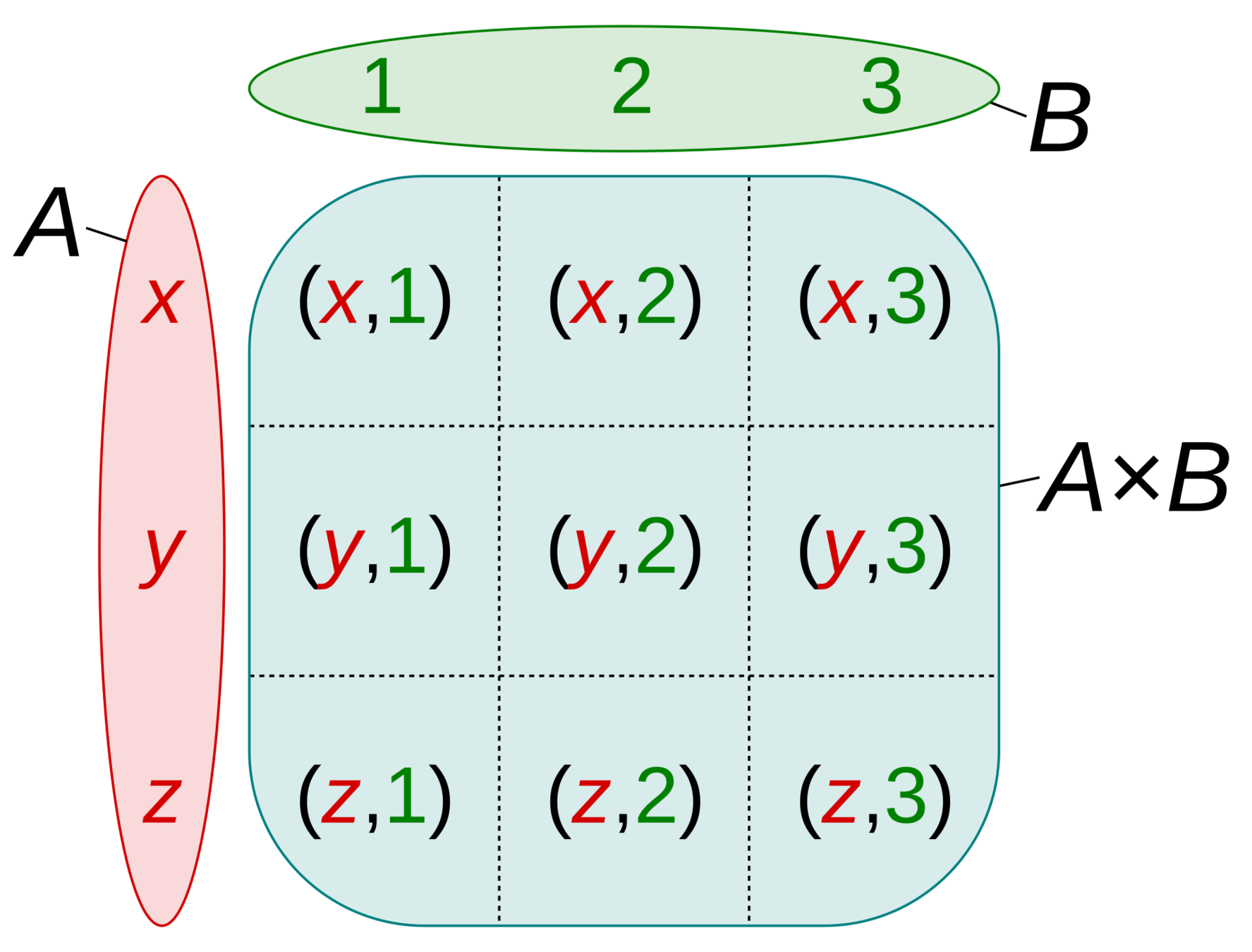
Given 2 sets A and B, the cartesian product of A and B, written \(A\times B\), is the set of ordered pairs \(\{(a,b):a\in A, b\in B\}\)
Example 1.
If \(A=\{1,2\}\) and \(B=\{x,y\}\), then
\(A\times B=\{(1,x),(1,y),(2,x),(2,y)\}\)
Example 2.
If \(C=\{a,b,c\}\) and \(D=\{0,1\}\), then
\(C\times D=\{(a,0),(a,1),(b,0),(b,1),(c,0),(c,1)\}\)
Example 3.
If \(E=\{2,4\}\), then
\(E\times E=\{(2,2),(2,4),(4,2),(4,4)\}\)
2 ordered pairs \((a,b)\) and \((a',b')\) are equal, written \((a,b)=(a',b')\) iff \(a=a'\) and \(b=b'\)
Important: order matters.
In general, \(A\times B\neq B\times A\).
We write:
\(A\subseteq B\)
This means:
If \(x\in A\), then \(x\in B\).
Def.:
A set \(A\) is a subset of a set \(B\) if every element of \(A\) is also an element of \(B\).
Ex:
Let \(A=\{1,2,3\}\) and \(B=\{1,2,3,4,5\}\).
Then: \(A\subseteq B\) because every element of \(A\) is also in \(B\).
Def.:
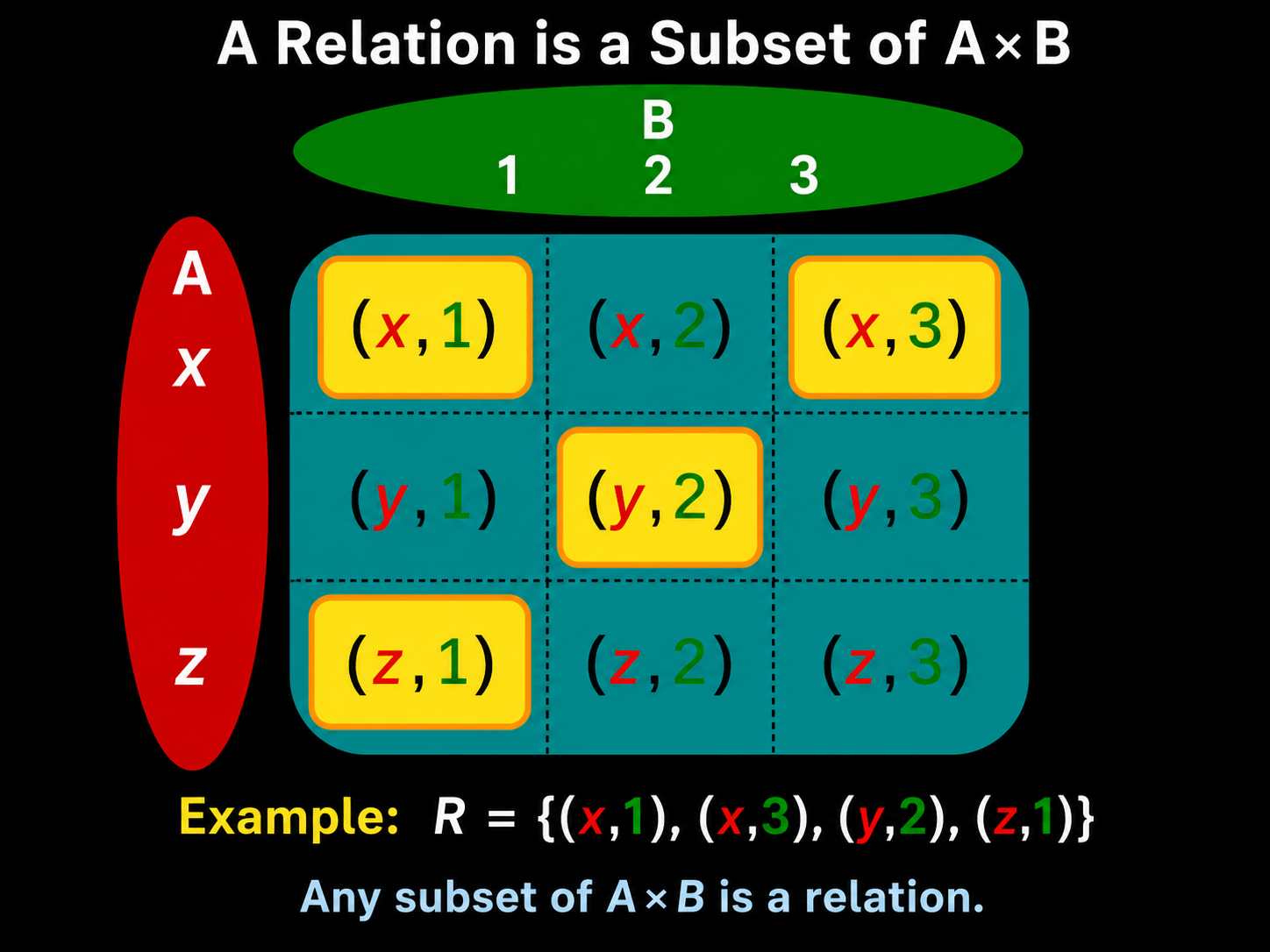
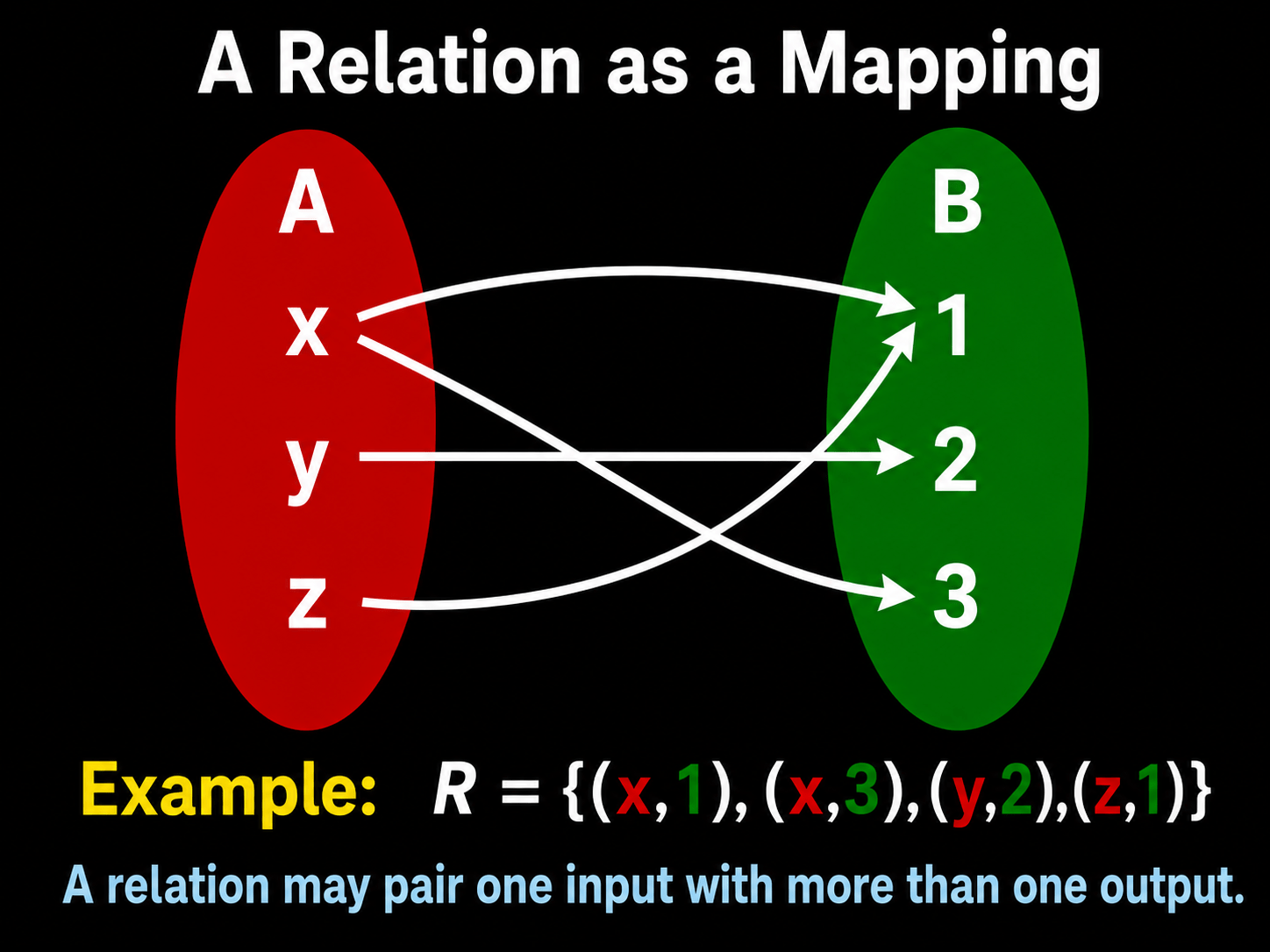
A relation on sets \(A\) and \(B\) is a subset \(R\subseteq A\times B\)
So a relation is a set of ordered pairs.
Essentially, a relation is just a set of relationships between two sets.
There’s no requirements on what can be related
Ex.:
Let \(A=\{1,2,3\}\) and \(B=\{a,b\}\).
One possible relation from \(A\) to \(B\) is:
\(R=\{(1,a),(2,a),(3,b)\}\)
This means:
\(1\) is related to \(a\), \(2\) is related to \(a\), and \(3\) is related to \(b\).
Ex.:
A student and their classes
Input: a student
Output: a class they are taking
For example:
\(\text{Maria} \to \text{College Algebra}\)
\(\text{Maria} \to \text{Biology}\)
\(\text{Maria} \to \text{English}\)
Ex.:
A state and its cities
Input: a state
Output: a city in that state
For example:
\(\text{Colorado} \to \text{Fort Collins}\)
\(\text{Colorado} \to \text{Denver}\)
\(\text{Colorado} \to \text{Boulder}\)
In many applications, we prefer to work with relations that have specific structures
Def.:
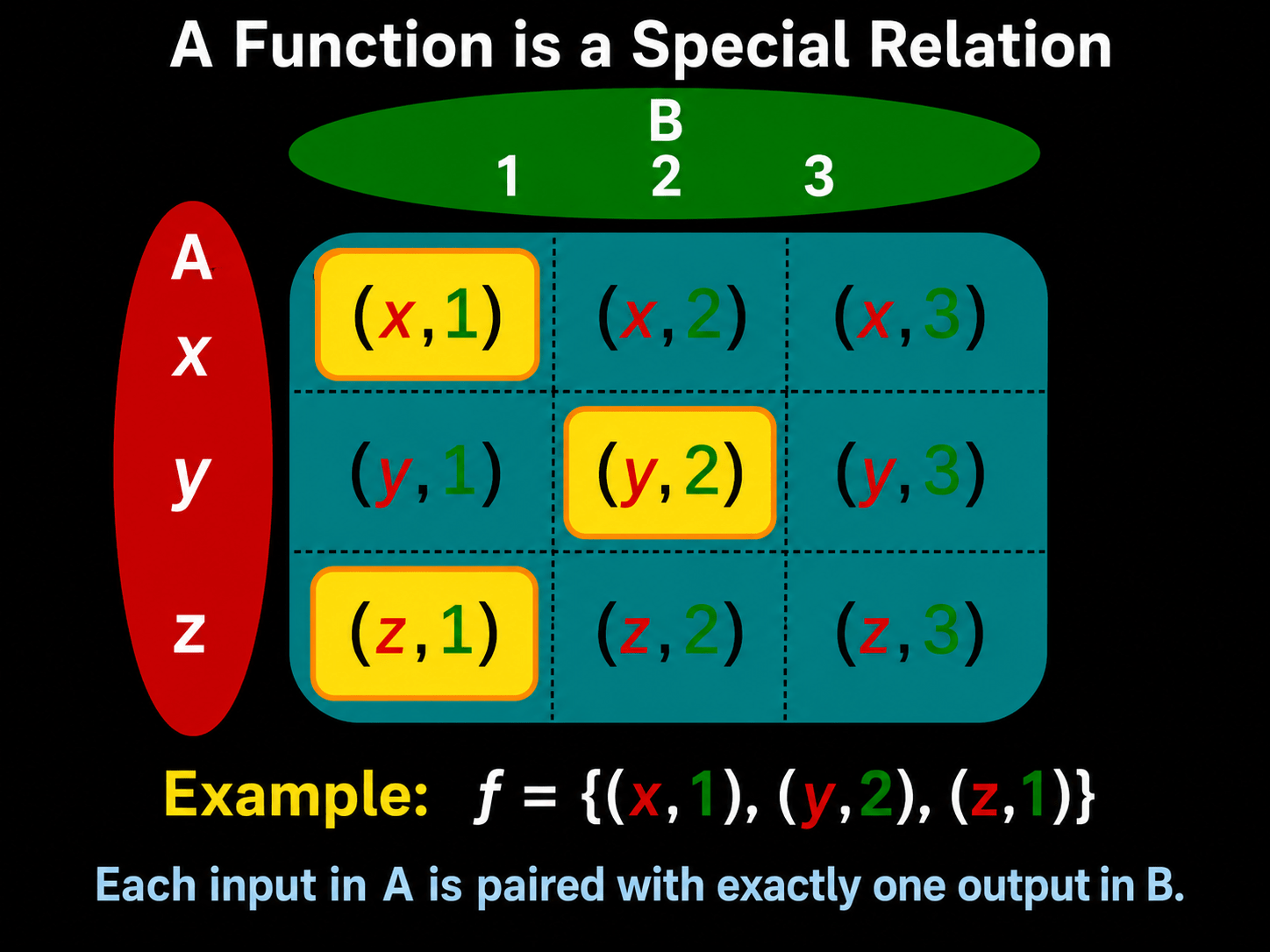
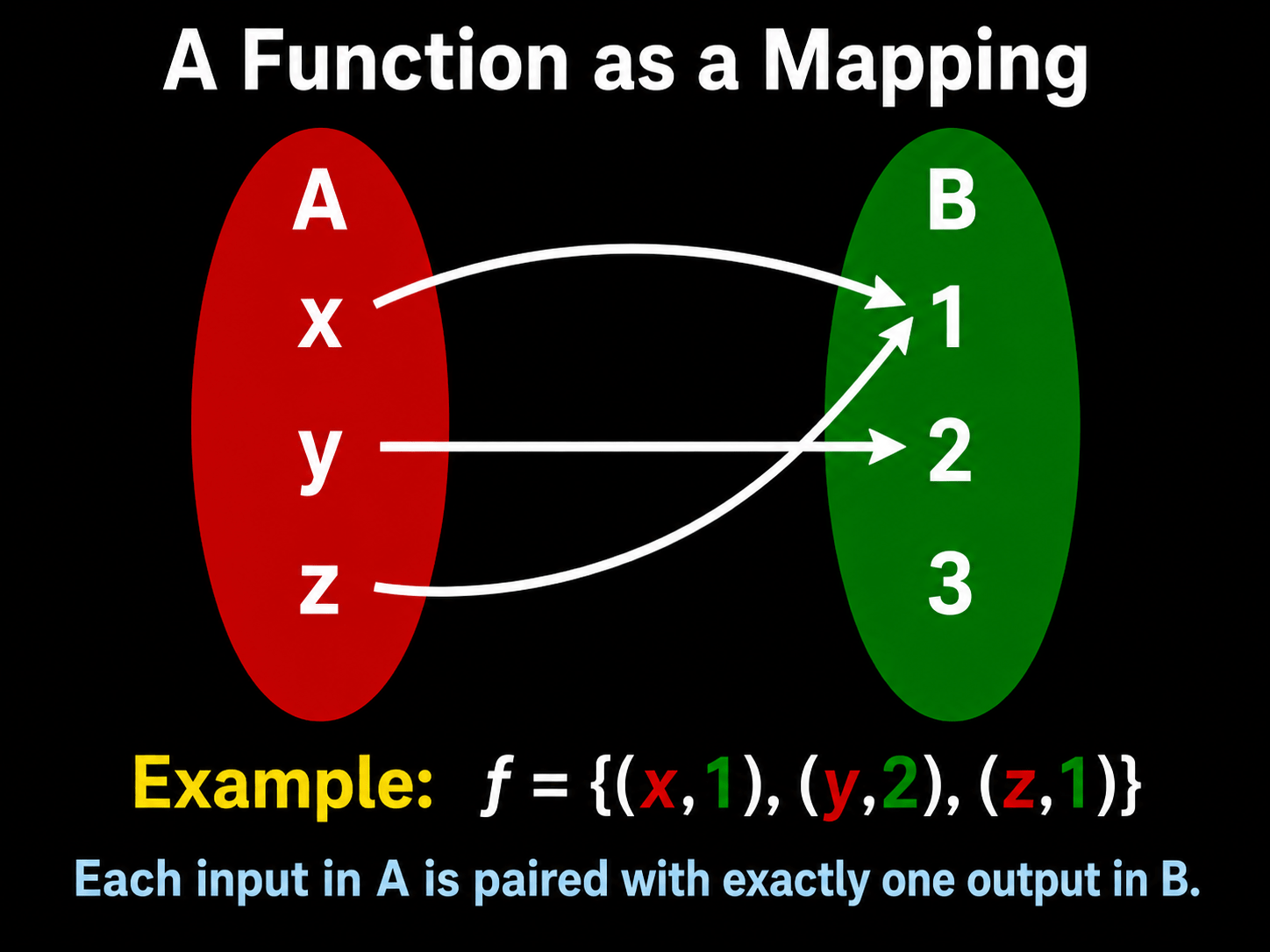
A function from \(A\) to \(B\) is a relation \(F\) on \(A\times B\) such that if \((a,b)\in F\) and \((a,b')\in F\), then it must be the case that \(b=b'\)
So each \(a\in A\) is related to at most one \(b\in B\)
We call this property well-definedness
As in: a relation is a function if it is well-defined
With this well-definedness condition, we've imposed a certain sense of information flow.
If I know what the little \(a\) is in a pair, then I unambiguously know what the \(b\) is in that pair and therefore what the pair is
The reverse is not true
Hence we say that: for every \(a\) we input into the function \(F\), we get exactly one output, \(b\), out of \(F\)
We call the set \(A\) of inputs, the Domain of \(F\)
We call the set \(B\) of outputs the Range of \(F\)
Ex.:
Decide whether each relation is a function.
1. \(\{(1,a),(2,b),(3,c)\}\)
2. \(\{(1,a),(2,a),(3,a)\}\)
3. \(\{(1,a),(1,b),(1,c)\}\)
4. \(\{(1,2),(2,4),(3,6),(4,8)\}\)
5. \(\{(1,2),(1,3),(1,4),(1,5)\}\)
Solutions
1. \(\{(1,a),(2,b),(3,c)\}\)
Function: Yes.
Each input has exactly one output.
2. \(\{(1,a),(2,a),(3,a)\}\)
Function: Yes.
Different inputs are allowed to have the same output.
3. \(\{(1,a),(1,b),(1,c)\}\)
Function: No.
The input \(1\) has three different outputs: \(a\), \(b\), and \(c\).
4. \(\{(1,2),(2,4),(3,6),(4,8)\}\)
Function: Yes.
Each input has exactly one output.
5. \(\{(1,2),(1,3),(1,4),(1,5)\}\)
Function: No.
The input \(1\) has four different outputs: \(2\), \(3\), \(4\), and \(5\).
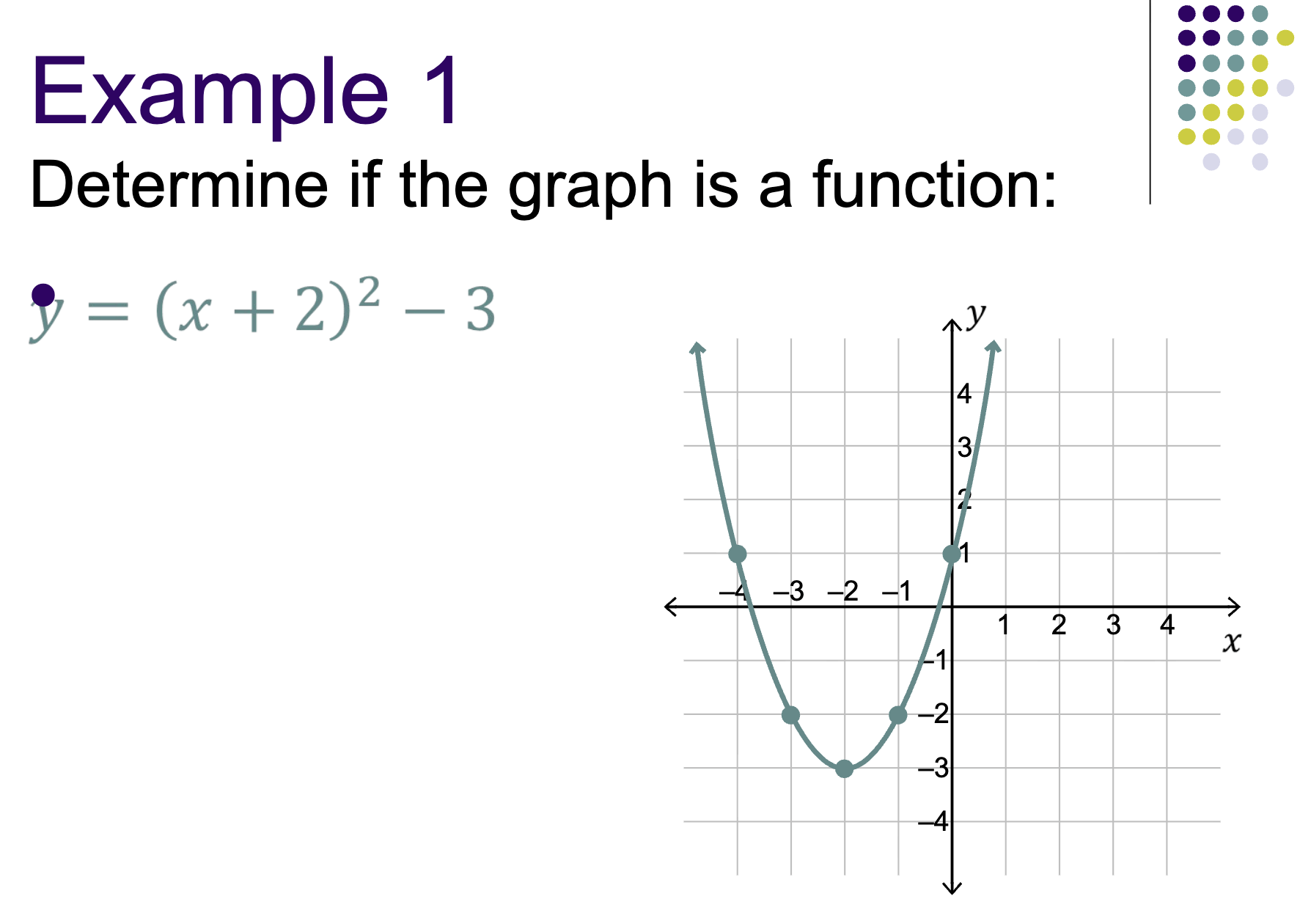
While we can use the definition to decide whether or not a relation is a function, this is often times difficult when the sets being related have an infinite number of elements.
For that reason, we also have the vertical line test, which allows us to judge whether or not a relation or equation represents a function by examining its graph.
Def.:
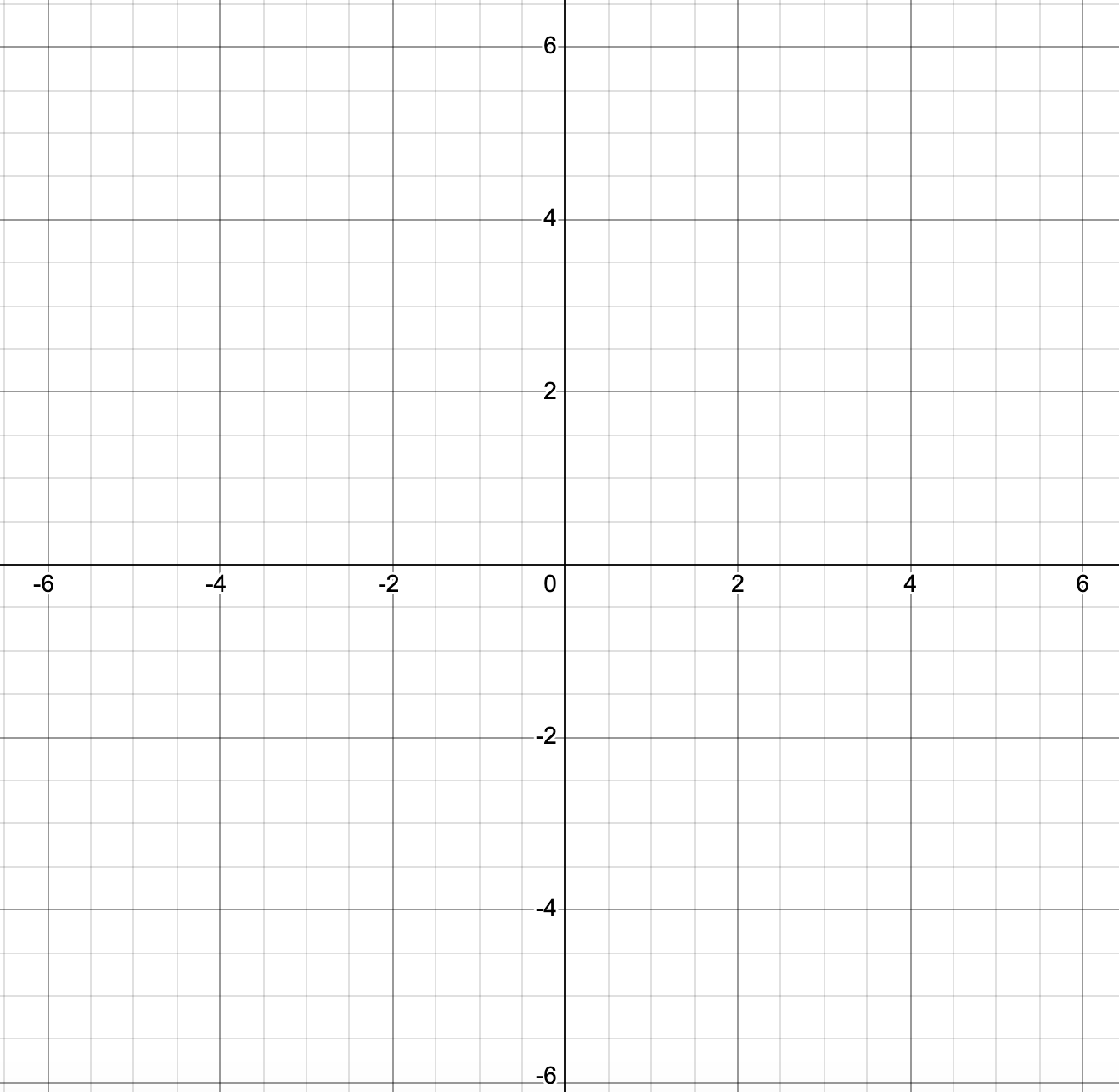
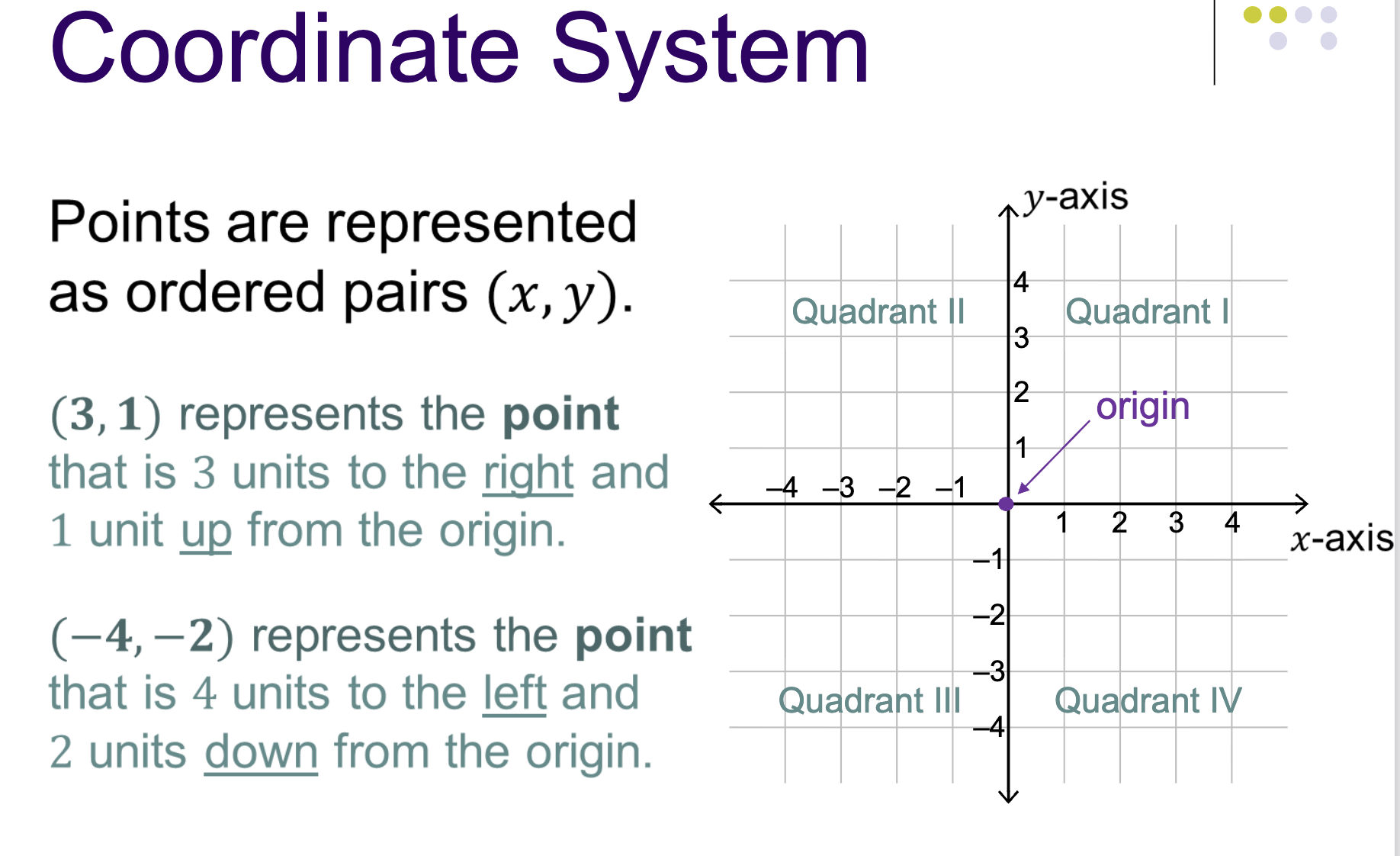
The coordinate plane is a flat two-dimensional plane formed by two perpendicular number lines.
The horizontal number line is called the \(x\)-axis.
The vertical number line is called the \(y\)-axis.
The axes meet at the origin: \((0,0)\)
Every point in the coordinate plane can be described by an ordered pair: \((x,y)\)
where \(x\) tells us the horizontal position and \(y\) tells us the vertical position.
Def.:
The graph of a function \(f\) is the set of points in the coordinate plane corresponding to the ordered pairs \((x,y)\in f\)

Day 1 Review
Text
(1,4)
(1,0)
Not well-defined
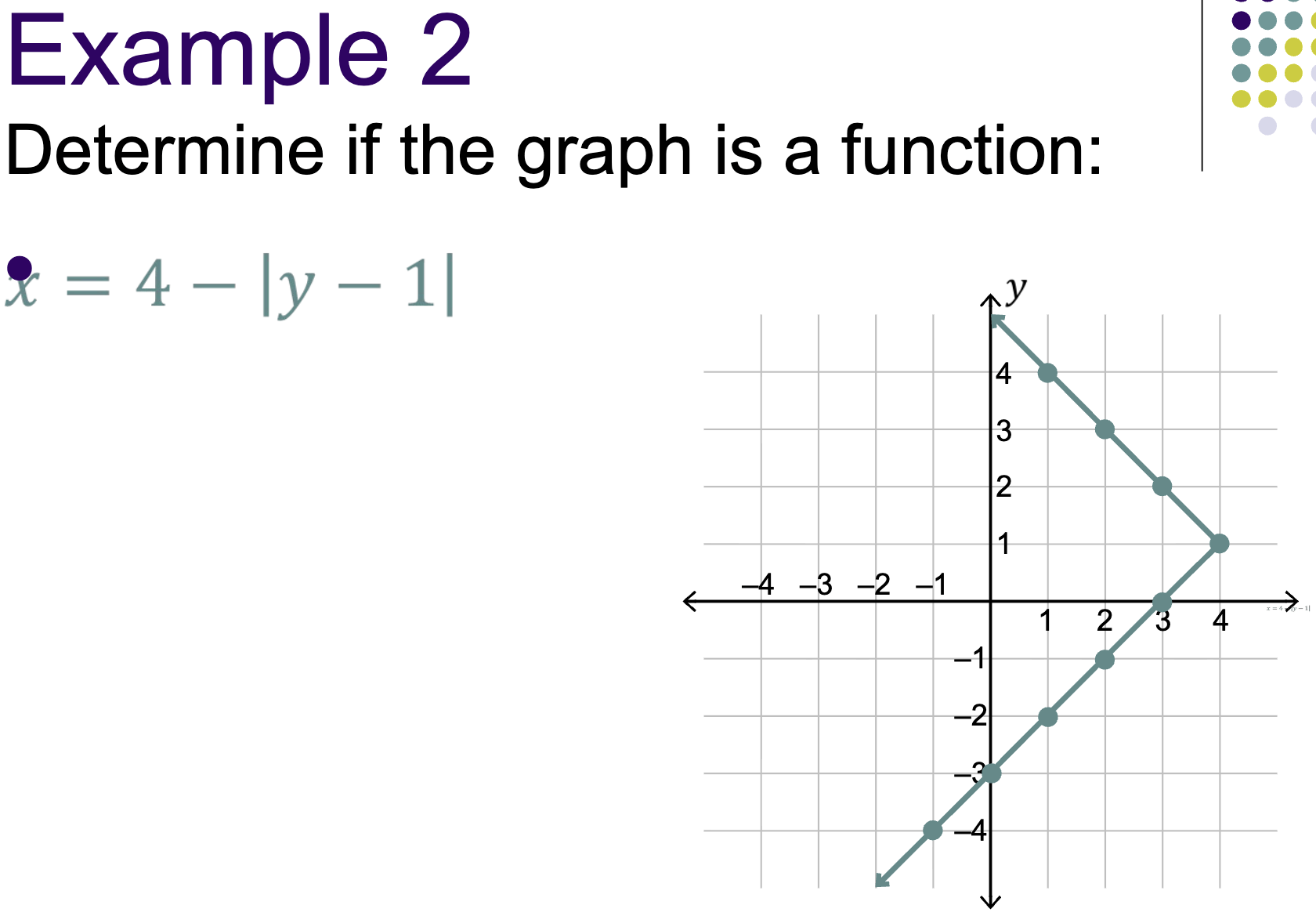
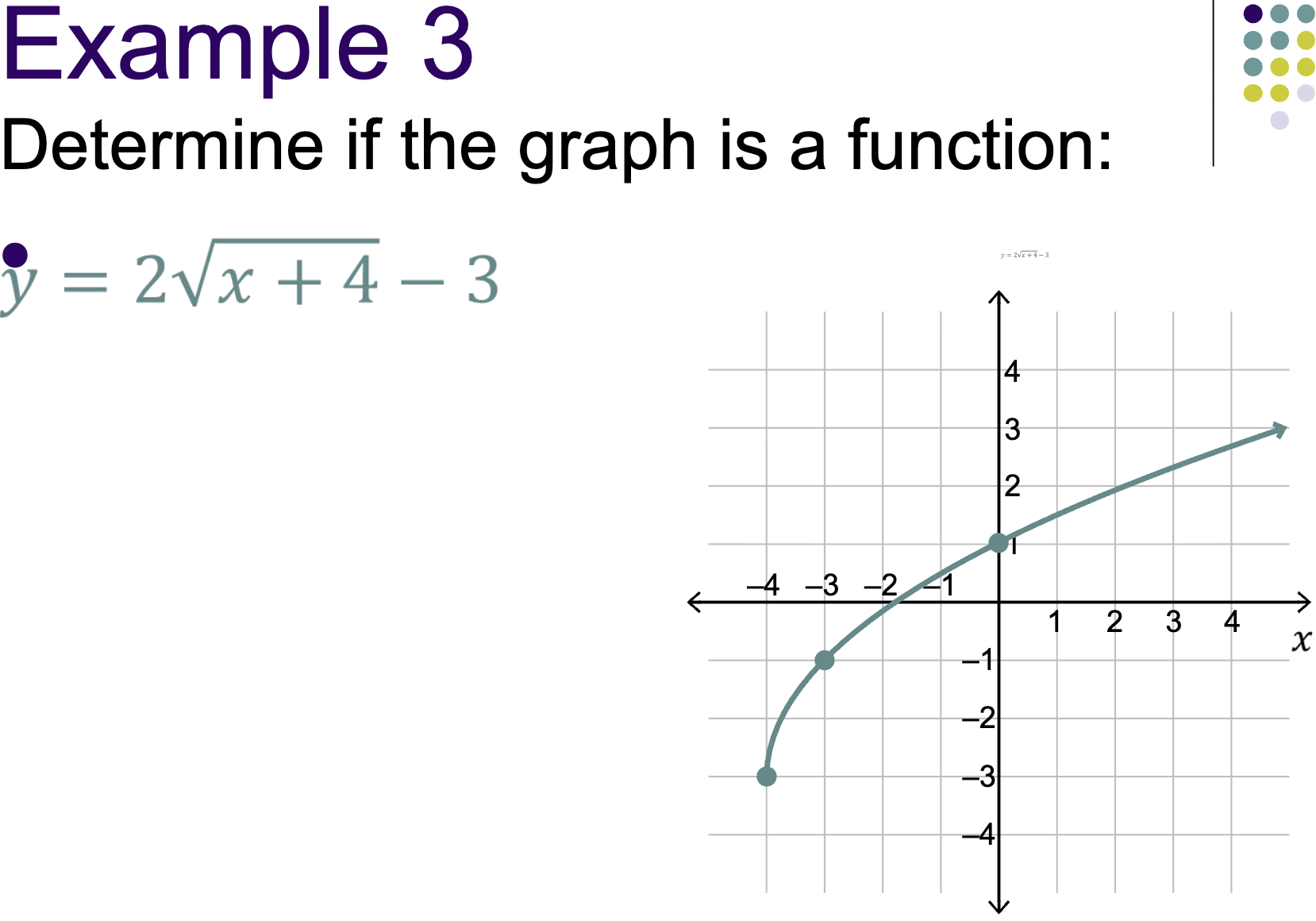
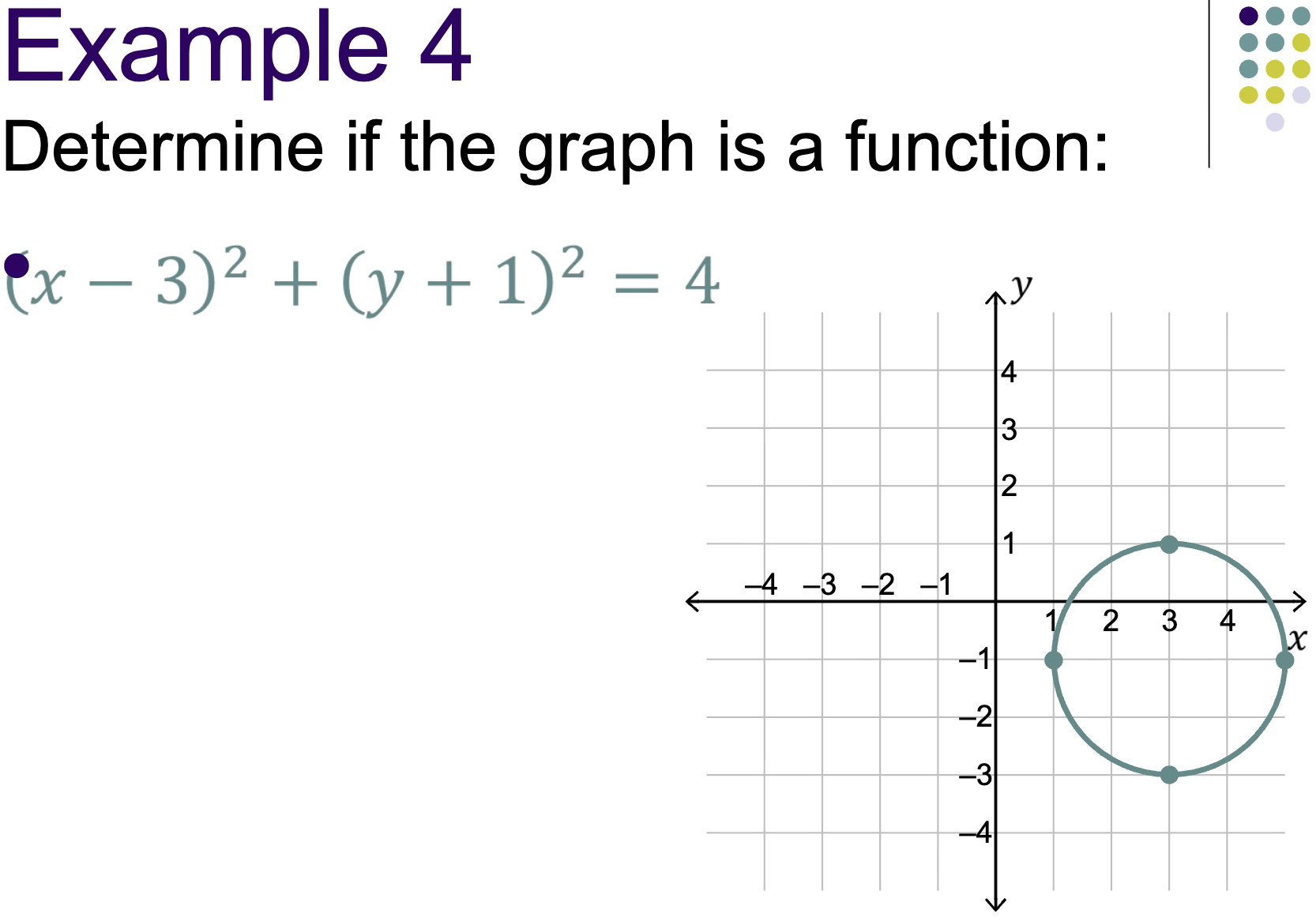
More Functions
Just like with other sets, we can specify a function by listing all of its elements, in this case ordered pairs like:
$$f=\{... (-2,-2), (-1,-1), (0,0), (1,1), (2,2)...\}\subseteq \mathbb{Z}\times \mathbb{Z}$$
However, this is often not very useful
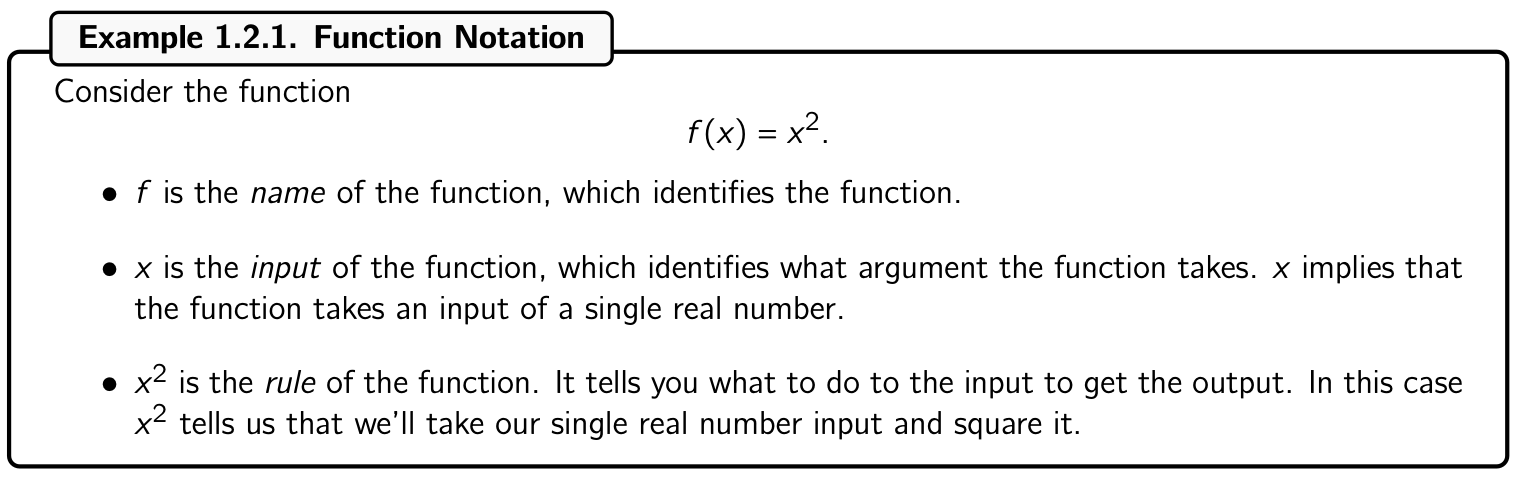
Instead, we use what is called function notation
Text
First, rather than write: \(f\in A\times B\) we write: \(f:A\rightarrow B\) to emphasize this idea of inputs and outputs
What we need is something akin to set builder notation.
A rule that tells how to find all of the elements of our function without actually listing them
Fortunately, well-definedness makes this possible
If I can give you a general rule for moving from an input to its unique corresponding output, then I have given you a way to build the entire set
Now, to build this rule we need to agree on some convention.
Since it needs to apply to all inputs and outputs we should use variables
Lets use \(x\) as a placeholder for the inputs and \(y\) as a placeholder for the outputs
We sometimes call \(x\) the independent variable and \(y\) the dependent variable
We need to give the function a name so that we can even start talking about it
Usually this is a lower case f, g, h,...
x is a stand in for any element of our domain: we could replace x with any element of our domain and our symbolism would still make sense
Often, rather than use \(y\) to indicate the outputs, we instead use the symbol \(f(x)\)
This has the advantage of emphasizing that our output is dependent on our input, \(x\), and specifying exactly which function we are talking about
Next, we write our rule for calculating the output as an expression
What we end up with is an equation of the form:
Output of plugging \(x\) into \(f\) = result of doing stuff to \(x\)
\(f(x)=\) expression involving \(x\)
Ex.:
1. \(f(x)=2x+3\)
2. \(g(x)=x^2-4x+1\)
3. \(h(t)=\frac{2t+1}{t-3}\)
This is read as: “\(f\) of \(x\) equals \(2x+3\).”
4. \(y=2x+3\)
This is NOT function notation.
Now that we have this notation, what do we do with it?
Evaluating Functions
When we calculate an output corresponding to a specific input, it is called evaluating the function at that input
Evaluating Functions
We can do this either graphically or algebraically
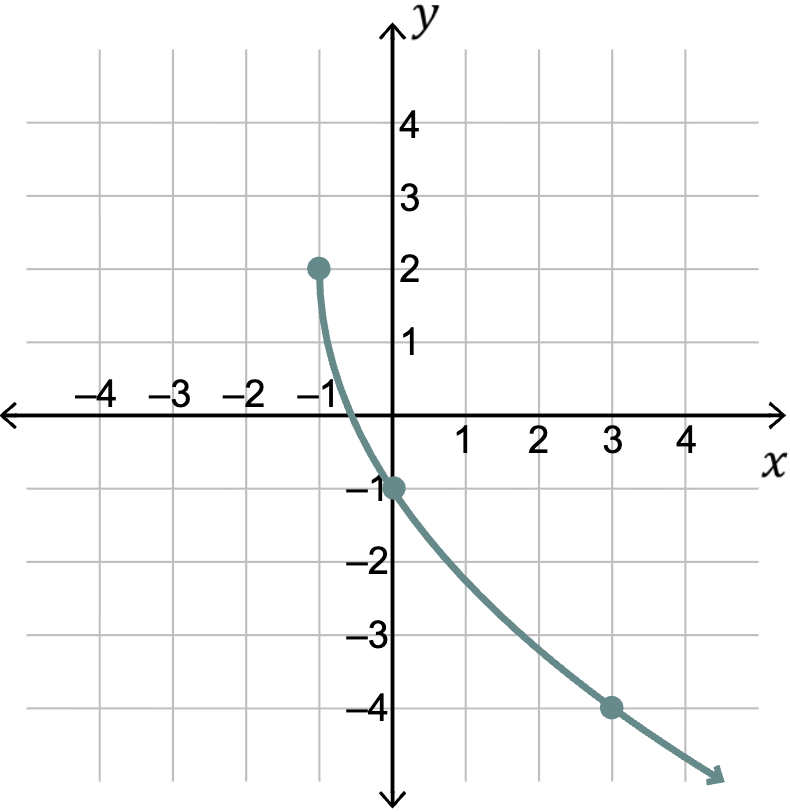
To do it graphically, we simply look at the point on the graph that aligns vertically with the input value on the x-axis, trace a straight line from this point to the y-axis, and read off this value.
Ex.:


Ex.:
Ex.:
\(=-4\)
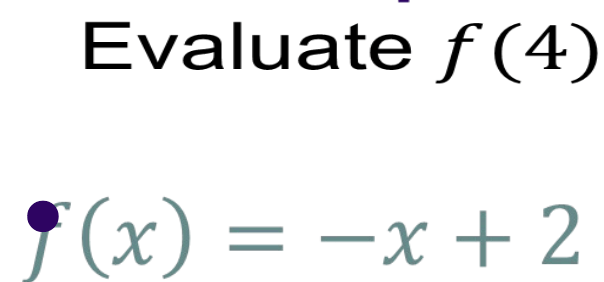
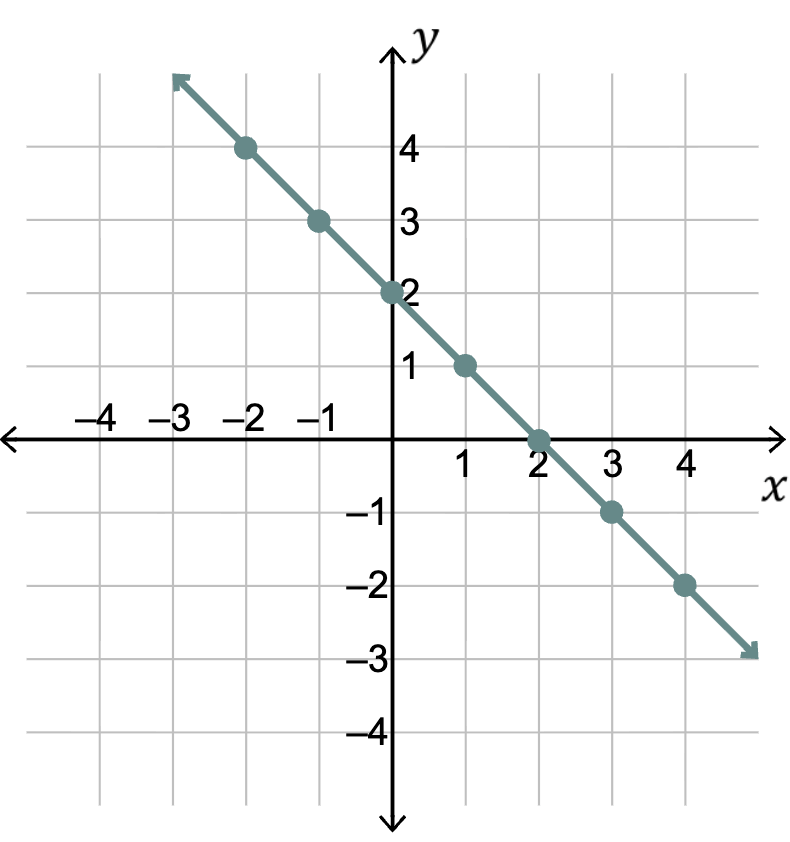

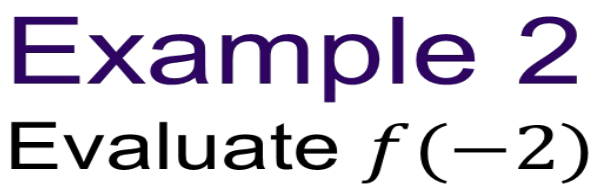

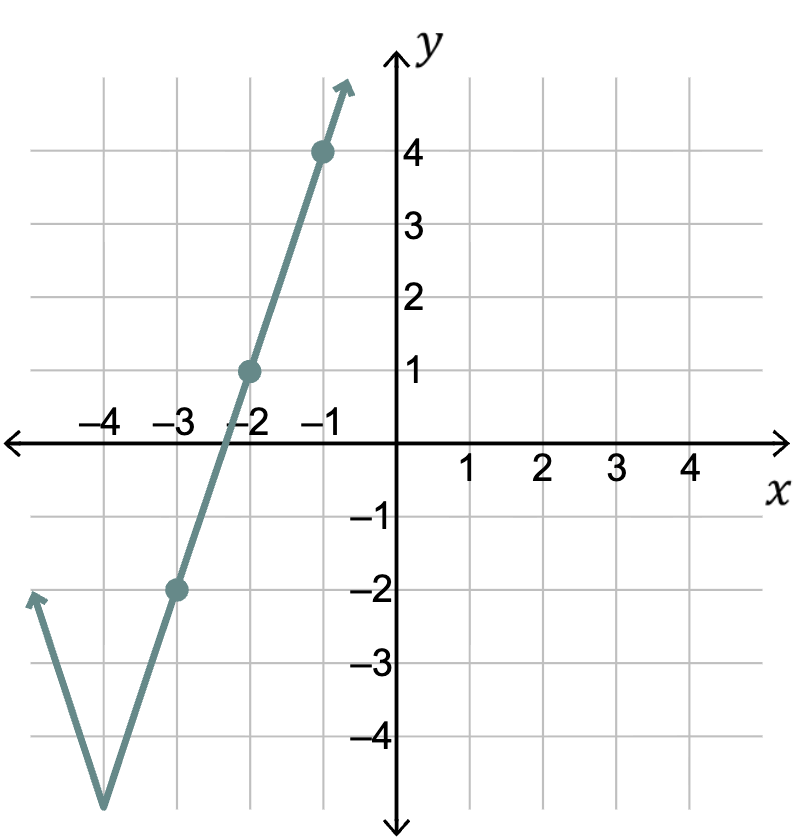



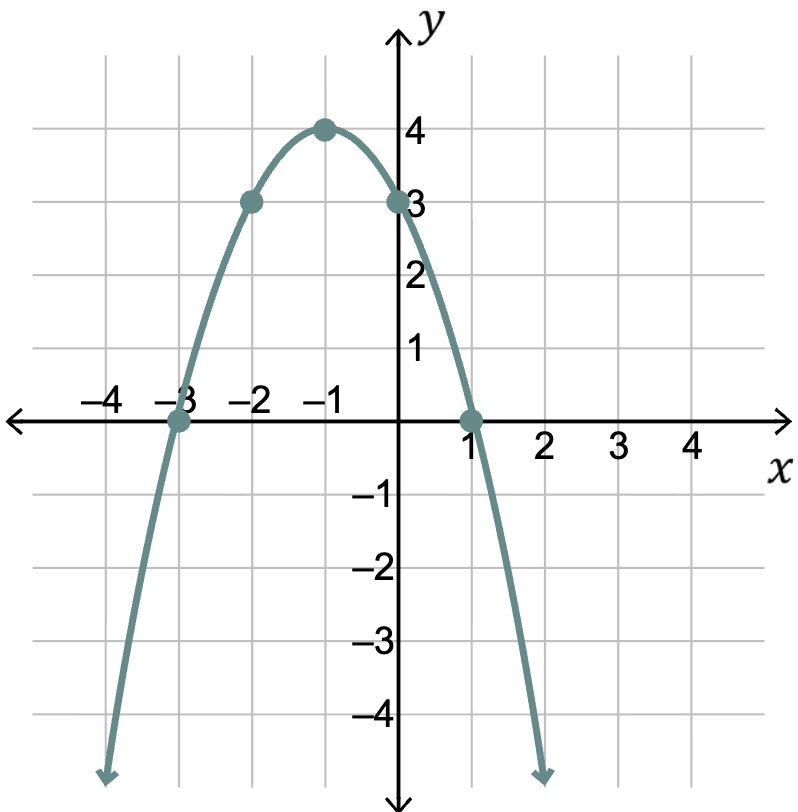
To evaluate a function algebraically, we replace every instance of \(x\) in the function notation and carry out the operations in the expression
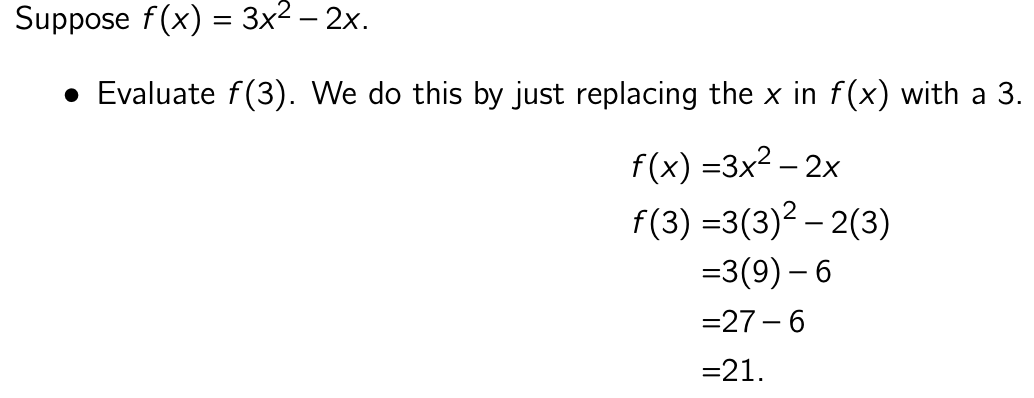
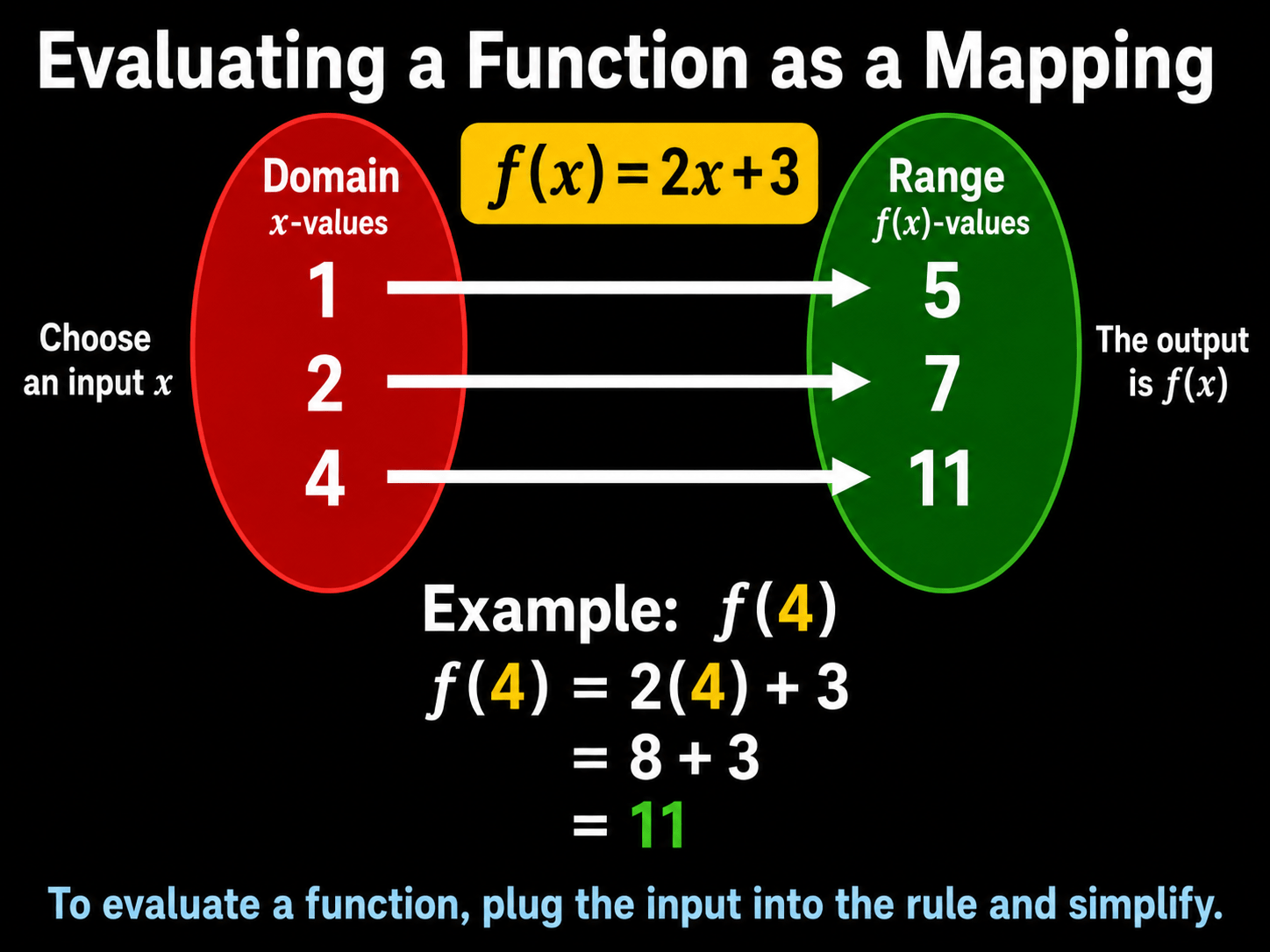
Ex.:
1. Let \(f(x)=3x^2+2x\).
(a) Evaluate \(f(1)\).
(b) Evaluate \(f(-2)\).
(c) Evaluate \(f(a)\).
2. Let \(f(x)=\sqrt{x+3}\).
(a) Evaluate \(f(1)\).
(b) Evaluate \(f(-2)\).
(c) Evaluate \(f(a)\).
Solutions
1. Let \(f(x)=3x^2+2x\).
(a) \(f(1)=3(1)^2+2(1)=3+2=5\)
(b) \(f(-2)=3(-2)^2+2(-2)=3(4)-4=12-4=8\)
(c) \(f(a)=3a^2+2a\)
2. Let \(f(x)=\sqrt{x+3}\).
(a) \(f(1)=\sqrt{1+3}=\sqrt{4}=2\)
(b) \(f(-2)=\sqrt{-2+3}=\sqrt{1}=1\)
(c) \(f(a)=\sqrt{a+3}\)
Why an Inequality Usually Does Not Define a Function
A function must assign each input exactly one output.
That means for each \(x\), there must be exactly one \(y\).
Compare:
\(y=x+2\)
This is a function because each \(x\)-value gives one \(y\)-value.
For example, if \(x=3\), then:
\(y=3+2=5\)
So the input \(3\) gives exactly one output: \(5\).
But consider:
\(y>x+2\)
If \(x=3\), then:
\(y>5\)
So \(y\) could be:
\(6,\ 7,\ 10,\ 100,\ 5.5,\dots\)
One input gives many possible outputs.
Therefore, \(y>x+2\) does not define a function.
It defines a region of points, not a single output for each input.
Linear Functions
Next up we're going to start talking about different types of functions
We are going to classify them based on what kind of expressions we use to define them and by the corresponding shape of their graph
One particularly common type of function is the linear function.
Linear functions are called such because in the single-variable world, their graphs are straight lines.
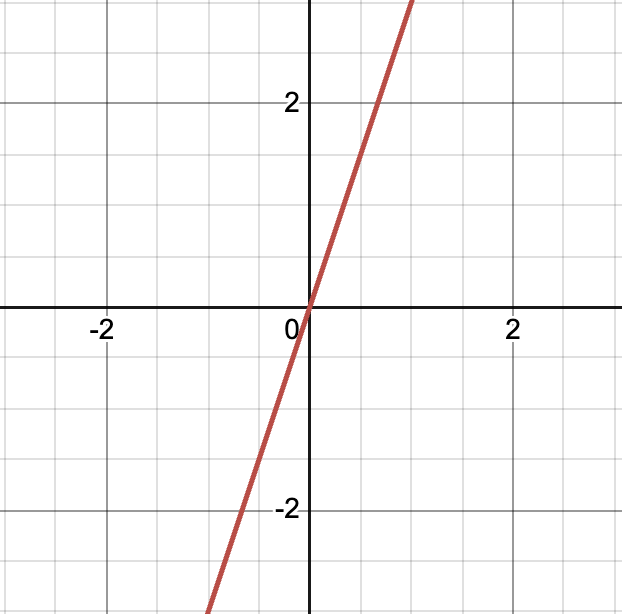
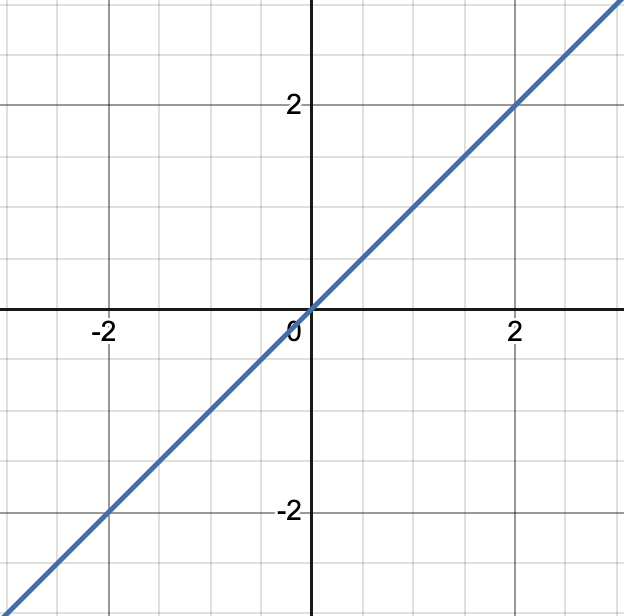
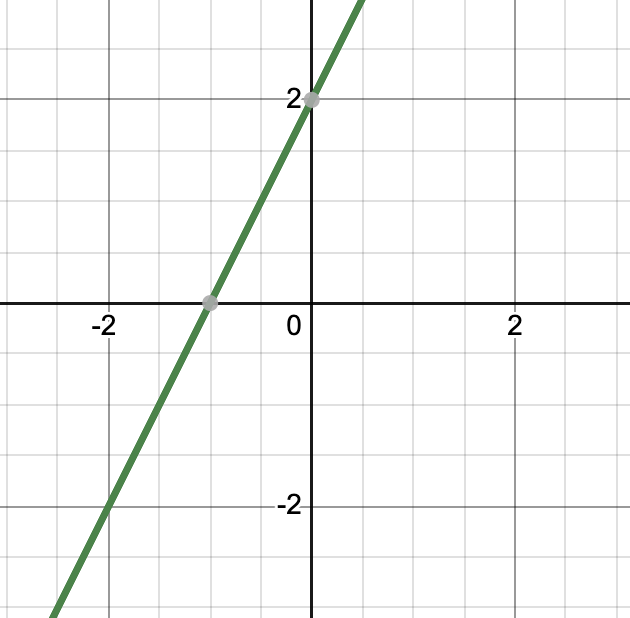
So how might we talk about these linear functions? What vocabulary would we use? What properties could we leverage to describe them?
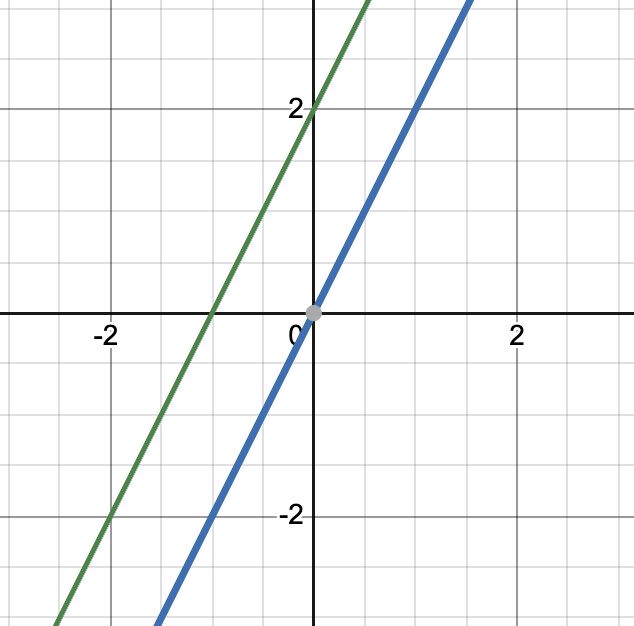
What do the green and blue lines have in common? How are they different?
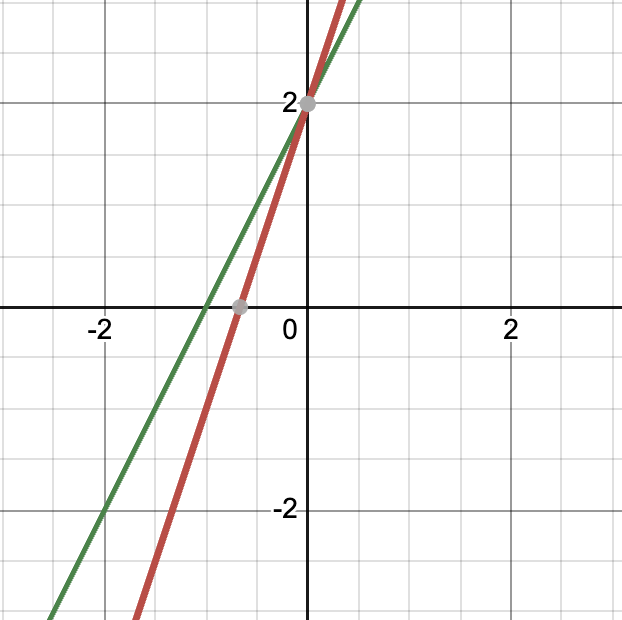
What about the green and red lines?
We say that the green and blue lines are parallel
What they have in common is that they have the same slope
They are different in that they intercept the y-axis in different places
We call this the y-intercept of the line
These lines have the same y-intercept but different slopes (they are not parallel)
Notice that neither of these properties by themselves is enough to tell me which specific line you are talking about
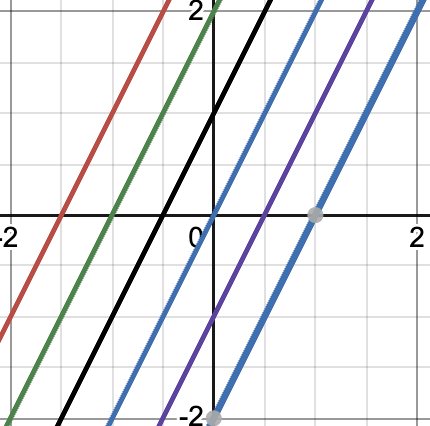
There are infinity many lines with the same slope
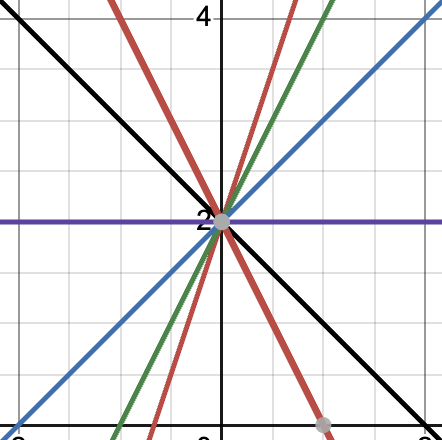
There are also infinitely many lines with the same y-intercept
So if we want an equation for a line, one option is to include both the slope and the y-intercept

The y-intercept of the green line is: \(y=2\)
The y-intercept of the blue line is: \(y=0\)
Hence we write \(b=2\)
So for this line we write \(b=0\)
Notice the x-values for both the red and the green points
The y-intercept always occurs at a point with x=0
the red dot is at \((0,2)\)
the green dot is at \((0,0)\)
Okay, now how do we talk about slope?
Intuitively, slope is the "steepness" of a line
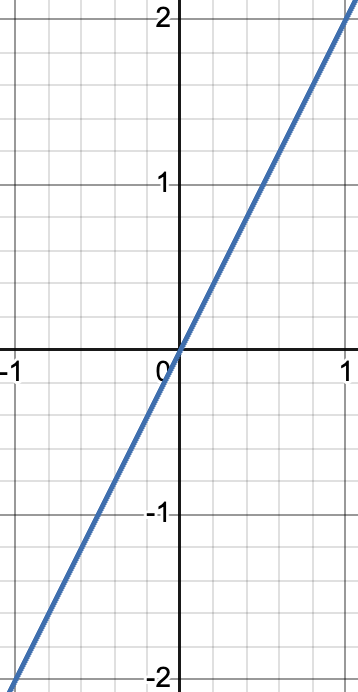
Okay, now how do we talk about slope?
Intuitively, slope is the "steepness" of a line
More formally,
\(\text{slope}=\frac{\text{rise}}{\text{run}}\)
Okay, now how do we talk about slope?
Intuitively, slope is the "steepness" of a line
More formally,
\(\text{slope}=\frac{\text{rise}}{\text{run}}\)
Text
Okay, now how do we talk about slope?
Intuitively, slope is the "steepness" of a line
More formally,
\(\text{slope}=\frac{\text{rise}}{\text{run}}\)
rise
Okay, now how do we talk about slope?
Intuitively, slope is the "steepness" of a line
More formally,
\(\text{slope}=\frac{\text{rise}}{\text{run}}\)
rise
run
Okay, now how do we talk about slope?
Intuitively, slope is the "steepness" of a line
More formally,
\(\text{slope}=\frac{\text{rise}}{\text{run}}\)
rise=2
run
Okay, now how do we talk about slope?
Intuitively, slope is the "steepness" of a line
More formally,
\(\text{slope}=\frac{\text{rise}}{\text{run}}\)
rise=2
run=1
Okay, now how do we talk about slope?
Intuitively, slope is the "steepness" of a line
More formally,
\(\text{slope}=\frac{\text{rise}}{\text{run}}\)
rise=2
run=1
\(=\frac21=2\)
Okay, now how do we talk about slope?
Intuitively, slope is the "steepness" of a line
More formally,
\(\text{slope}=\frac{\text{rise}}{\text{run}}\)
rise=2
run=1
\(=\frac21=2\)
\(m=2\)
So for this line: \(m=2\) and \(b=0\)
This gives us a slope intercept form of:
\(y=mx+b=2x+0=2x\)
\(\rightarrow y=2x\)
Ex.:
Find the slope-intercept equation for the following
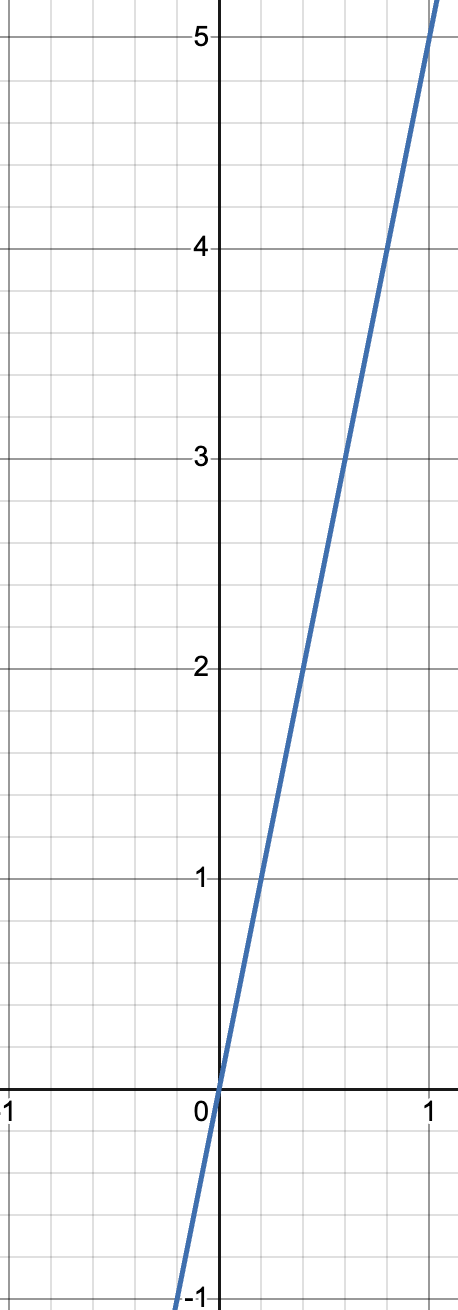
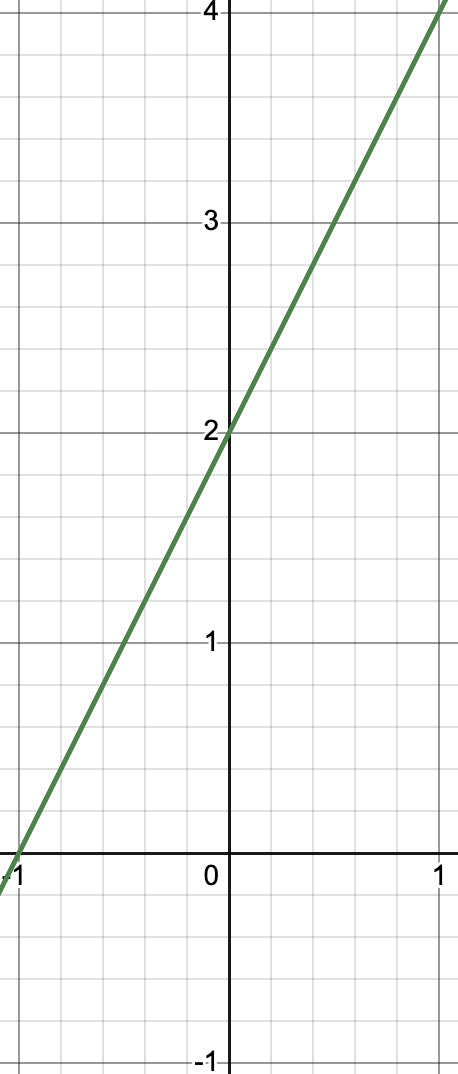
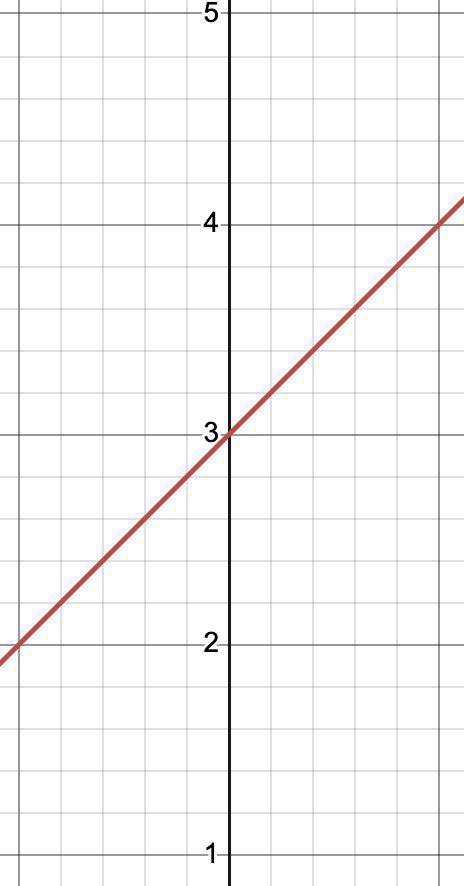
1.
2.
3.
Ex.:
Find the slope-intercept equation for the following
1.
2.
3.
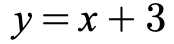
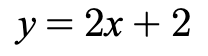
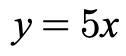
Can we go the other direction?
If I give you the slope-intercept equation of a line, can you draw the graph?
Can we go the other direction?
If I give you the slope-intercept equation of a line, can you draw the graph?
All we need to do is evaluate the equation at a few sample points...
Consider the linear equation: \(y=x+1\)
Let's choose a few x-values to test
The values we choose don't really matter
We really just need 2
Consider the linear equation: \(y=x+1\)
Let's choose a few x-values to test
| x | y |
|---|---|
| -1 | |
| 0 | |
| 1 |
Consider the linear equation: \(y=x+1\)
Let's choose a few x-values to test
| x | y |
|---|---|
| -1 | |
| 0 | |
| 1 |
\(y=x+1=-1+1=0\)
\(y=x+1=0+1=1\)
\(y=x+1=1+1=2\)
Consider the linear equation: \(y=x+1\)
Let's choose a few x-values to test
| x | y |
|---|---|
| -1 | 0 |
| 0 | 1 |
| 1 | 2 |
\(y=x+1=-1+1=0\)
\(y=x+1=0+1=1\)
\(y=x+1=1+1=2\)
Consider the linear equation: \(y=x+1\)
Let's choose a few x-values to test
| x | y | (x,y) |
|---|---|---|
| -1 | 0 | (-1,0) |
| 0 | 1 | (0,1) |
| 1 | 2 | (1,2) |
Consider the linear equation: \(y=x+1\)
Let's choose a few x-values to test
| x | y | (x,y) |
|---|---|---|
| -1 | 0 | (-1,0) |
| 0 | 1 | (0,1) |
| 1 | 2 | (1,2) |
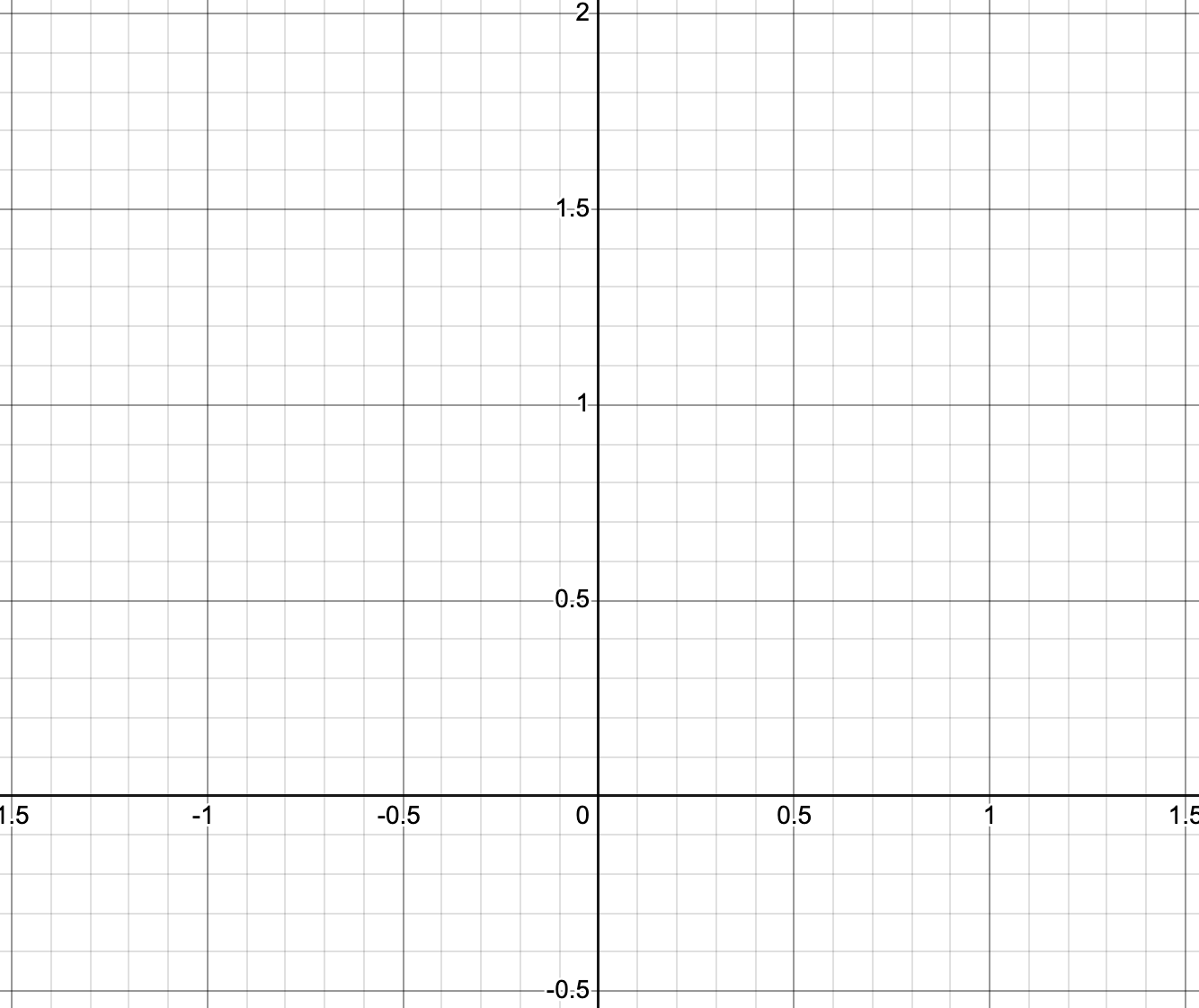
Consider the linear equation: \(y=x+1\)
Let's choose a few x-values to test
| x | y | (x,y) |
|---|---|---|
| -1 | 0 | (-1,0) |
| 0 | 1 | (0,1) |
| 1 | 2 | (1,2) |
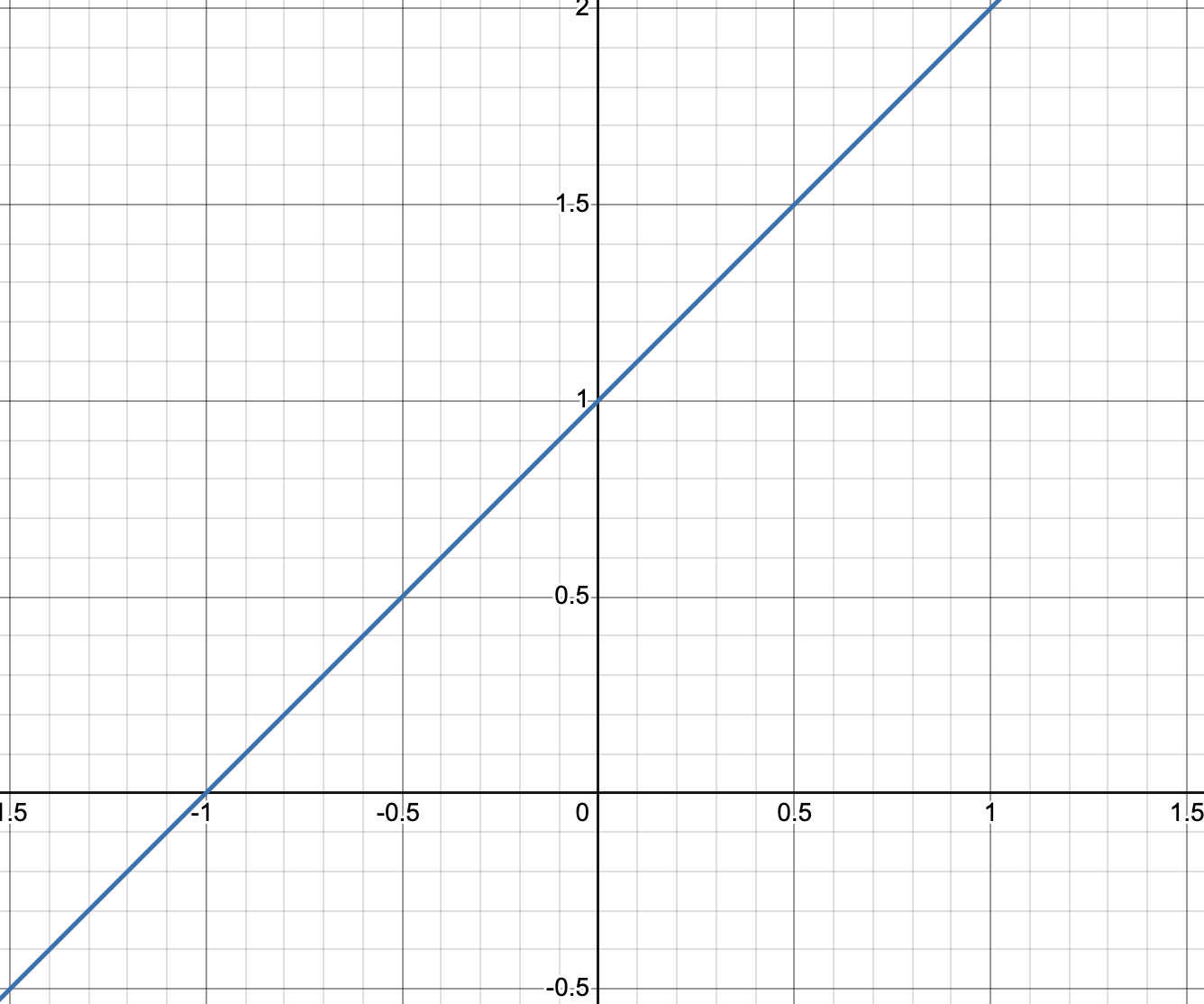
Ex.:
Graph the following linear equations:
2. \(y=2x-1\)
1. \(y=x\)
3. \(y=11x+7\)
Even more formally,
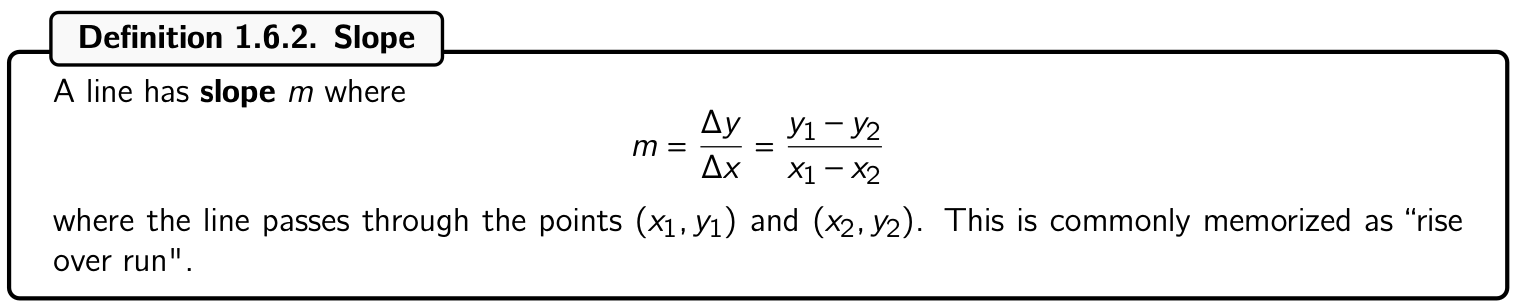
What this is saying is:
- pick 2 points on the line
- moving from left to right, call the first point \((x_1,y_1)\) and the second point \((x_2,y_2)\)
- \(\Delta y\) is just a way of symbolizing the difference \(y_2-y_1\)
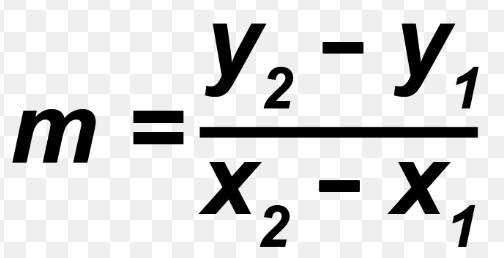
This is the "rise"
4. \(\Delta x\) is just a symbol for \(x_2-x_1\)
This is the "run"
\(\text{slope}=\frac{\text{rise}}{\text{run}}=\frac{y_2-y_1}{x_2-x_1}\)
Left most dot @ \((0,0)\)
Right most dot @ \((1,2)\)
Text
rise= \(y_2-y_1\)
run= \(x_2-x_1\)
\((1,2)=(x_2,y_2)\)
\((0,0)=(x_1,y_1)\)
rise= \(y_2-y_1\)
run= \(x_2-x_1\)
Left most dot @ \((0,0)\)
Right most dot @ \((1,2)\)
\((0,0)=(x_1,y_1)\)
\((1,2)=(x_2,y_2)\)
\(\text{slope}=\frac{\text{rise}}{\text{run}}=\frac{y_2-y_1}{x_2-x_1}\)
\(=\frac{2-0}{1-0}=\frac21=2\)
Important: Notice that slope DOES NOT have to be positive
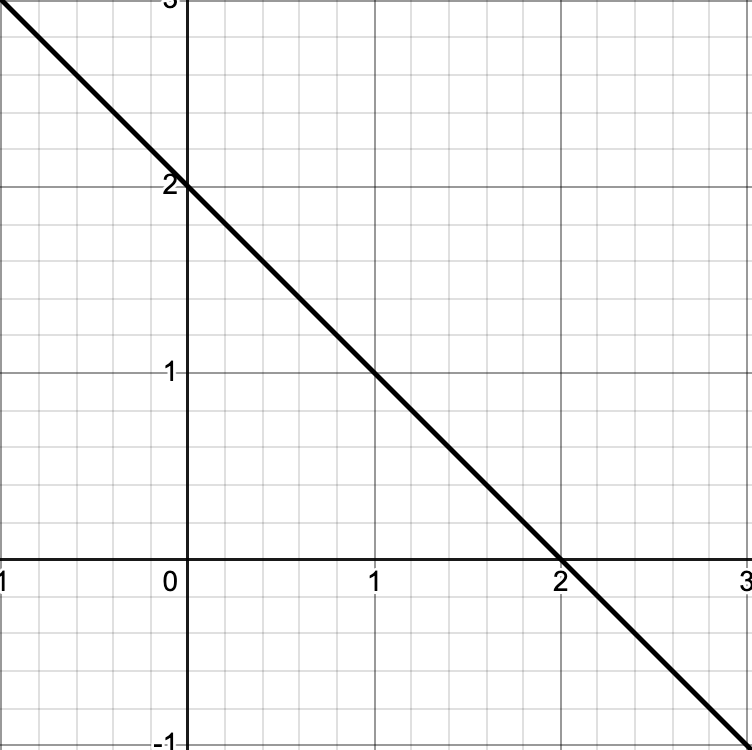
Important: Notice that slope DOES NOT have to be positive
Text
\((x_1,y_1)=(1,1)\)
\((x_2,y_2)=(2,0)\)
Important: Notice that slope DOES NOT have to be positive
Text
\((x_1,y_1)=(1,1)\)
\((x_2,y_2)=(2,0)\)
\(\frac{y_2-y_1}{x_2-x_1}=\frac{0-1}{2-1}=\frac{-1}{1}=-1\)
Slope can also be 0
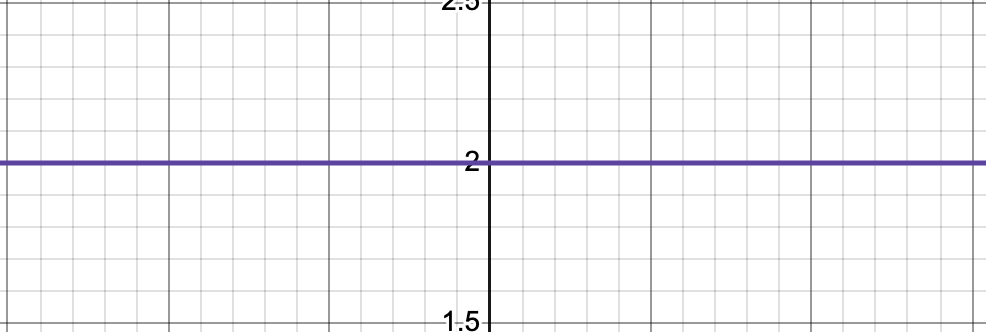
Slope can also be 0
Text
\((x_1,y_1)=(-1,2)\)
\((x_2,y_2)=(1,2)\)
\(\frac{y_2-y_1}{x_2-x_1}=\frac{2-2}{1--1}=\frac02=0\)
Finding Slope from Two Points
Use the slope formula: \(m=\frac{y_2-y_1}{x_2-x_1}\)
Find the slope of the line through each pair of points.
1. \((2,3)\) and \((6,11)\)
2. \((-1,5)\) and \((3,-3)\)
3. \((-4,2)\) and \((5,2)\)
4. \((0,-1)\) and \((4,7)\)
5. \((2,6)\) and \((8,0)\)
6. \((-3,-4)\) and \((1,-4)\)
Solutions
1. \((2,3)\) and \((6,11)\)
\(m=\frac{11-3}{6-2}=\frac{8}{4}=2\)
2. \((-1,5)\) and \((3,-3)\)
\(m=\frac{-3-5}{3-(-1)}=\frac{-8}{4}=-2\)
3. \((-4,2)\) and \((5,2)\)
\(m=\frac{2-2}{5-(-4)}=\frac{0}{9}=0\)
4. \((0,-1)\) and \((4,7)\)
\(m=\frac{7-(-1)}{4-0}=\frac{8}{4}=2\)
5. \((2,6)\) and \((8,0)\)
\(m=\frac{0-6}{8-2}=\frac{-6}{6}=-1\)
6. \((-3,-4)\) and \((1,-4)\)
\(m=\frac{-4-(-4)}{1-(-3)}=\frac{0}{4}=0\)
Algebra Review
Text
First, let's practice simplifying some algebraic expressions
1. \(4 + 3(12 - 8)^2 - 10\)
Classwork
Calculate the following:
2. \(18 - (-5) + 2(-3)\)
3. \((-4)(-6) - 3^2 + 5\)
4. \(\sqrt{49} + 2(15 - 9) - 8\)
5. \(3\sqrt[3]{-8} - 4(-5) + 7\)
6. \(\frac{3}{4} - \frac{1}{6} + \frac{2}{3}\)
\(\rightarrow 18 - (-5) = 18 + 5\)
So:
\(18 + 5 + 2(-3)\)
Now multiply:
\(2(-3) = -6\)
So:
\(18 + 5 - 6\)
Finish from left to right:
\(18 + 5 = 23\)
\(\rightarrow 23 - 6 = 17\)
Therefore:
\(\boxed{17}\)
2. \(18 - (-5) + 2(-3)\)
4. \(\sqrt{49} + 2(15 - 9) - 8\)
\(\rightarrow \sqrt{49} = 7\)
Simplify inside the parentheses:
\(15 - 9 = 6\)
So:
\(7 + 2(6) - 8\)
Multiply:
\(2(6) = 12\)
So:
\(7 + 12 - 8\)
Finish from left to right:
\(7 + 12 = 19\)
\(\rightarrow 19 - 8 = 11\)
Therefore:
\(\boxed{11}\)
6. \(\frac{3}{4} - \frac{1}{6} + \frac{2}{3}\)
The denominators are:
\(4,\ 6,\ 3\)
A common denominator is:
\(12\)
Rewrite each fraction with denominator \(12\):
\(\frac{3}{4} = \frac{9}{12}\)
\(\rightarrow \frac{1}{6} = \frac{2}{12}\)
\(\rightarrow \frac{2}{3} = \frac{8}{12}\)
So:
\(\frac{3}{4} - \frac{1}{6} + \frac{2}{3}=\frac{9}{12} - \frac{2}{12} + \frac{8}{12}\)
Combine the numerators:
\(\frac{9 - 2 + 8}{12}\)
\(\rightarrow \frac{15}{12}\)
Simplify:
\(\frac{15}{12} = \frac{5}{4}\)
Therefore:
\(\boxed{\frac{5}{4}}\)
Next, let's quickly review evaluating functions:
This is very similar to the simplification we did in the last exercise except now we have the additional steps of starting with an expression involving a variable and replacing all instances of that variable with the value in question.
1. Let \(f(x) = 3x - 7\).
Find \(f(5)\).
2. Let \(g(t) = -2t + 9\).
Find \(g(-4)\)
3. Let \(h(x) = x^2 - 3x + 2\).
Find \(h(-2)\).
Replace \(x\) with \(-2\).
\(h(-2) = (-2)^2 - 3(-2) + 2\)
Simplify the exponent.
\(h(-2) = 4 - 3(-2) + 2\)
Multiply.
\(h(-2) = 4 + 6 + 2\)
Add.
\(h(-2) = 12\)
Therefore:
\(\boxed{h(-2) = 12}\)
3. Let \(h(x) = x^2 - 3x + 2\).
Find \(h(-2)\).
Now, let's review solving an equation for a single variable
Remember, this involves starting with an equation we assume holds true for some values of \(x\). We then create a serries of new equations by performing the same operations on both sides of the equality symbol until we have isolated the varialbe on one side.
Classwork:
Solve the following:
1. \(x + 8 = 19\)
2. \(-2y + 7 = 21\)
3. \(\frac{\omega}{4} - 3 = 5\)
4. \(\frac{r}{3} + \frac{r}{6} = 12\)
5. \(a^2 + 6 = 31\)
6. \(\sqrt[3]{m} + 4 = 1\)
2. \(-2y + 7 = 21\)
We want to get \(t\) by itself.
First add \(5\) to both sides.
\(3t - 5 + 5 = 16 + 5\)
Simplify.
\(3t = 21\)
Now divide both sides by \(3\).
\(\frac{3t}{3} = \frac{21}{3}\)
Simplify.
\(t = 7\)
Therefore:
\(\boxed{t = 7}\)
4. \(\frac{r}{3} + \frac{r}{6} = 12\)
Rewrite \(\frac{r}{3}\) with denominator \(6\).
\(\frac{r}{3} = \frac{2r}{6}\)
So:
\(\frac{2r}{6} + \frac{r}{6} = 12\)
Combine the fractions.
\(\frac{3r}{6} = 12\)
Simplify.
\(\frac{r}{2} = 12\)
Multiply both sides by \(2\).
\(2 \cdot \frac{r}{2} = 2 \cdot 12\)
Simplify.
\(r = 24\)
Therefore:
\(\boxed{r = 24}\)
6. \(\sqrt[3]{m} + 4 = 1\)
First subtract \(4\) from both sides.
\(\sqrt[3]{m} + 4 - 4 = 1 - 4\)
Simplify.
\(\sqrt[3]{m} = -3\)
Now cube both sides.
\((\sqrt[3]{m})^3 = (-3)^3\)
Simplify.
\(m = -27\)
Therefore:
\(\boxed{m = -27}\)
Last, let's review some of the new material from last week
Classwork
1. Determine whether the relation is a function.
\(\{(-2, 4), (0, 1), (3, 7), (3, -1), (5, 9)\}\)
Explain your answer.
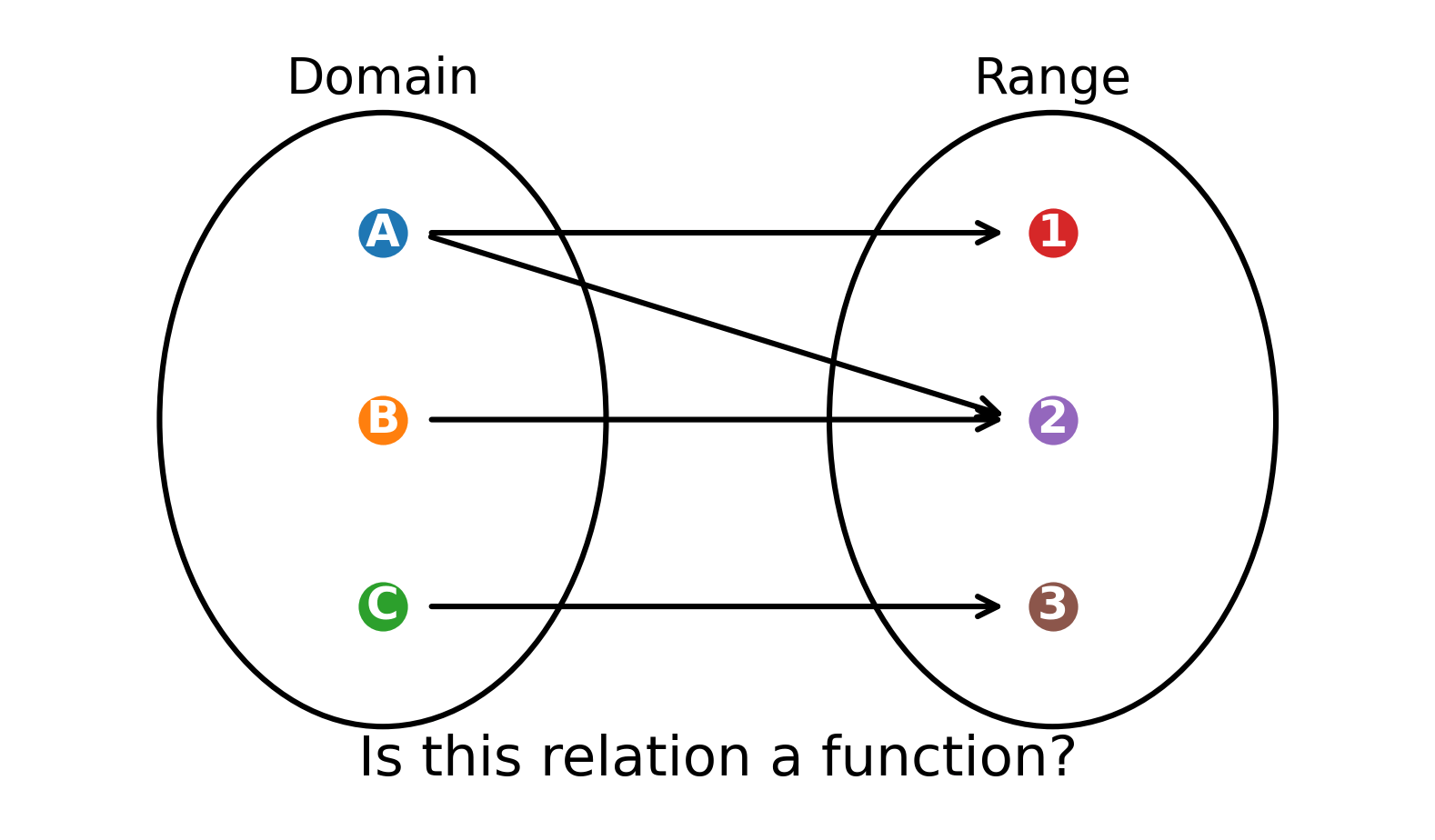
2. Determine whether the mapping diagram represents a function.
Explain your answer.
2. Determine whether the graph represents a function.
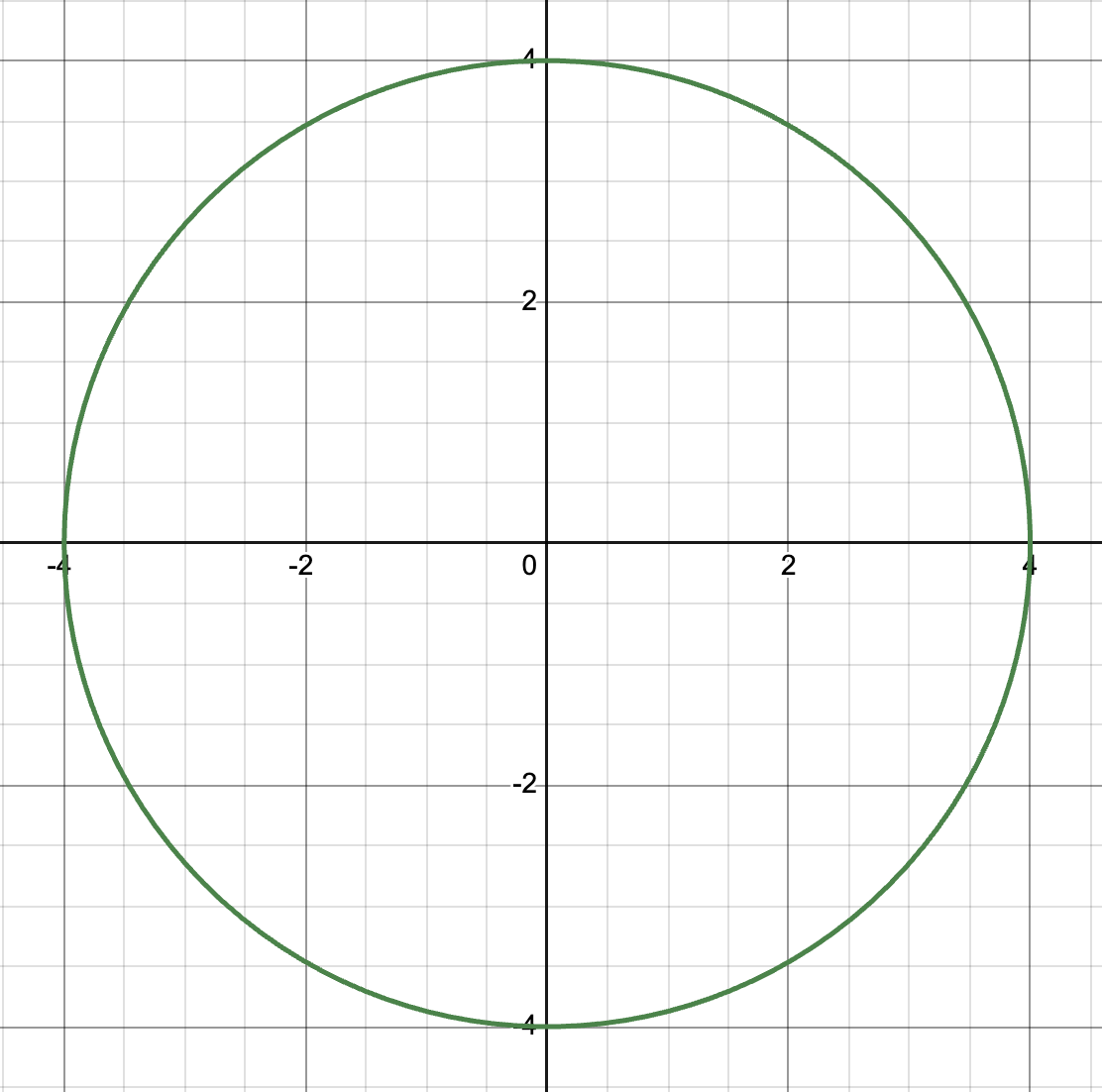
Classwork
1.
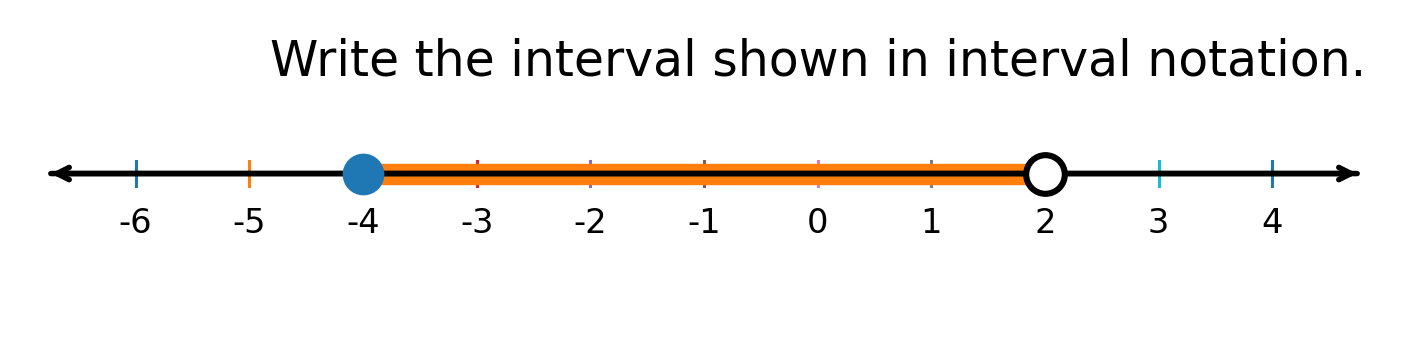
2. Write the interval in set-builder notation.
\((-3, 8]\)
3. Write the intersection in interval notation.
\([ -5, 4 ) \cap ( 1, 7 ]\)
Classwork
1. Use the graph to find the slope and \(y\)-intercept of the line.
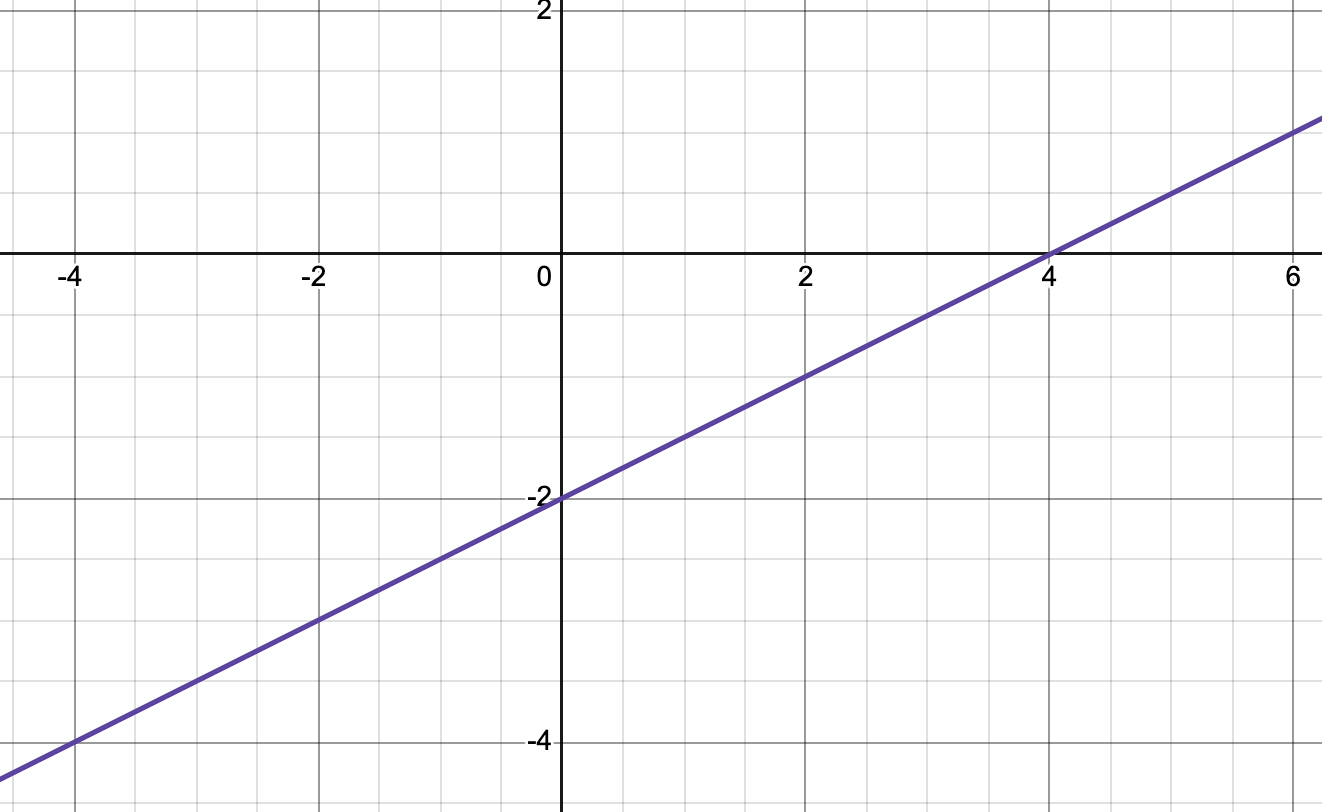
2. Graph the line.
\(y = -\frac{3}{2}x + 4\)
3. Find the slope of the line passing through the points.
\((-4, 7)\) and \((2, -5)\)
Finishing Linear Equations
Text
Consider the line: \(y = 2x + 1\)
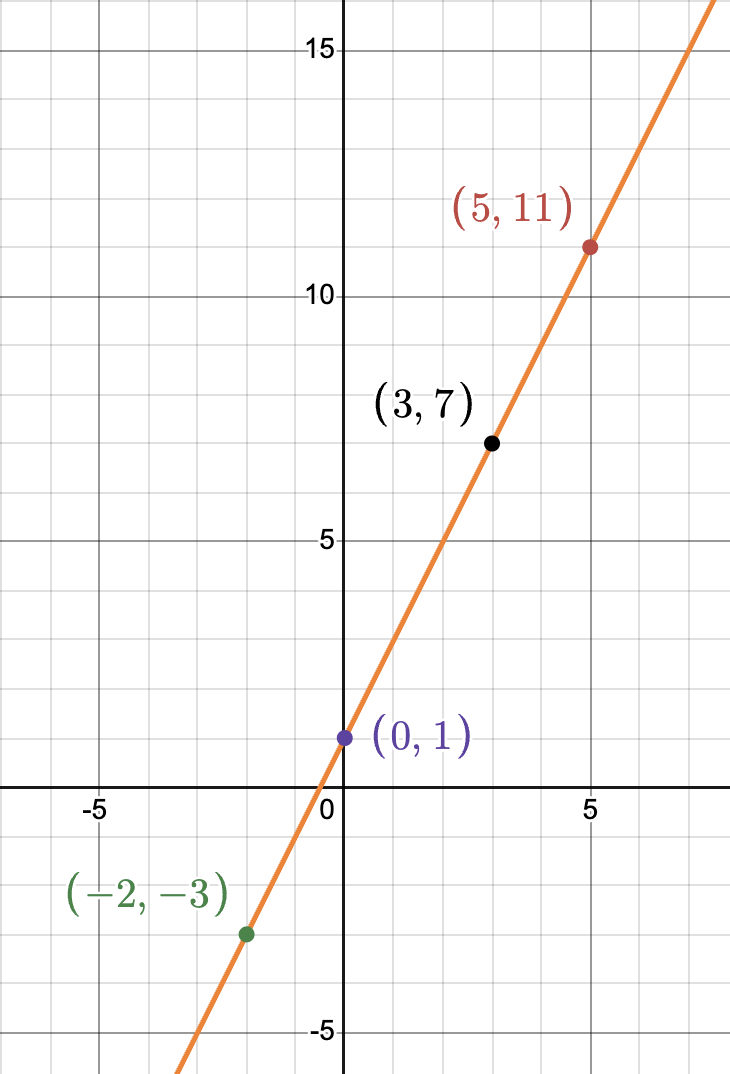
Some points on the line are:
\((-2,-3), \ (0,1), \ (3,7), \ (5,11)\)
Text
Consider the line: \(y = 2x + 1\)
Some points on the line are:
\((-2,-3), \ (0,1), \ (3,7), \ (5,11)\)
\(\frac{rise}{run}=\frac42=2\)
\(\frac{rise}{run}=\frac63=2\)
\(\frac{rise}{run}=\frac42=2\)
Text
Algebraically:
\(m = \frac{y_2-y_1}{x_2-x_1}\)
---
Pair 1: \((-2,-3)\) and \((0,1)\)
\(m = \frac{1-(-3)}{0-(-2)}=\frac{4}{2}=2\)
---
Pair 2: \((0,1)\) and \((3,7)\)
\(m = \frac{7-1}{3-0}=\frac{6}{3}=2\)
---
Pair 3: \((-2,-3)\) and \((5,11)\)
\(m = \frac{11-(-3)}{5-(-2)}=\frac{14}{7}=2\)
Each pair gives the same slope:
\(\boxed{m=2}\)
So it does not matter which two different points on the line we choose.
\(\frac{rise}{run}=\frac42=2\)
\(\frac{rise}{run}=\frac63=2\)
\(\frac{rise}{run}=\frac42=2\)
Consider 2 points on the coordinate plane
Is it possible to draw more than 1 line between these points?
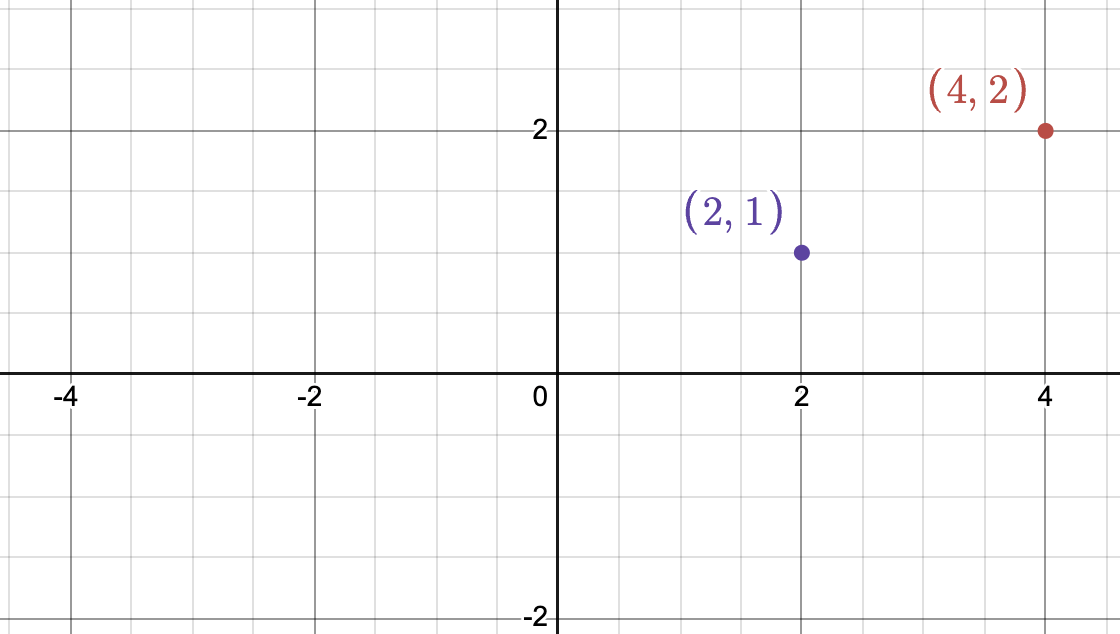
Consider 2 points on the coordinate plane
Is it possible to draw more than 1 line between these points?
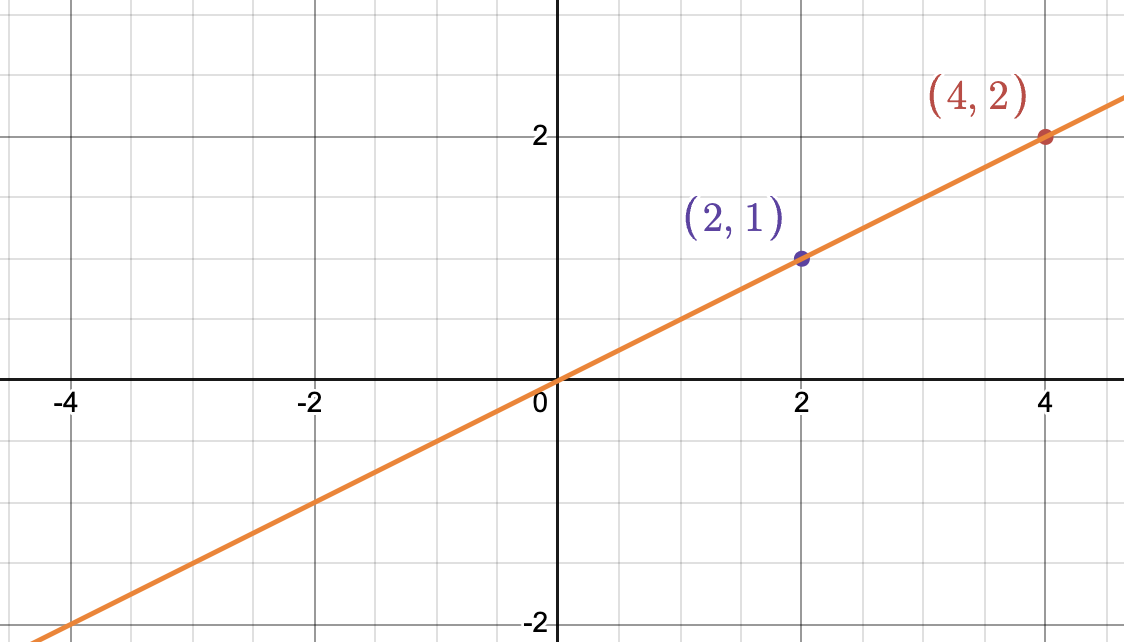
We saw last time that a line is completely determined by a slope and a y-intercept.
We also saw that the slope of a line can be determined from any 2 points on that line
Therefore, if a line is completely determined by any 2 points that it passes through, we must be able to determine the y-intercept from those points in addition to the slope.
Let's work our way up to this...
Classwork:
Put the following equations into slope-intercept form.
1. \(y - 4 = 3x\)
2. \(2y = -6x + 10\)
3. \(3x + y = 8\)
Solve for \(b\).
4. \(7 = 2(3) + b\)
5. \(-4 = -3(2) + b\)
6. \(10 = \frac{1}{2}(8) + b\)
What were we actually doing in problems 4.-6.?
We were being given equations in slope-intercept form and being asked to find the y-intercept, b.
Let's take this a step further...
Classwork
1. Find the slope and \(y\)-intercept of the line passing through the points.
2. Find the slope and \(y\)-intercept of the line passing through the points.
3. Find the slope and \(y\)-intercept of the line passing through the points.
\((0, 4)\) and \((3, 10)\)
\((0, -2)\) and \((-4, 6)\)
\((0, 5)\) and \((7, 5)\)
Then write the equation in slope-intercept form.
Then write the equation in slope-intercept form.
Then write the equation in slope-intercept form.
In these problems, we were lucky that one of the given points was the y-intercept \((0,b)\)
Let's see what happens if we plug this point into the general slope formula:
\(m=\frac{y_2-y_1}{x_2-x_1}\)
Let \((x_1,y_1)=(0,b)\)
This gives us:
\(m=\frac{y_2-b}{x_2-0}\)
\((x_2-0)m=(y_2-b)\)
\(mx_2=y_2-b\)
\(y_2=mx_2+b\)
So we see that the slope-intercept form is just a special case of the slope formula where one of the points is the y-intercept
While slope-intercept form is the most desired and simplified form of a line , it’s not always the most useful form if we’re trying to find the equation of a line.
Often times, we’ll know either two points, or the slope of the line and a single point.
Either way, we’ll typically start with point-slope form of a line, then simplify it into slope-intercept form.

Ex. 1:
Find the slope-intercept equation of the line with slope \(m = 3\) passing through the point \((2, 7)\).
We already know the slope:
\(m = 3\)
So \(y = 3x + b\)
Now use the point \((2,7)\).
This means: \(x = 2\) and \(y = 7\)
\(7 = 3(2) + b\)
\(7 = 6 + b\)
\(b = 1\)
\(\boxed{y = 3x + 1}\)
Ex. 2:
Find the equation of the line passing through the points \((-1, 8)\) and \((3, 0)\).
First find the slope.
\(m = \frac{y_2-y_1}{x_2-x_1}\)
Use: \((x_1,y_1)=(-1,8)\) and \((x_2,y_2)=(3,0)\)
\(m = \frac{0 - 8}{3 - (-1)}\)
\(m = \frac{-8}{3 + 1}\)
\(m = -2\)
Now use slope-intercept form: \(y = mx + b\)
\(y = -2x + b\)
Now use one of the points. Use \((3,0)\).
So: \(x = 3\) and \(y = 0\)
\(0 = -2(3) + b\)
\(b = 6\)
\(\boxed{y = -2x + 6}\)
Summary
If you are given slope and one point:
1. Start with \(y = mx + b\)
2. Plug in the slope for \(m\)
3. Plug in the point for \(x\) and \(y\)
4. Solve for \(b\)
5. Write the final equation
If you are given two points:
1. Find the slope first
2. Start with \(y = mx + b\)
3. Plug in the slope for \(m\)
4. Use one point to solve for \(b\)
5. Write the final equation
Classwork:
Find the equation of each line in slope-intercept form.
1. Slope \(m = 2\), through the point \((4, 11)\).
2. Through the points \((1, 7)\) and \((4, 16)\).
3. Slope \(m = -3\), through the point \((-2, 5)\).
4. Through the points \((-1, 6)\) and \((3, -2)\)
5. Slope \(m = \frac{1}{2}\), through the point \((6, 1)\).
6. Through the points \((0, -4)\) and \((5, 6)\)
2. Through the points \((1, 7)\) and \((4, 16)\).
First find the slope: \(m = \frac{y_2-y_1}{x_2-x_1}\)
\(m = \frac{16-7}{4-1}\)
\(m = 3\)
Now use slope-intercept form: \(y = mx + b\)
\(y = 3x + b\)
Use the point \((1,7)\)
\(7 = 3(1) + b\)
\(b = 4\)
\(\boxed{y = 3x + 4}\)
Linear Applications
What do applications of linear functions look like?
How do they apply to the "real world"?
Ex.:
At a small gym, a day pass costs a flat fee of \(\$5.00\) plus \(\$2.50\) per hour for use of the rock-climbing wall.
Write a linear function to model the total cost \(C(h)\) for using the climbing wall for \(h\) hours.
\(\text{total cost} = \text{hourly rate}\cdot \text{hours}+\text{flat fee}\)
\(C(x)=mx+b\)
\(\text{total cost} = (\text{variable cost per unit})(\text{number of units}) + \text{fixed cost}\)
\(m=\text{variable cost per unit}\)
\(x=\text{number of units}\)
\(b=\text{fixed cost}\)
Ex.:
At a small gym, a day pass costs a flat fee of \(\$5.00\) plus \(\$2.50\) per hour for use of the rock-climbing wall.
Write a linear function to model the total cost \(C(h)\) for using the climbing wall for \(h\) hours.
\(\text{total cost} = \text{hourly rate}\cdot \text{hours}+\text{flat fee}\)
\(C(x)=mx+b\)
The flat fee is: \(\$5.00\)
The hourly rate is: \(\$2.50 \text{ per hour}\)
\(\boxed{C(h)=2.50h+5}\)
The domain is: \(\boxed{h \geq 0}\) because the number of hours cannot be negative.
Ex.:
At a small gym, a day pass costs a flat fee of \(\$5.00\) plus \(\$2.50\) per hour for use of the rock-climbing wall.
Evaluate \(C(3.2)\) and interpret the meaning in context.
Start with the function: \(C(h)=2.50h+5\)
\(C(3.2)=2.50(3.2)+5\)
\(C(3.2)=8.00+5\)
\(C(3.2)=13.00\)
This means that it costs \(\boxed{\$13.00}\) to use the climbing wall for \(\boxed{3.2}\) hours.
This function tells us what the customer pays.
So for the customer:
\(\boxed{C(h)=2.50h+5}\)
But for the gym, that same amount of money is revenue.
So from the gym's perspective:
\(\boxed{R(h)=2.50h+5}\)
The formula is the same, but the interpretation changes depending on whose perspective we are using.
Important Note:
Now suppose it costs the gym \(\$0.75\) per hour to operate the climbing wall.
The gym's operating cost is: \(G(h)=0.75h\)
Profit is:
\(\text{profit}=\text{revenue}-\text{cost}\)
\(P(h)=R(h)-G(h)\)
\(P(h)=(2.50h+5)-0.75h\)
\(P(h)=1.75h+5\)
Classwork:
1. A small gym rents out a climbing wall.
The gym has a fixed operating cost of \(\$40\) per day.
It costs the gym \(\$3\) per hour to operate the wall.
The gym charges customers \(\$8\) per hour to use the wall.
Let \(h\) be the number of hours the wall is used in one day.
Find:
1. The cost function \(C(h)\)
2. The revenue function \(R(h)\)
3. The profit function \(P(h)\)
Classwork:
2. A local bakery sells cupcakes.
The bakery has a fixed daily cost of \(\$75\).
Each cupcake costs \(\$1.20\) to make.
The bakery sells each cupcake for \(\$3.50\).
Let \(q\) be the number of cupcakes sold in one day.
Find:
1. The cost function \(C(q)\)
2. The revenue function \(R(q)\)
3. The profit function \(P(q)\)
Quadratic Functions
After linear functions, the next type of type of function that we need to look at is quadratic functions
Let's Compare...
Graphically:
In 2 dimensions, the graph of a linear function is a line.
Linear Functions:
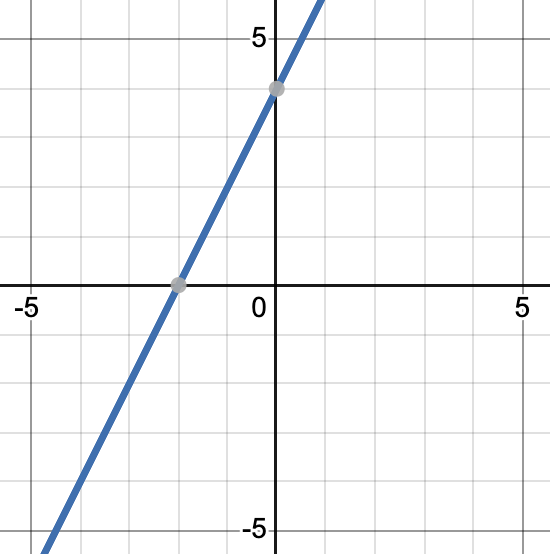
Quadratic Functions:
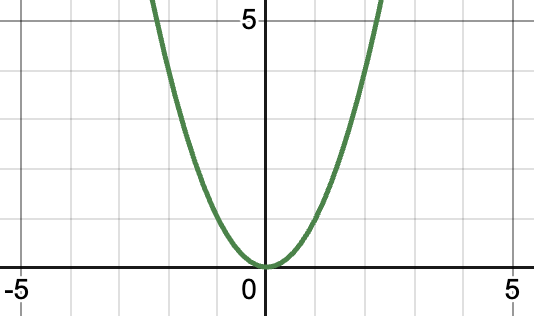
In 2 dimensions, the graph of a quadratic function is a parabola


Algebraically:
Linear Functions:
Quadratic Functions:
Dissecting the standard form
\(p(x)=ax^2+bx+c\)
{
{
{
term
term
term

Expression
{
function name
Function Notation
Dissecting the standard form
\(p(x)=ax^2+bx+c\)
{
coefficient
{
{
{
coefficient
variable
{
variable
constant
Note that a linear function looks a lot like a quadratic function with \(a=0\)
\(y=0\cdot x^2 + bx+c=bx+c\)
It turns that quadratic functions are themselves just special cases of even larger functions...
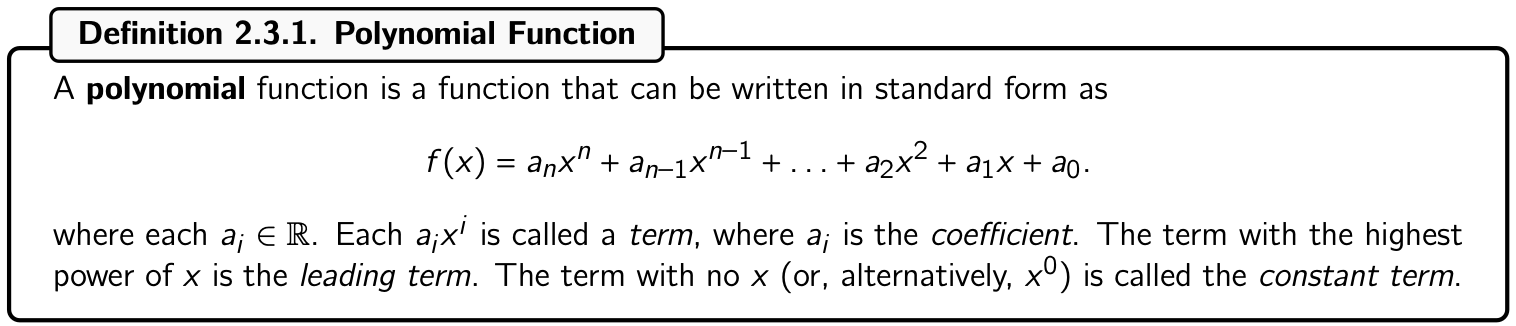

\(f(x)=3x^4+x^3-2x^2+x\)
degree 4 polynomial
\(g(x)=x^2+1\)
degree 2 polynomial
\(h(x)=a_nx^n+a_{n-1}x^{n-1}+...+a_1x+a_0\)
degree n polynomial
Linear functions are degree 1 or degree 0 polynomials
\(y=2x+1\)
degree 1 polynomial
\(y=5\)
degree 0 polynomial
Quadratic functions are degree 2 polynomials
\(y=x^2+x+1\)
degree 2 polynomial
Now, how do we solve a quadratic function for x?
We need to leverage 2 main properties:
Distributive Property
\(a(b+c)=ab+ac\),
\((b+c)a=ba+ca\) \(a,b,c\in \mathbb{R}\)

- \(x^a \cdot x^b = x^{a+b}\)
- \(\frac{x^a}{x^b} = x^{a-b}\)
- \((x^a)^b = x^{ab}\)
- \((xy)^a = x^a y^a\)
- \(\left(\frac{x}{y}\right)^a = \frac{x^a}{y^a}\)
- \(x^0 = 1\), where \(x \neq 0\)
- \(x^{-a} = \frac{1}{x^a}\)
Power Rules
\(x^3 \cdot x^5 = x^{3+5} = x^8\)
\(\frac{x^7}{x^2} = x^{7-2} = x^5\)
\((x^4)^3 = x^{12}\)
\((3x)^2 = 3^2x^2 = 9x^2\)
\(\left(\frac{x}{2}\right)^3 = \frac{x^3}{2^3} = \frac{x^3}{8}\)
\(7^0 = 1\)
\(x^{-3} = \frac{1}{x^3}\)
Classwork
Problem 1
\(x^4 \cdot x^7\)
Problem 2
\(\frac{y^9}{y^3}\)
Problem 3
\((a^5)^2\)
Simplify each expression.
Problem 4
\((3x^2)^3\)
Problem 5
\(\frac{12m^7}{4m^2}\)
Problem 6
\((2x^3y^2)(5x^4y)\)
Classwork
1. \(3(x+4)\)
3. \(-2x(x-9)\)
2. \(6(x-2)+3x\)
5. \(-3(2x+1)+4(x-5)\)
4. \(x^2(2x+x)\)
Distribute in each of the following:
A quick refresher:
Let \(a,b\in \mathbb{Z}\).
We say that a divides b if there exists an integer c such that
$$b=ac$$
We say that b is a multiple of a or that a is a factor of b or that a is a divisor of b
Ex.:
\(6=3\cdot 2\)
so 3 is a factor of 6
We can also go in the reverse direction.
This is called factoring.
Steps:
Look at each term in the expression:
- Find the greatest common factor of the coefficients
- "Pull out" this factor by dividing every coefficient by this value and writing it outside of the expression
- Find the largest power of each variable that appears in every term.
- "Pull out" this power by dividing each variable by this power and writing it outside the expression
That is, we can "undo" distribution
The simplest form of factoring is called: factoring out the greatest common factor
Ex.:
Start with the expression:
\(12x^3 + 8x^2\)
The coefficients are: \(12\) and \(8\)
The greatest common factor is: \(4\)
Rewrite: \(4(3x^3+2x^2)\)
Find the largest power of each variable that appears in every term.
In both terms, \(x^3\) and \(x^2\), have at least \(x^2\).
So the variable part of the GCF is: \(x^2\)
Rewrite: \(4x^2(3x+2x)\)
Classwork
Factor out the greatest common factor.
Problem 1
\(6x+12\)
Problem 2
\(15y-25\)
Problem 3
\(8x^2+20x\)
Problem 4
\(12a^3-18a^2\)
Problem 5
\(10m^4n+15m^2n^2\)
Problem 6
\(14x^5-21x^3+7x^2\)
Notice that we can distribute an entire expression over another:
\((ax+b)(cx+d)\)
Consider the linear expressions:
1. \((ax+b)\)
Suppose we want to multiply them together:
2. \((cx+d)\)
\(\Longrightarrow (ax+b)cx+(ax+b)d\)
\(\Longrightarrow ax\cdot cx+b\cdot cx+ax\cdot d+b\cdot d\)
\(\Longrightarrow acx^2+bcx+adx+bd\)
\(\Longrightarrow acx^2+(bc+ad)x+bd\)
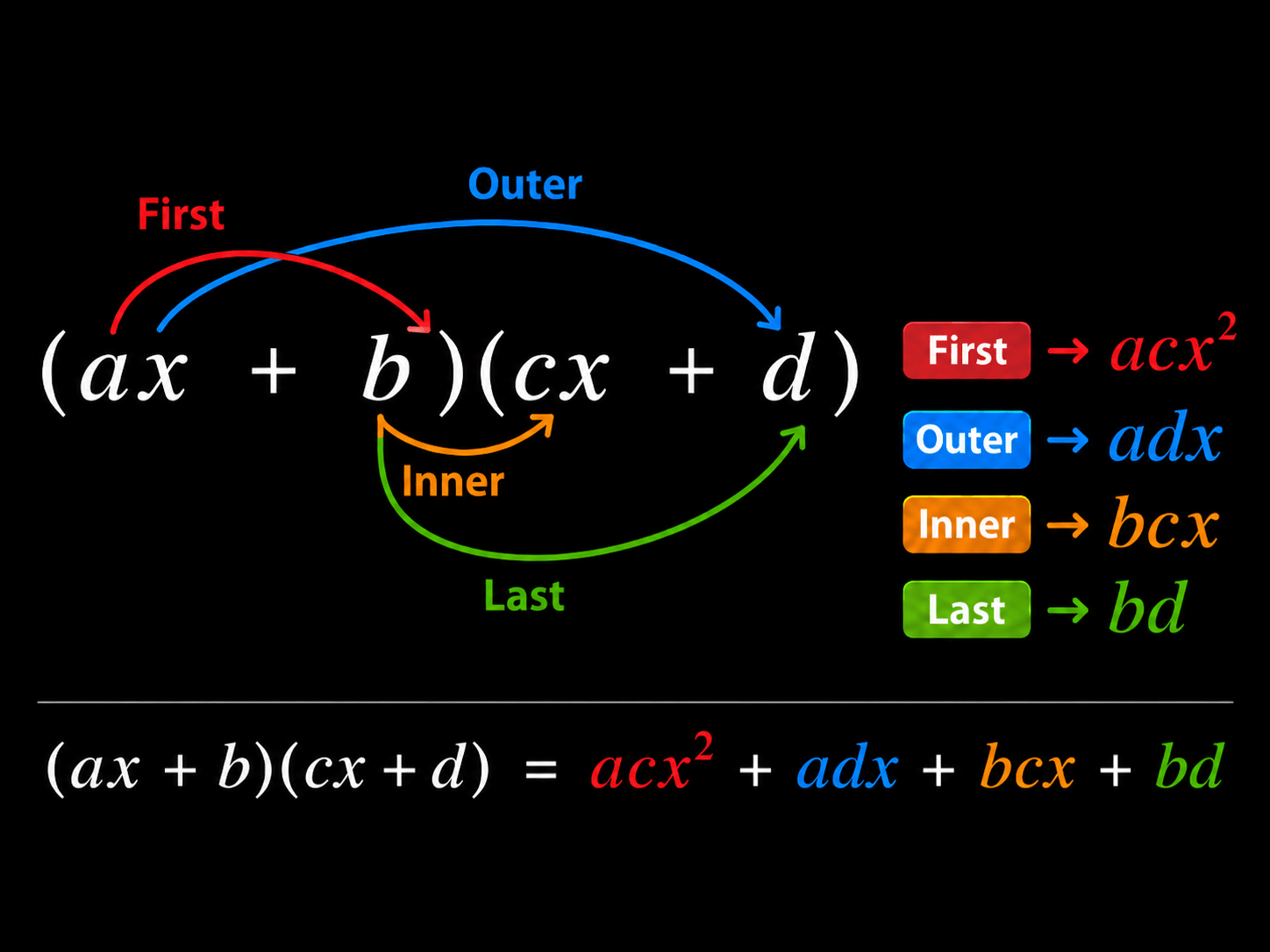
However, rather than do all of those steps every time, we have a shortcut.
This is called the FOIL method
F
O
I
L
First
Outside
Inside
Last
Classwork
Use FOIL to simplify each expression:
Problem 1
\((x+3)(x+5)\)
Problem 2
\((x-4)(x+7)\)
Problem 3
\((2x+1)(x+6)\)
Problem 4
\((3x-2)(x+5)\)
Problem 5
\((2x+3)(4x-1)\)
Problem 6
\((5x-2)(3x-7)\)
Next, how do we undo FOIL?
That is, how do we start with a quadratic
\(ax^2+bx+c\)
and factor it into 2 linear expressions
\(ax^2+bx+c=(ux+r)(wx+s)\)
Unfortunately, there isn't a single algorithm or method for doing this...
Let's take a look at a few options
Factoring by Grouping
Sometimes we can factor an expression by grouping terms that have common factors.
This is useful when there are four terms.
Factoring by Grouping
Example
Factor:
\(x^3 + 3x^2 + 2x + 6\)
Final Answer
\(\boxed{x^3 + 3x^2 + 2x + 6 = (x+3)(x^2+2)}\)
Step 1: Group the terms in pairs
\((x^3 + 3x^2) + (2x + 6)\)
Step 2: Factor out the GCF from each group
From the first group:
\(x^3 + 3x^2 = x^2(x+3)\)
From the second group:
\(2x + 6 = 2(x+3)\)
So we have:
\(x^2(x+3) + 2(x+3)\)
Step 3: Look for the shared factor
Both terms now have a factor of:
\((x+3)\)
So factor out \((x+3)\).
\((x+3)(x^2+2)\)
Check
Distribute:
\((x+3)(x^2+2)\)
\(=x(x^2+2)+3(x^2+2)\)
\(=x^3+2x+3x^2+6\)
\(=x^3+3x^2+2x+6\)
So the factoring is correct.
Classwork
Factor each expression by grouping.
Problem 1
\(x^3 + 4x^2 + 3x + 12\)
Problem 2
\(2x^3 - 6x^2 + 5x - 15\)
Problem 3
\(3x^3 + 6x^2 + 7x + 14\)
Problem 4
\(4x^3 - 8x^2 - 9x + 18\)
But what about quadratics?!
This method can still work with quadratics but note that, in the previous examples, it worked because our cubic expressions had 4 terms that we grouped into pairs
Quadratic expressions only have 3 terms
\(ax^2+bx+c\)
So we are going to split the middle term into 2
\(ax^2+bx+c=ax^2+\alpha x+\beta x+c\)
Here is the general procedure
Start with a quadratic expression
\(ax^2+bx+c\)
We want to find 2 numbers, \(\alpha\) and \(\beta\), such that:
1. \(\alpha\cdot \beta=ac\)
2. \(\alpha+\beta=b\)
Split the middle term:
\(ax^2+bx+c=ax^2+\alpha x+\beta x+c\)
Factor by grouping
Ex.:
\(6x^2+x-15=ax^2+bx+c\)
Start with the quadratic expression:
Want to find numbers \(\alpha\) and \(\beta\) such that:
1. \(\alpha\cdot \beta=ac=6\cdot (-15)=-90\)
2. \(\alpha+\beta=b=1\)
This requires a little trial and error
\(1\cdot -90=-90\) but \(1+-90=-89\)
\(2\cdot -45=-90\) but \(2+-45=-43\)
\(10\cdot -9=-90\) but \(10+-9=1\)
Ex.:
\(6x^2+x-15=ax^2+bx+c\)
Start with the quadratic expression:
Want to find numbers \(\alpha\) and \(\beta\) such that:
1. \(\alpha\cdot \beta=ac=6\cdot (-15)=-90\)
2. \(\alpha+\beta=b=1\)
\(10\cdot -9=-90\) but \(10+-9=1\)
Let \(\alpha=10\) and \(\beta=-9\)
Split the middle term:
\(ax^2+bx+c=ax^2+\alpha x+\beta x+c\)
\(=6x^2+10x-9x-15\)
Ex.:
\(6x^2+x-15=ax^2+bx+c\)
Start with the quadratic expression:
Split the middle term:
\(ax^2+bx+c=ax^2+\alpha x+\beta x+c\)
\(=6x^2+10x-9x-15\)
Factor by grouping:
\(6x^2+10x-9x-15=(6x^2+10x)+(-9x-15)\)
\(=2x(3x+5)-3(3x+5)\)
\(=(2x-3)(3x+5)\)
Classwork
Problem 1
\(2x^2+7x+3\)
Problem 2
\(3x^2+10x+8\)
Problem 3
\(4x^2-4x-15\)
Problem 4
\(6x^2-x-12\)
Solution 1
\(\boxed{2x^2+7x+3=(x+3)(2x+1)}\)
Solution 2
\(\boxed{3x^2+10x+8=(x+2)(3x+4)}\)
Solution 3
\(\boxed{4x^2-4x-15=(2x-5)(2x+3)}\)
Solution 4
\(\boxed{6x^2-x-12=(2x-3)(3x+4)}\)
Now that we've seen how to factor, let's return to the question of how to solve a quadratic equation for x
Recall the zero product property:

Suppose we have a quadratic equation of the form:
\(ax^2+bx+c=0\)
Factor the quadratic expression on the left:
\(ax^2+bx+c=(ux+r)(wx+s)=0\)
So we have to linear factors:
1. \((ux+r)\)
2. \((wx+s)\)
whose product is equal to 0.
Hence, by the zero product property, it must be the case that:
\((ux+r)=0\) or \((wx+s)=0\)
\(x=\frac{-r}{u}\) or \(x=\frac{-s}{w}\)

In the case that:
\(ax^2+bx+c=px^2+qx+r\)
First get all of the terms on one side:
Group like terms:
\((ax^2+bx+c)-(px^2+qx+r)=0\)
\((ax^2-px^2)+(bx-qx)+(c-r)=0\)
And now we have a quadratic expression on the left that can be factored:
\((a-p)x^2+(b-q)x+(c-r)=0\)
Ex.:
Solve: \(x^2+7x+12=0\)
Step 1: Factor the quadratic
We need two numbers that multiply to \(12\) and add to \(7\).
\(3\cdot 4=12\) and \(3+4=7\)
So: \(x^2+7x+12=(x+3)(x+4)\)
The equation becomes: \((x+3)(x+4)=0\)
Step 2: Use the Zero Product Property
If two things multiply to zero, then at least one of them must be zero.
So:
\(x+3=0\) or \(x+4=0\)
Ex.:
Solve: \(x^2+7x+12=0\)
Step 3: Solve each equation
\(x+3=0\)
\(\Longrightarrow x=-3\)
and
\(x+4=0\)
\(\Longrightarrow x=-4\)
Final Answer
\(\boxed{x=-3 \text{ or } x=-4}\)
Check:
If \(x=-3\):
\((-3)^2+7(-3)+12=9-21+12=0\)
If \(x=-4\):
\((-4)^2+7(-4)+12=16-28+12=0\)
Classwork
Solve each equation.
Problem 1
\(x^2=49\)
Problem 2
\(t^2-16=0\)
Problem 3
\(x^2+5x=0\)
Problem 4
\(3y^2-12y=0\)
Problem 5
\(x^2+9x=-20\)
Problem 6
\(2x^2+7x+3=0\)
Problem 7
\(x^2+4x=12\)
Problem 8
\(6x^2-x=12\)
Before we introduce the next method, we need a couple more definitions
Perfect Square
A perfect square is an expression that can be written as something squared.
\(A^2\)
Examples:
\(9=3^2\)
\(x^2+6x+9=(x+3)^2\)
\(x^2-10x+25=(x-5)^2\)
Key pattern:
\((x+a)^2=x^2+2ax+a^2\) and \((x-a)^2=x^2-2ax+a^2\)
Difference of Squares
A difference of squares is a subtraction problem where both terms are perfect squares.
\(A^2-B^2\)
It factors as:
\(A^2-B^2=(A+B)(A-B)\)
Examples:
\(x^2-25\)
Since \(x^2=(x)^2\) and \(25=5^2\),
\(x^2-25=(x+5)(x-5)\)
Another example:
\(4x^2-9\)
Since \(4x^2=(2x)^2\) and \(9=3^2\),
\(4x^2-9=(2x+3)(2x-3)\)
Completing the Square
Start with the quadratic equation:
\(ax^2+bx+c=0\)
For this method to work, we actually want \(c\) on the right side of the equation
\(ax^2+bx=-c\)
Next, find half of \(b\): \(\frac{b}{2}\)
Square it: \((\frac{b}{2})^2\)
Add it to both sides of the equation:
\(ax^2+bx+(\frac{b}{2})^2=-c+(\frac{b}{2})^2\)
At this point, we can factor the left and it should be a perfect square
Take the square root of both sides
\(x^2+bx+\left(\frac{b}{2}\right)^2=\left(x+\frac{b}{2}\right)^2\)
Completing the Square
Goal: rewrite a quadratic as a perfect square so we can use square roots.
Example: \(x^2+6x=7\)
Take half of the \(x\)-coefficient, then square it:
\(\frac62 = 3\)
\(3^2=9\)
Add \(9\) to both sides:
\(x^2+6x+9=7+9\)
Factor the perfect square:
\((x+3)^2=16\)
Use square roots:
\(x+3=\pm 4\)
Solve:
\(x=1\) or \(x=-7\)
Classwork:
Completing the Square
Problem 1
\(x^2+8x=9\)
Problem 2
\(x^2-10x+4=0\)
Problem 3
\(t^2+6t-7=0\)
Problem 4
\(y^2-5y=14\)
The Nuclear Option: The Quadratic Formula
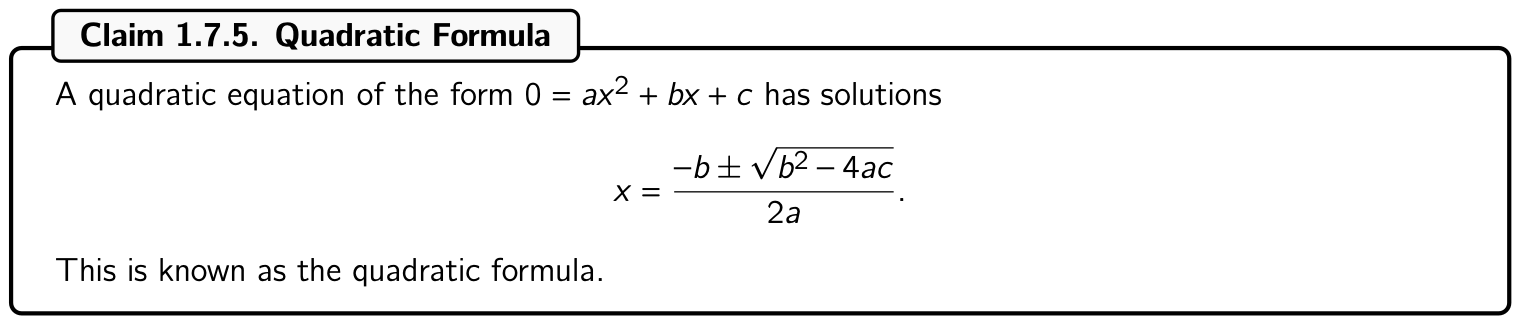
If all else fails, the quadratic formula is useful because it solves any quadratic, regardless of whether or not it could be factored conventionally.
Warning: do NOT become overly reliant on the quadratic formula
There are many instances where we want to factor without solving for x
Ex.:
Solve:
\(2x^2+5x-3=0\)
First identify \(a\), \(b\), and \(c\):
\(a=2\) \(b=5\) \(c=-3\)
Substitute into the quadratic formula:
\(x=\frac{-(5)\pm\sqrt{(5)^2-4(2)(-3)}}{2(2)}\)
Simplify inside the square root:
\(x=\frac{-5\pm\sqrt{25+24}}{4}=\frac{-5\pm\sqrt{49}}{4}\)
Since \(\sqrt{49}=7\): \(x=\frac{-5\pm 7}{4}\)
Now split into two solutions:
\(x=\frac{-5+7}{4}=\frac12\) or \(x=\frac{-5-7}{4}=-3\)
Final Answer:
\(\boxed{x=\frac{1}{2} \text{ or } x=-3}\)
Classwork
Solve each equation using the quadratic formula.
Problem 1
\(x^2+5x+6=0\)
Problem 2
\(2x^2+7x=-3\)
Problem 3
\(3x^2-4x-4=0\)
Problem 4
\(5x^2=-2x+3\)
Standard Forms

Classwork:
Rewriting Functions
1. Rewrite in point-slope form using the given point.
\(3x-y=7\), point: \((2,-1)\)
2. Rewrite in slope-intercept form.
\(y-5=2(x+3)\)
3. Rewrite in standard quadratic form.
\(q(x)=(x-5)(2x+3)\)
4. Rewrite in point-slope form using the given point.
\(x+2y=8\), point: \((6,1)\)
5. Rewrite in slope-intercept form.
\(3x+y+4=0\)
6. Rewrite in standard quadratic form.
\(r(x)=-(x+4)^2+7\)
1. \(y=3x-7\), point: \((2,-1)\)
The slope is \(3\).
Point-slope form:
\(y+1=3(x-2)\)
2. \(y-5=2(x+3)\)
\(y-5=2x+6\)
\(y=2x+11\)
3. \(q(x)=(x-5)(2x+3)\)
\(q(x)=2x^2+3x-10x-15\)
\(q(x)=2x^2-7x-15\)
Evaluate each function at the given value.
Classwork:
1. \(f(x)=3x-7\)
2. \(g(t)=-2t+5\)
3. \(h(x)=(x-2)(x+5)\)
Find \(f(4)\).
Find \(g(-3)\).
Find \(h(3)\).
4. \(p(a)=2a^2+3a-1\)
Find \(p(-2)\).
5. \(q(x)=(x-4)^2+3\)
Find \(q(1)\).
6. \(r(x)=x(x+5)-2(x-1)\)
Find \(r(-4)\)
More on Graphs
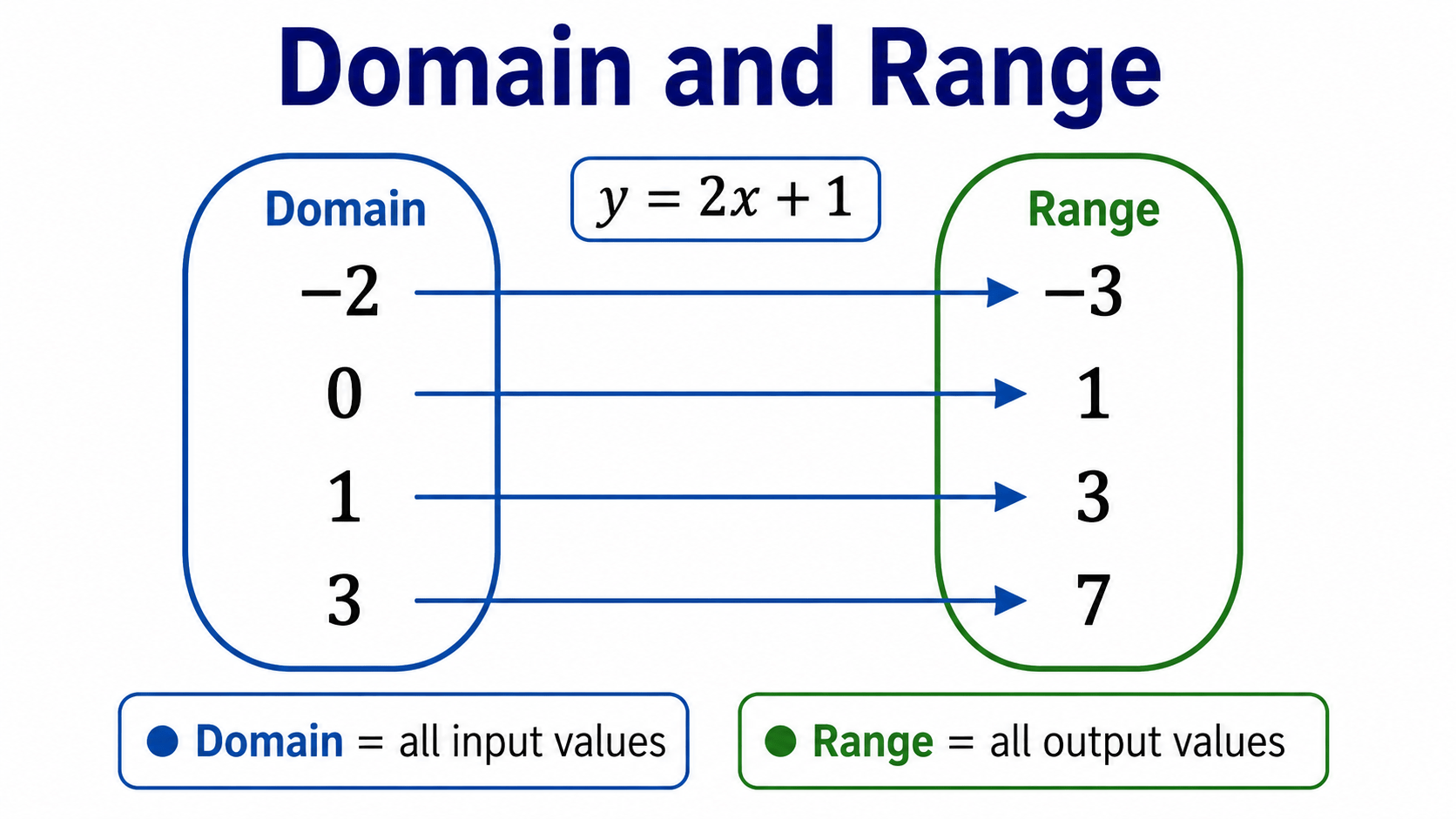
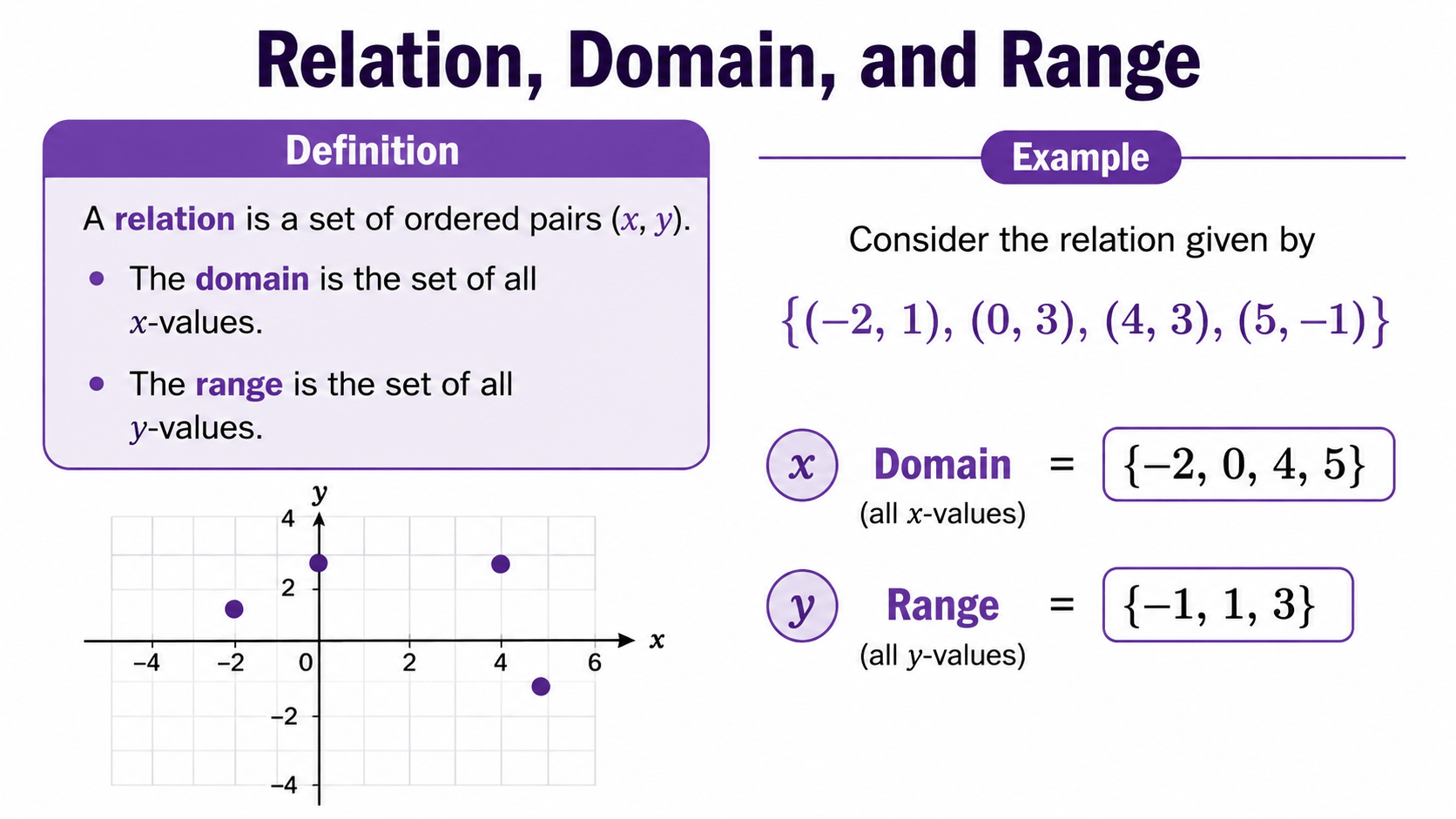
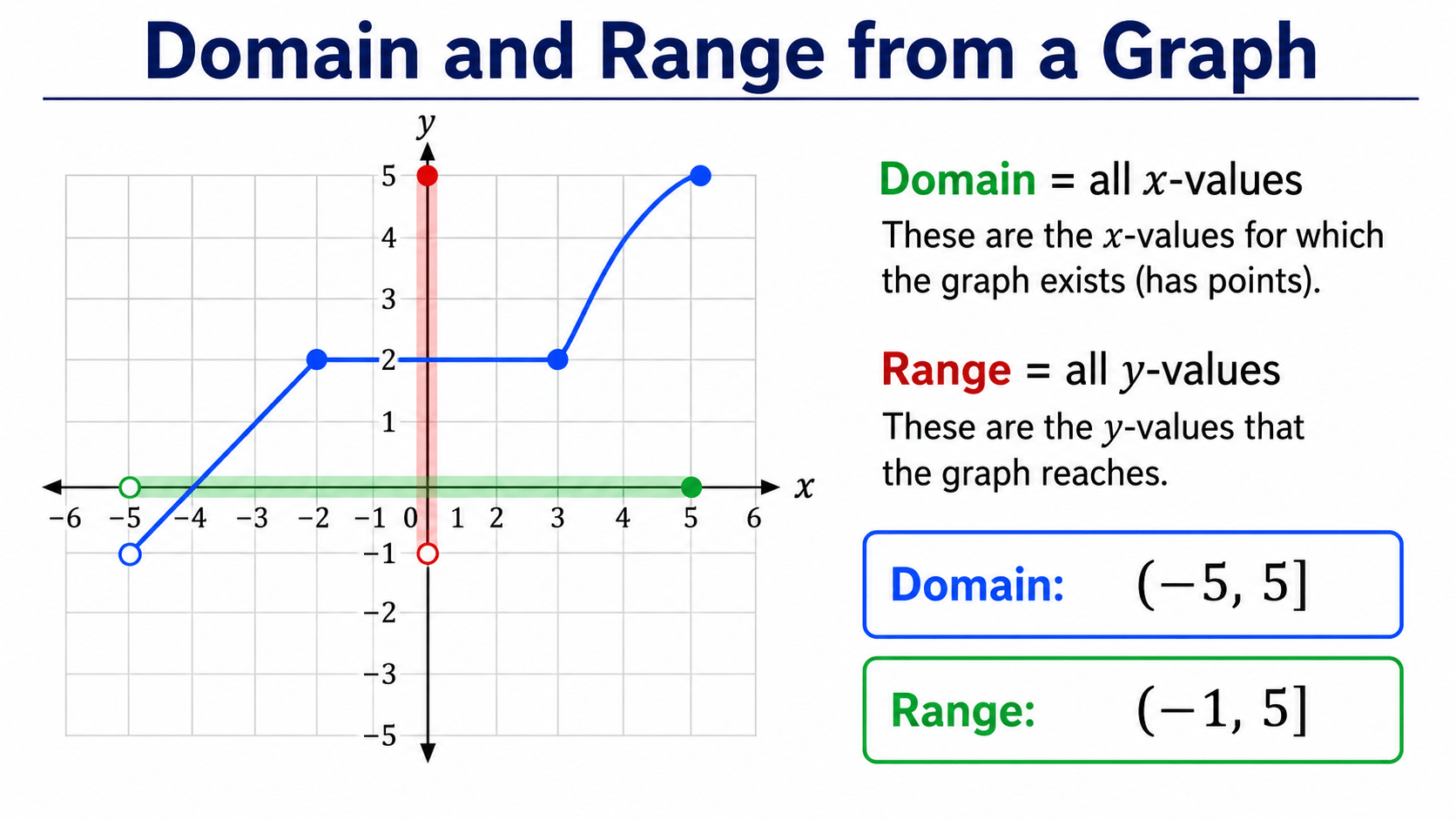
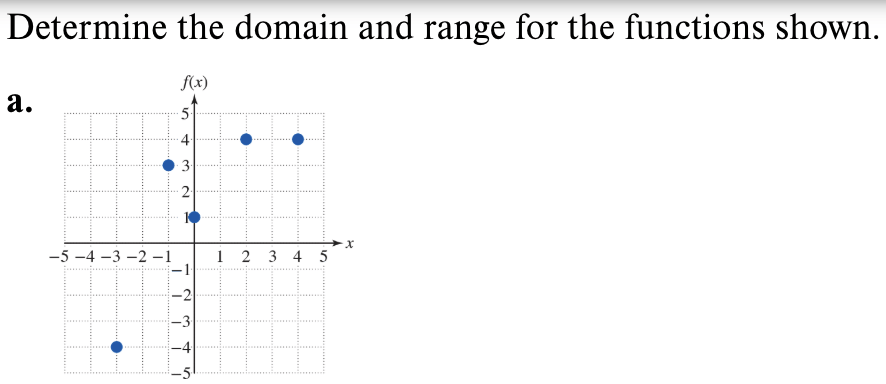
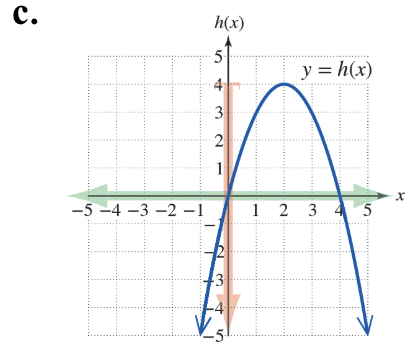
Let's start by revisiting this idea of domain and range:
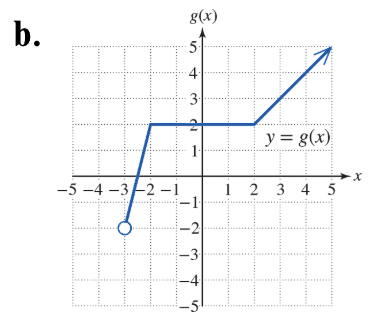
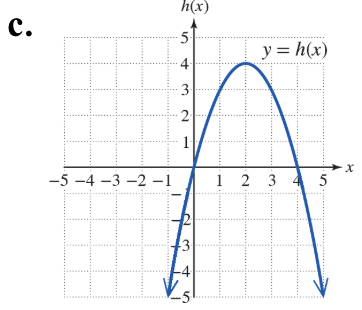
Classwork
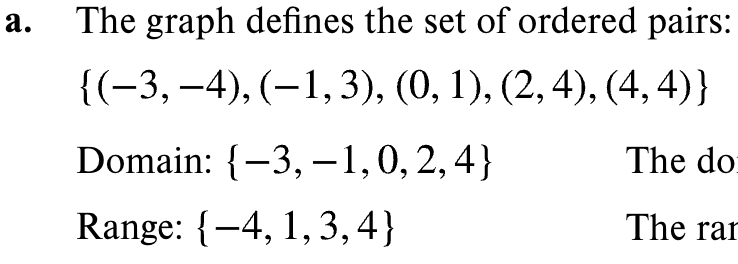
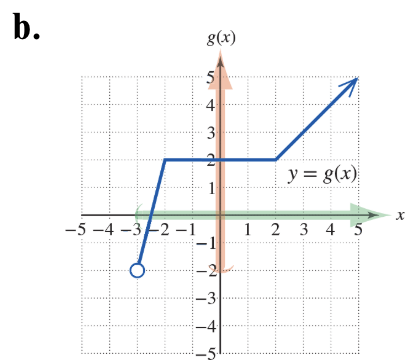
Next, let's look at determining the domain and range algebraically
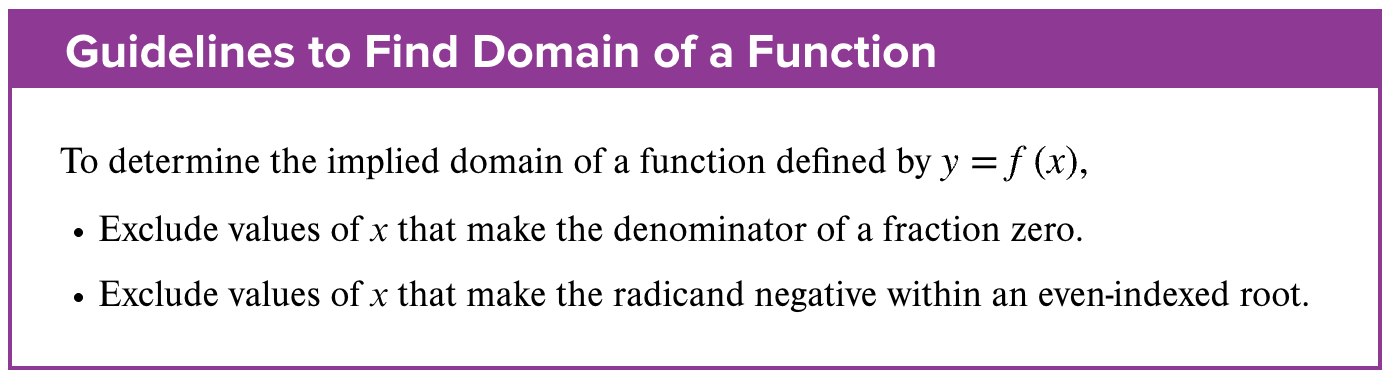
Ex.:
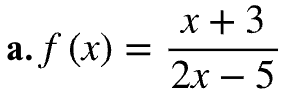
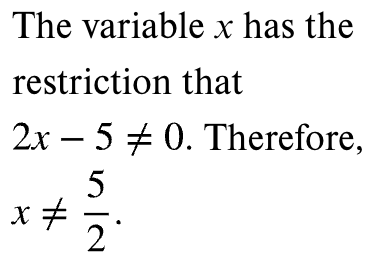
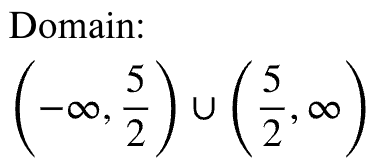
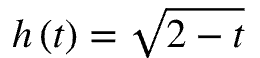
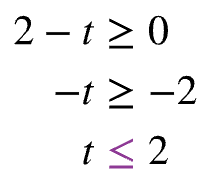
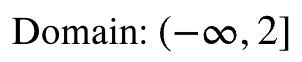
Classwork
1. \(g(x)=\frac{x}{x^2+4}\)
2. \(m(a)=|4+a|\)
3. \(k(x)=\sqrt{x+3}\)
4. \(g(x)=\frac{x^2}{5}\)
1. \(g(x)=\frac{x}{x^2+4}\)
The denominator cannot equal \(0\).
\(x^2+4 \neq 0\)
Since \(x^2+4\) is always positive, there are no restrictions.
Domain: \((-\infty,\infty)\)
2. \(m(a)=|4+a|\)
Absolute value functions are defined for all real numbers.
Domain: \((-\infty,\infty)\)
3. \(k(x)=\sqrt{x+3}\)
The expression inside the square root must be greater than or equal to \(0\).
\(x+3 \geq 0\)
\(x \geq -3\)
Domain: \([-3,\infty)\)
4. \(g(x)=\frac{x^2}{5}\)
There are no variables in the denominator and no square roots.
Domain: \((-\infty,\infty)\)
Next, let's revisit x and y intercepts
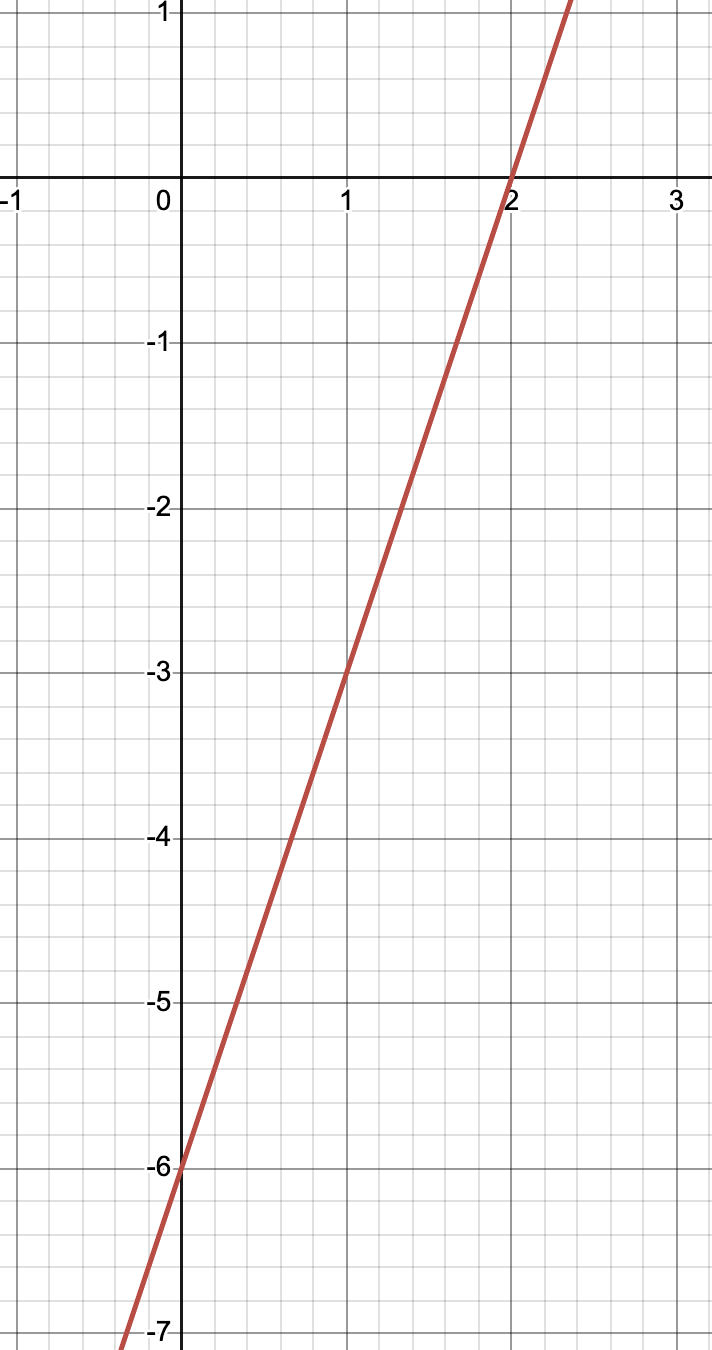
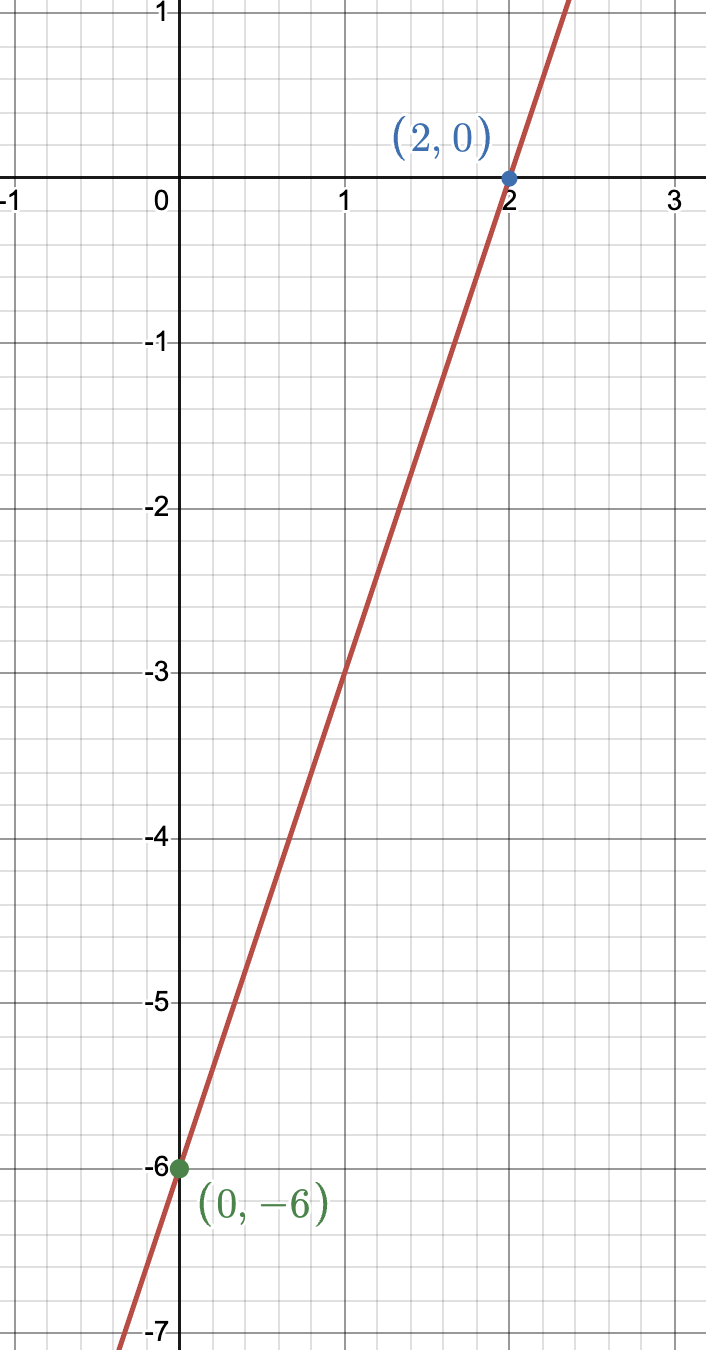
\(y=3x-6\)
Recall that, to find the y-intercept, we set \(x=0\)
The \(y\)-intercept is where the graph crosses the \(y\)-axis.
\(y=3x-6\)
Recall that, to find the y-intercept, we set \(x=0\)
The \(y\)-intercept is where the graph crosses the \(y\)-axis.
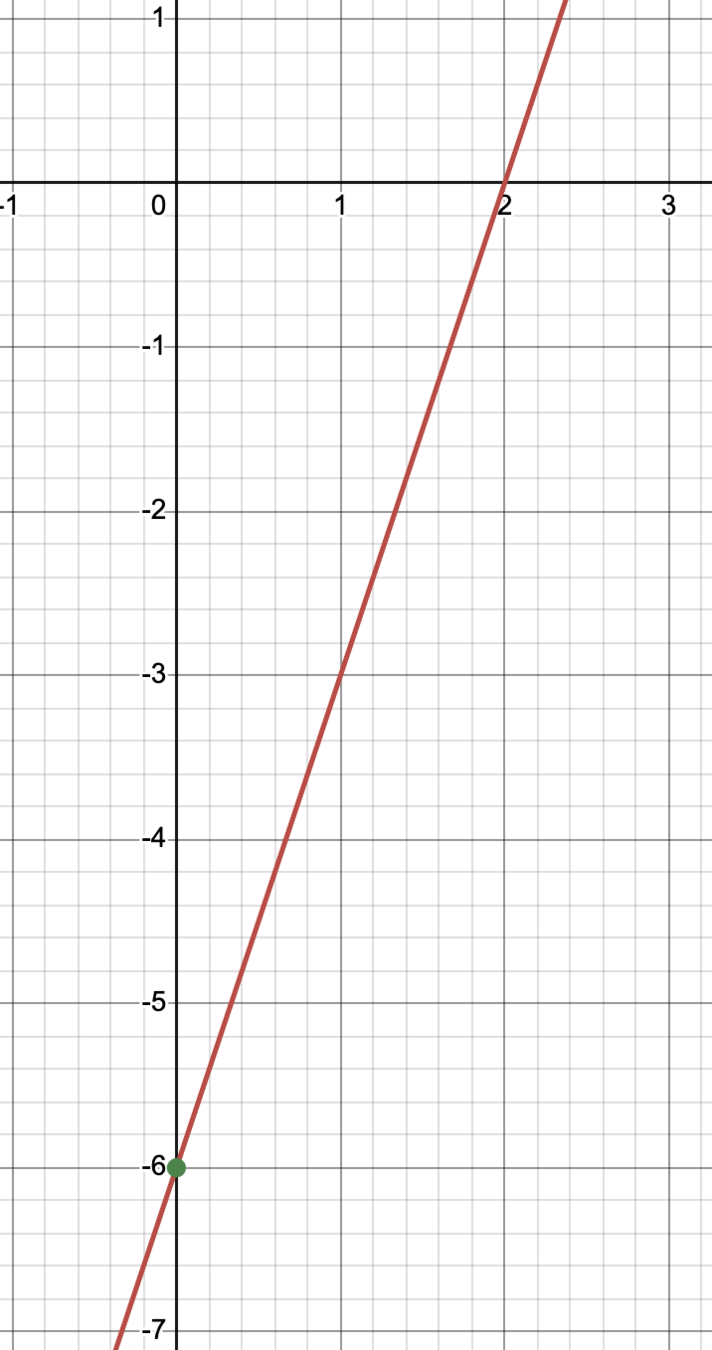
\(y=3(0)-6\)
\(y=-6\)
So the \(y\)-intercept is: \((0,-6)\)
\(y=3x-6\)
Recall that, to find the y-intercept, we set \(x=0\)
The \(y\)-intercept is where the graph crosses the \(y\)-axis.
\(y=3(0)-6\)
\(y=-6\)
So the \(y\)-intercept is: \((0,-6)\)
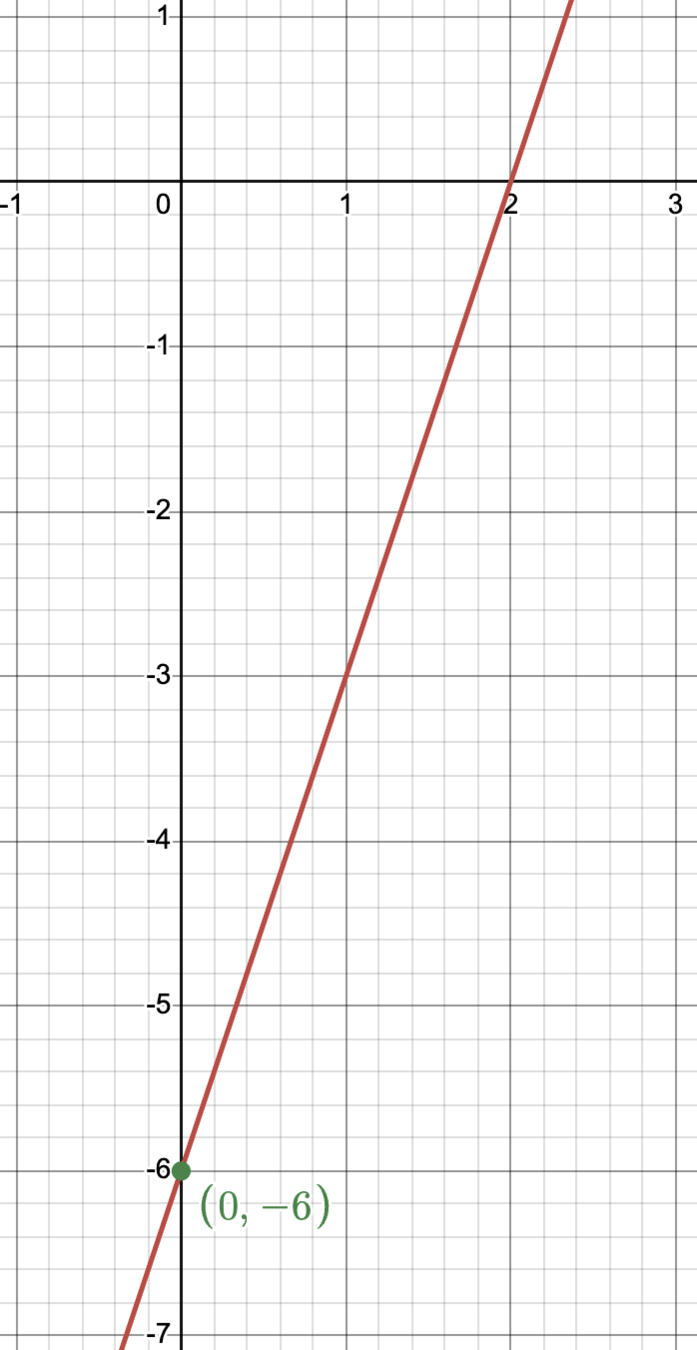
\(y=3x-6\)
We could also ask: where does the graph intercept the x-axis?
\(y=3x-6\)
We could also ask: where does the graph intercept the x-axis?
This is called the x-intercept
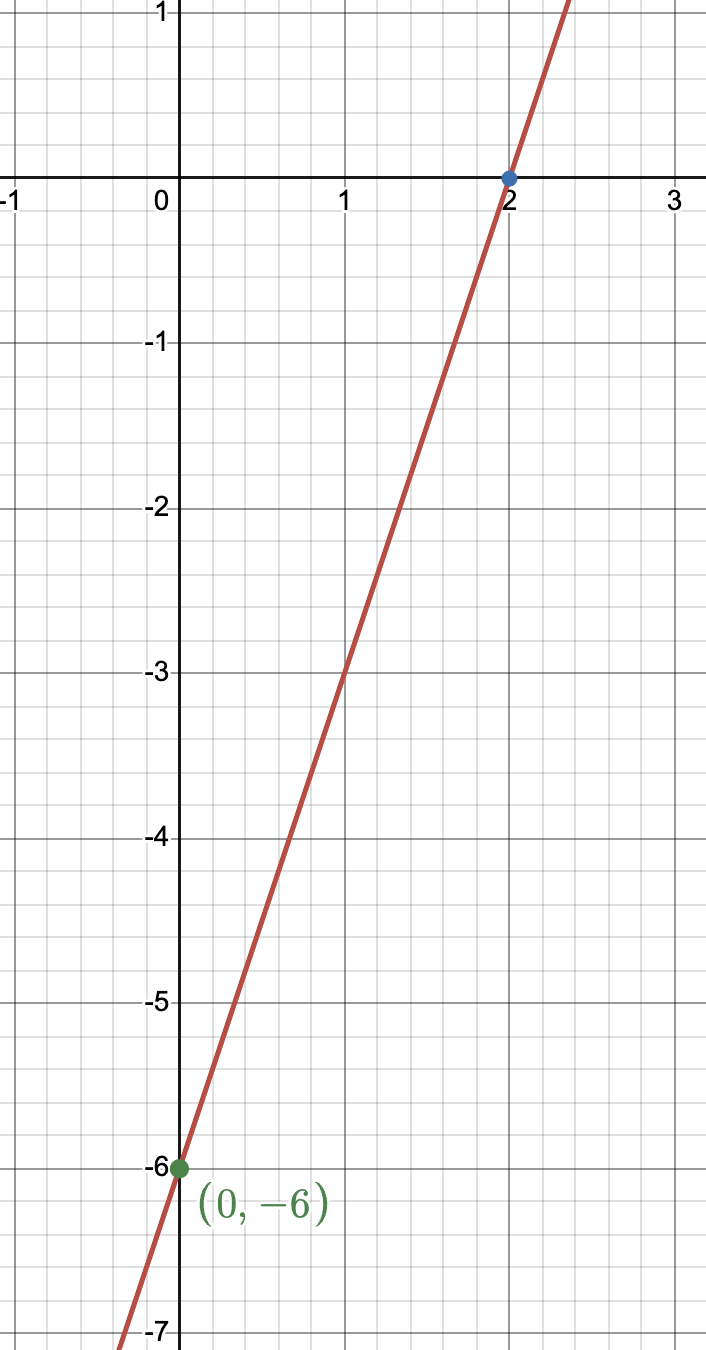
To find the x-intercept, we set \(y=0\)
\(0=3x-6\)
\(x=2\)
So the x-intercept is \((2,0)\)
\(y=3x-6\)
We could also ask: where does the graph intercept the x-axis?
This is called the x-intercept
To find the x-intercept, we set \(y=0\)
\(0=3x-6\)
\(x=2\)
So the x-intercept is \((2,0)\)
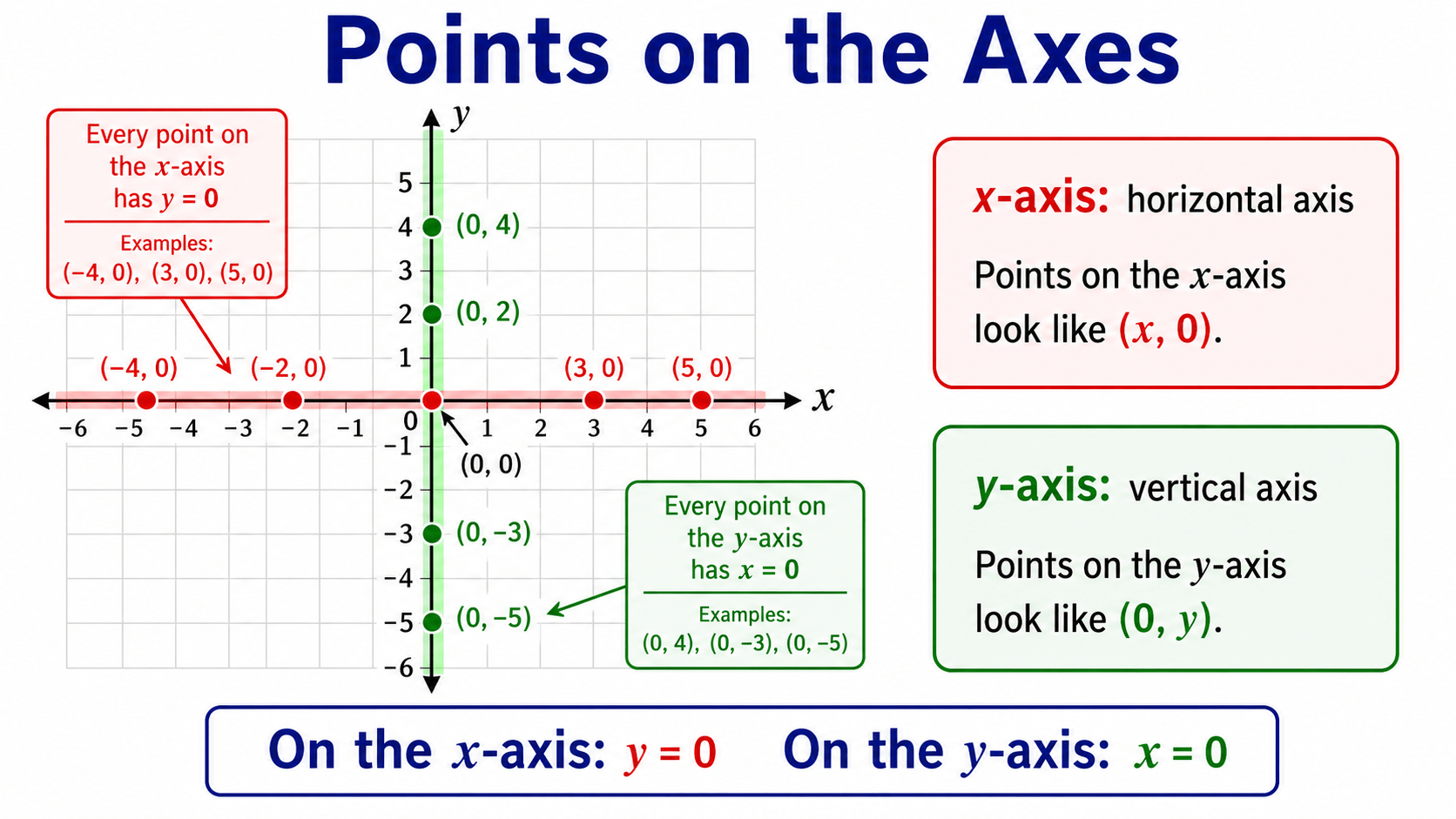
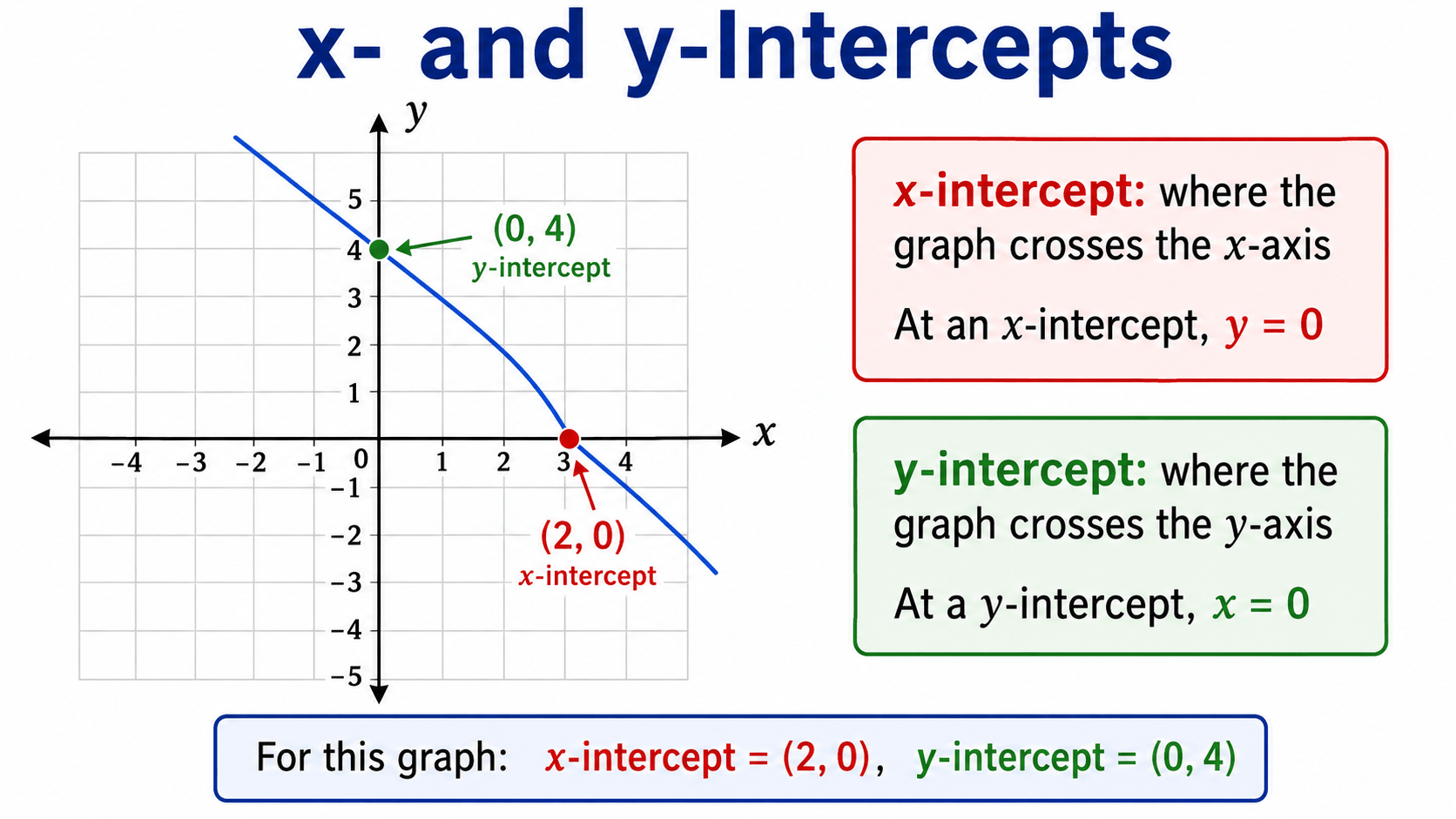
Note that, using function notation, \(y=f(x)\)
So finding the x-intercept is the same as setting \(y=f(x)=0\)
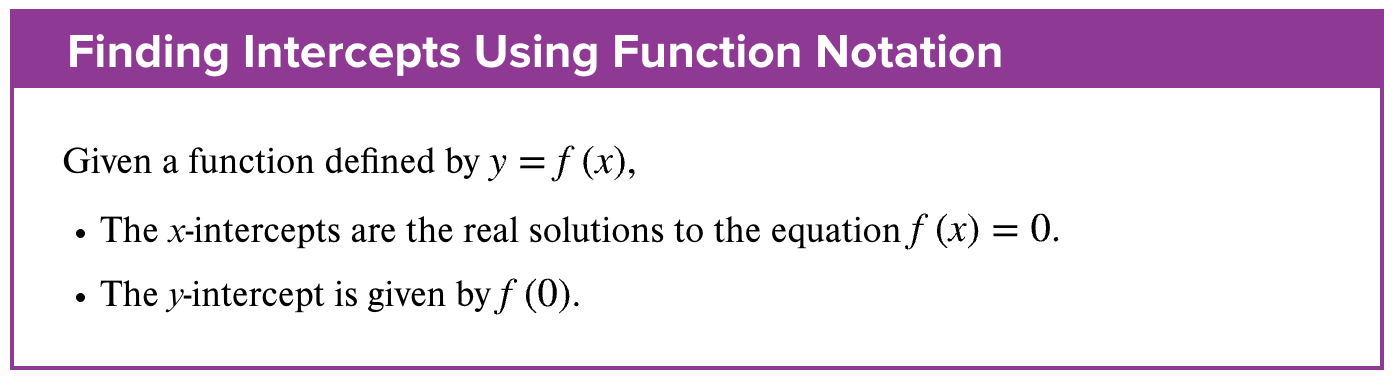

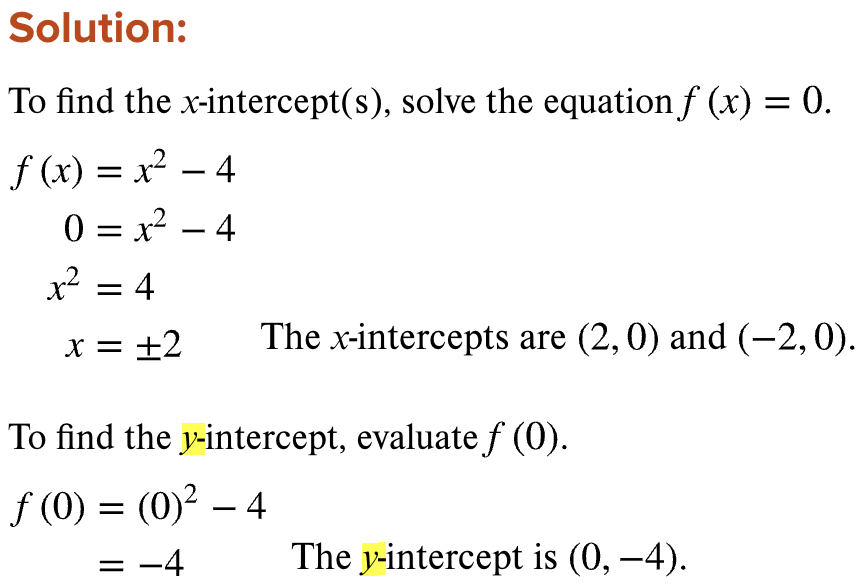
Finding the x-intercept of quadratics should look familiar...
Setting \(f(x)=0\) is exactly how we solved for x using the zero product property...
So when we solved for x, we were finding the x-intercepts without knowing it
Classwork
Directions: Find the \(x\)-intercept(s) and \(y\)-intercept for each function.
1. \(y=2x-8\)
3. \(3x+2y=12\)
5. \(y=-4\)
2. \(f(x)=x^2-25\)
4. \(g(x)=x^2-5x+6\)
6. \(h(x)=2x^2+7x+3\)
Solving Inequalities
Solving inequalities is often a lot like solving equations...
Goal: isolate the variable
Ex:
\(2x-5<7\)
Add \(5\) to both sides:
\(2x<12\)
Divide by \(2\):
\(x<6\)
Solving inequalities is often a lot like solving equations...
Goal: isolate the variable
Important Rule
Most steps work the same way as equations.
You can add, subtract, multiply, or divide both sides.
Solving inequalities is often a lot like solving equations...
Goal: isolate the variable
Important Rule
Most steps work the same way as equations.
You can add, subtract, multiply, or divide both sides.
But there is one special rule:
When you multiply or divide by a negative, flip the inequality sign.
Solving inequalities is often a lot like solving equations...
Goal: isolate the variable
But there is one special rule:
When you multiply or divide by a negative, flip the inequality sign.
Ex:
\(-3x \geq 12\)
Divide both sides by \(-3\).
Since we divided by a negative, flip the sign:
\(x \leq -4\)
Solving Compound Inequalities
Sometimes the variable is between two numbers.
Ex:
Solve:
\(2<3x-1<11\)
Add \(1\) to all three parts:
\(3<3x<12\)
Divide all three parts by \(3\):
\(1<x<4\)
When solving a compound inequality, do the same operation to all three parts.
Solving Compound Inequalities
Sometimes the variable is between two numbers.
Be careful when you multiply or divide by a negative.
Ex:
\(-2 < -3x + 1 < 10\)
Subtract \(1\) from all three parts:
\(-3 < -3x < 9\)
Divide all three parts by \(-3\).
Since we divided by a negative, flip both inequality signs:
\(1 > x > -3\)
Classwork
Solve each inequality. Write your answer in interval notation.
1. \(3x-7<11\)
2. \(-2x+5\geq 13\)
3. \(4\leq x+9<12\)
4. \(-6<-2x-4\leq 8\)
5. \(x^2\leq 25\)
6. \(\sqrt{x+3}>4\)
Graphing Quadratics
In order to uniquely describe the graph of a linear function we needed either:
1. 2 points on the line
2. A slope and y-intercept
3. A slope and a point on the line
What would we need to uniquely describe the graph of a quadratic function?
The graph of a quadratic function is called a parabola
A parabola is a symmetric, U-shaped curve
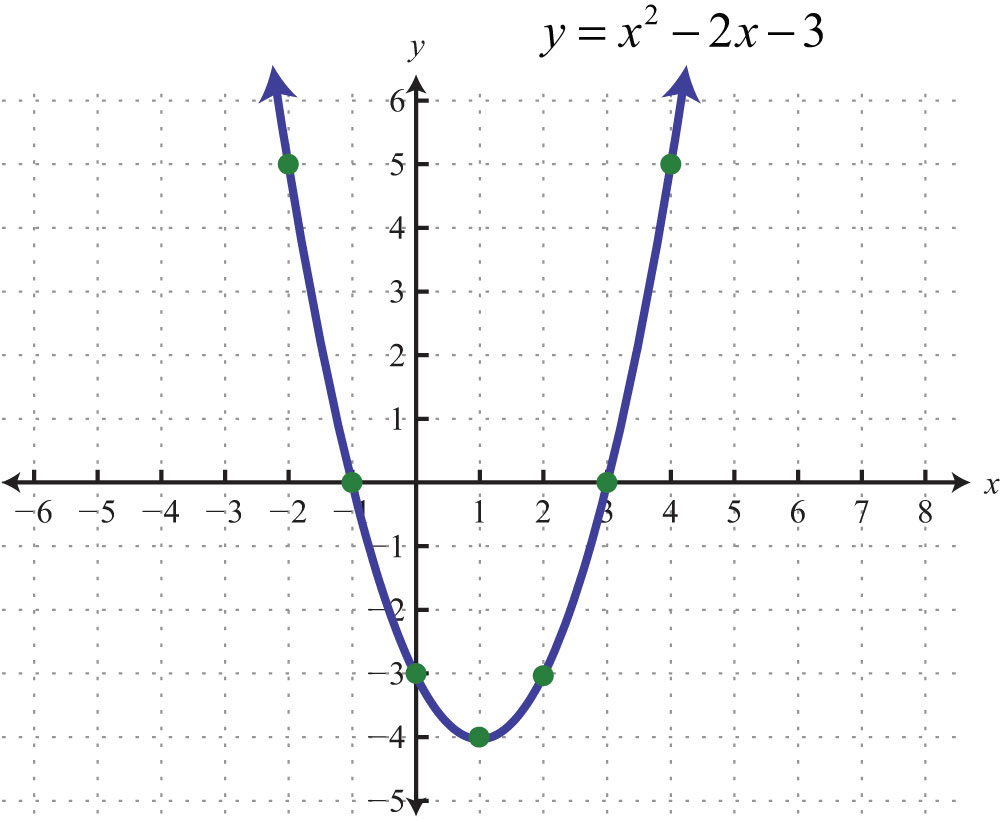
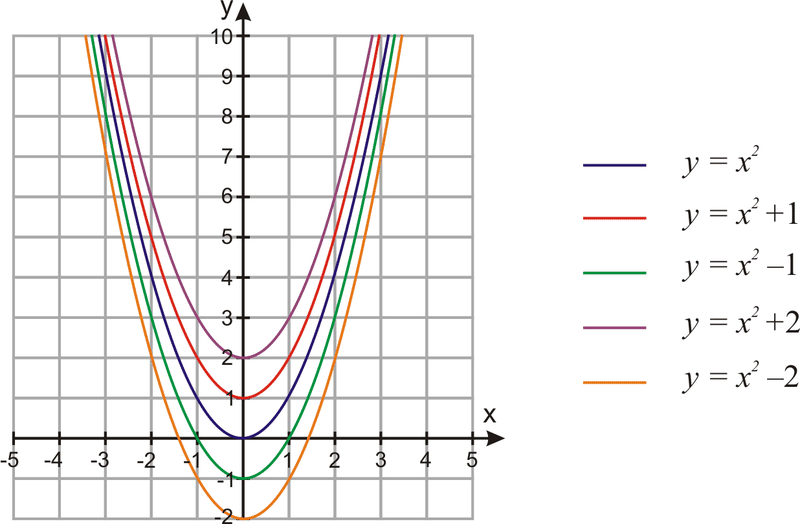
They can be shifted up and down
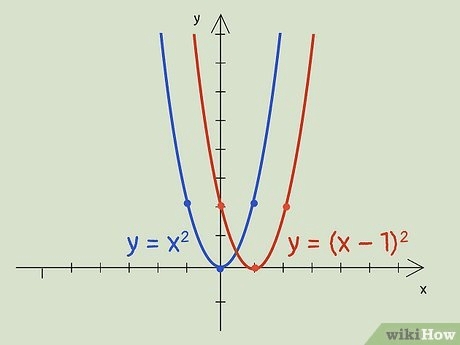
Shifted left and right
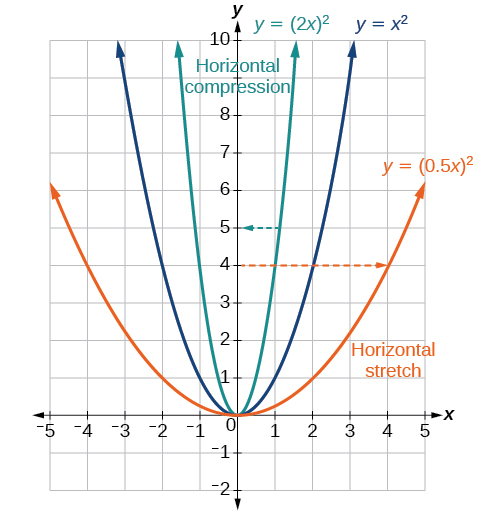
Stretched and compressed
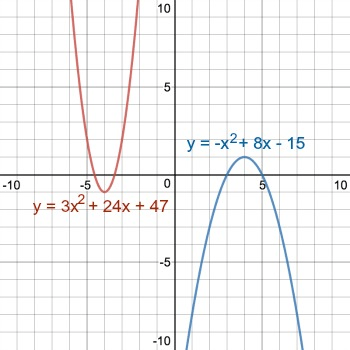
Flipped upside down
We've already seen that we can find the x and y intercepts of a quadratic function
What features of a parabola can we talk about?
3 more features of the parabola are called:
1. The Vertex
2. The Axis of Symmetry
3. Concavity
- The vertex is a point lying on the intersection of the parabola and the axis of symmetry corresponding to either the minimum (graph opens up) or the maximum (graph opens down) y-value attained by the parabola
- The axis of symmetry is the imaginary line that divides a parabola into two perfectly symmetrical mirror images.
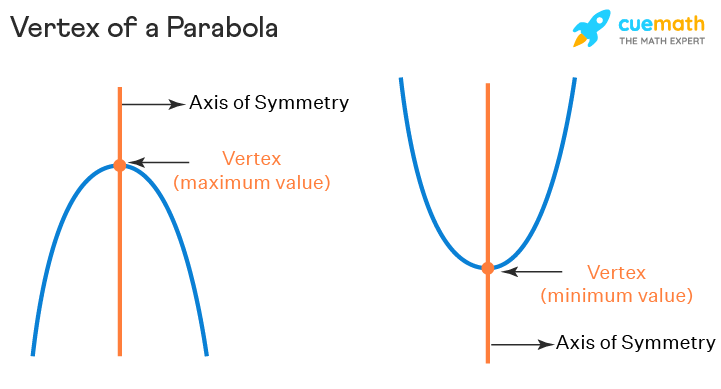
- Concavity just refers to whether a parabola opens up or down
Opens Up
Opens Down
Can we describe these features algebraically?
Recall the standard form for a quadratic function:
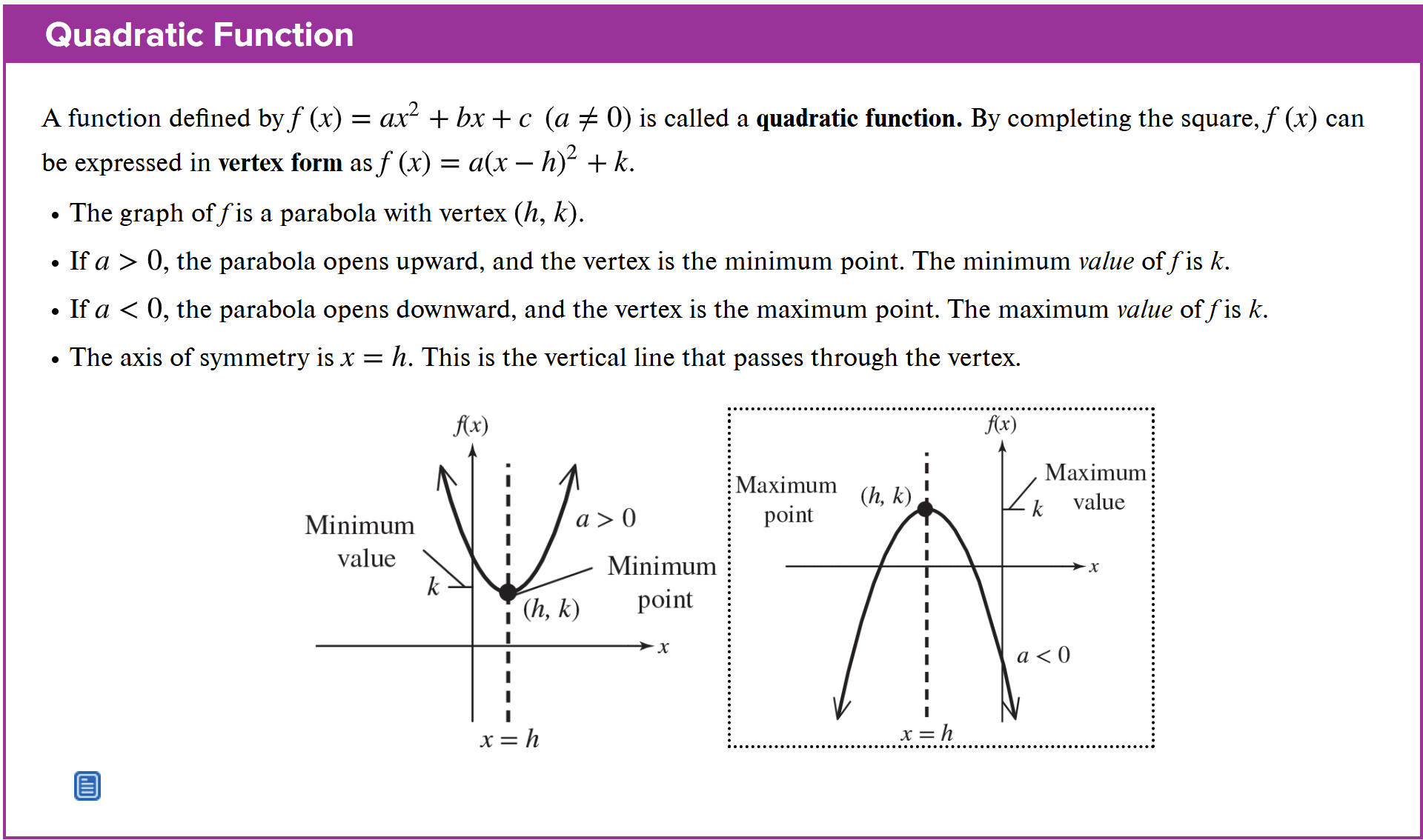
If \(a>0\), then the parabola opens upward and the vertex is the minimum point .
\(ax^2+bx+c\)
If \(a<0\), then the parabola opens downward and the vertex is the maximum point.
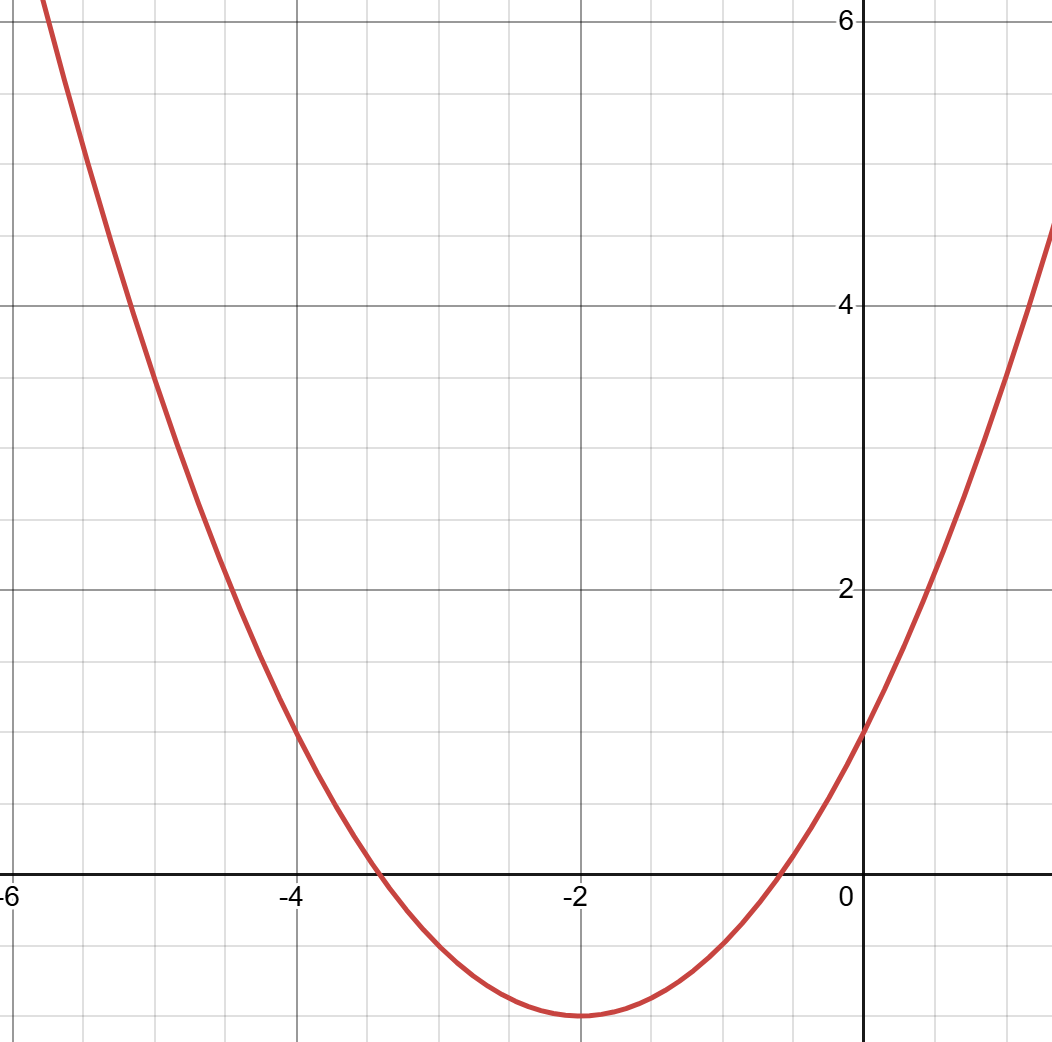
\(y=.5x^2+2x+1\)
\(a=.5>0\)
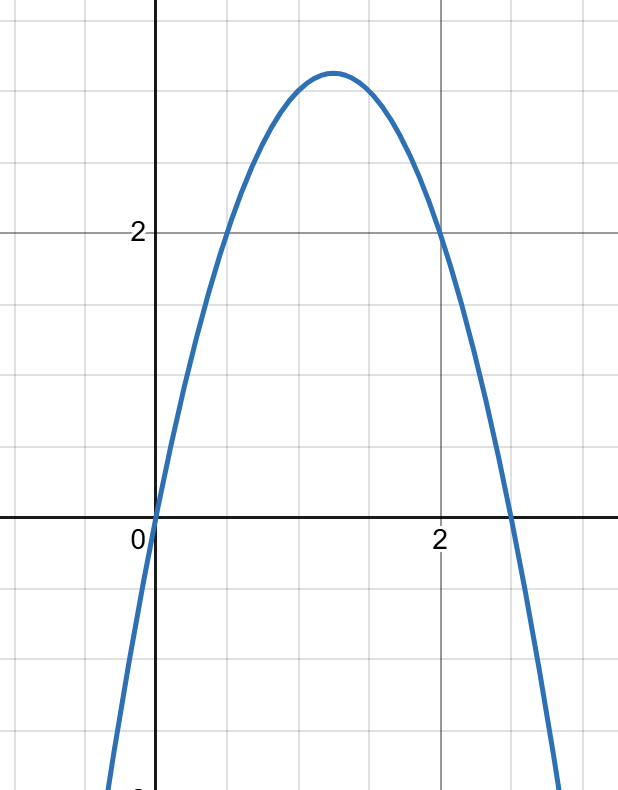
\(y=-2x^2+5x\)
\(a=-2<0\)
Text
Vertex is the minimum point
Vertex is the maximum point
The vertex and axis of symmetry don't appear explicitly in standard form:
\(ax^2+bx+c\)
However, just like we had point-slope and slope-intercept forms of linear functions, we have alternative forms of quadratic functions
Ex.:
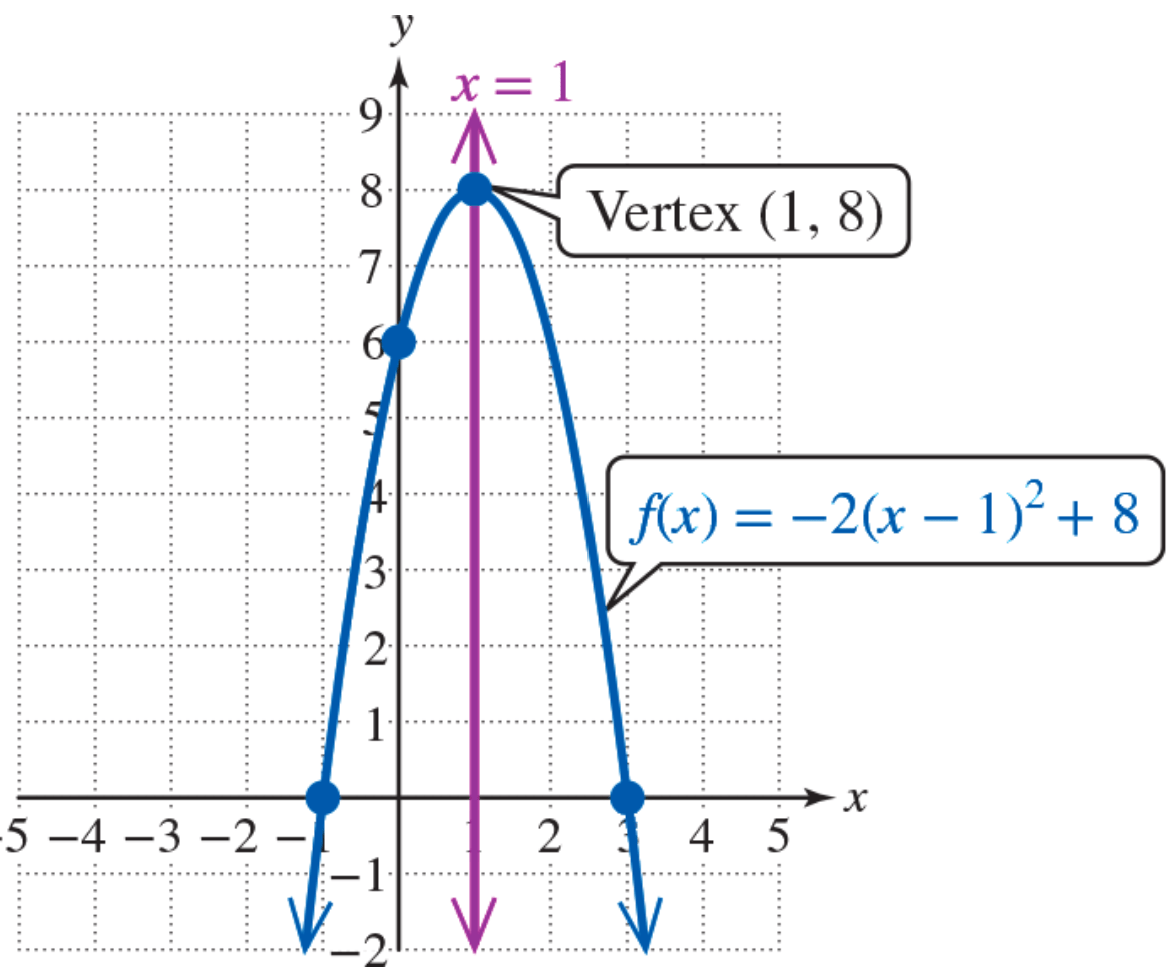
\(f(x)=-2\left(x-1\right)^{2}+8\)
Consider the quadratic function given in vertex form by:
Ex.:
\(f(x)=-2\left(x-1\right)^{2}+8=a(x-h)^2+k\)
Consider the quadratic function given in vertex form by:
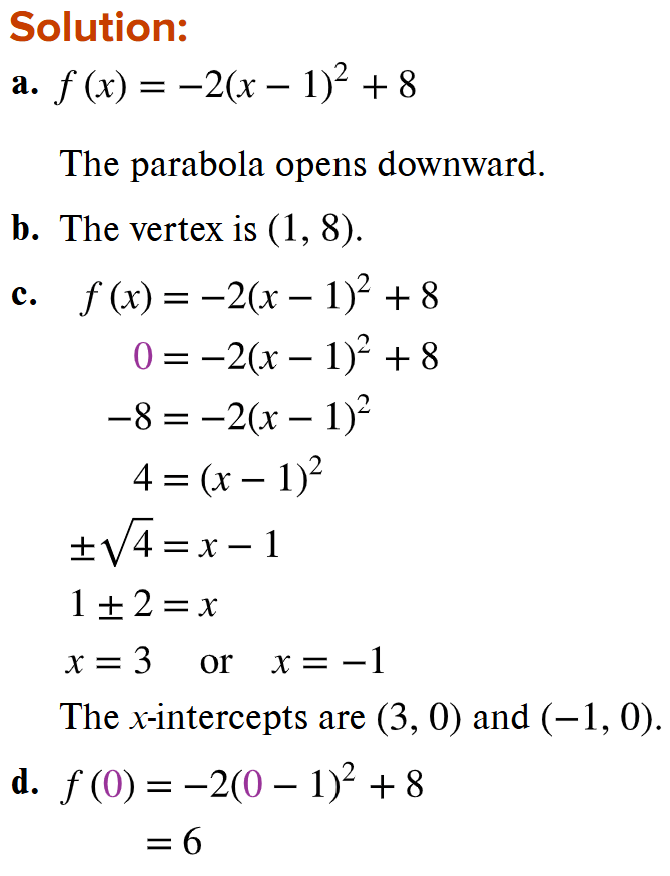
\(a=-2<0\)
\((h,k)=(1,8)\)

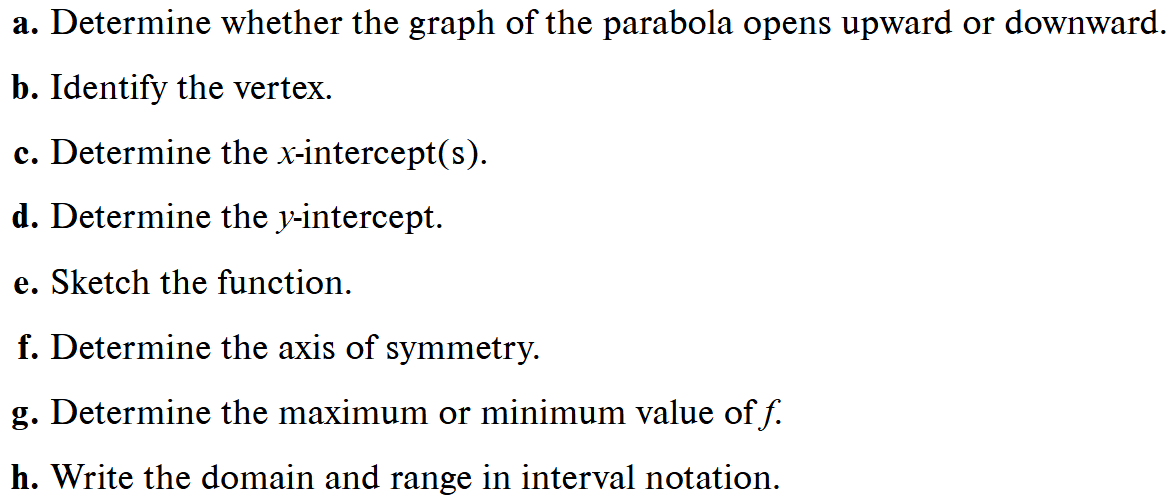
e.
Classwork:
h. Write the domain and range in interval notation.
1. Given \(f(x)=3(x+2)^2-12\),
a. Determine whether the graph of the parabola opens upward or downward.
b. Identify the vertex.
c. Determine the \(x\)-intercept(s).
d. Determine the \(y\)-intercept.
e. Sketch the function.
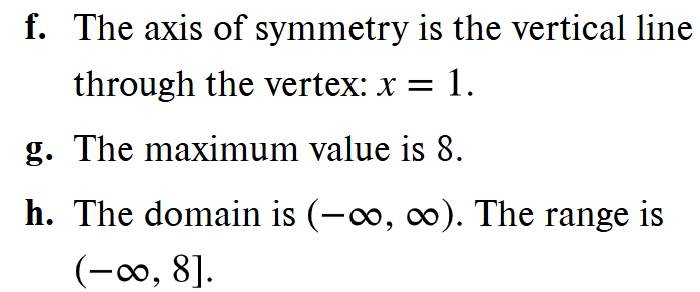
f. Determine the axis of symmetry.
g. Determine the maximum or minimum value of \(f\).
2. Given \(g(x)=-(x-4)^2+9\),
h. Write the domain and range in interval notation.
a. Determine whether the graph of the parabola opens upward or downward.
b. Identify the vertex.
c. Determine the \(x\)-intercept(s).
d. Determine the \(y\)-intercept.
e. Sketch the function.
f. Determine the axis of symmetry.
g. Determine the maximum or minimum value of \(f\).
What do we do when we are asked to graph a quadratic function given in standard form?
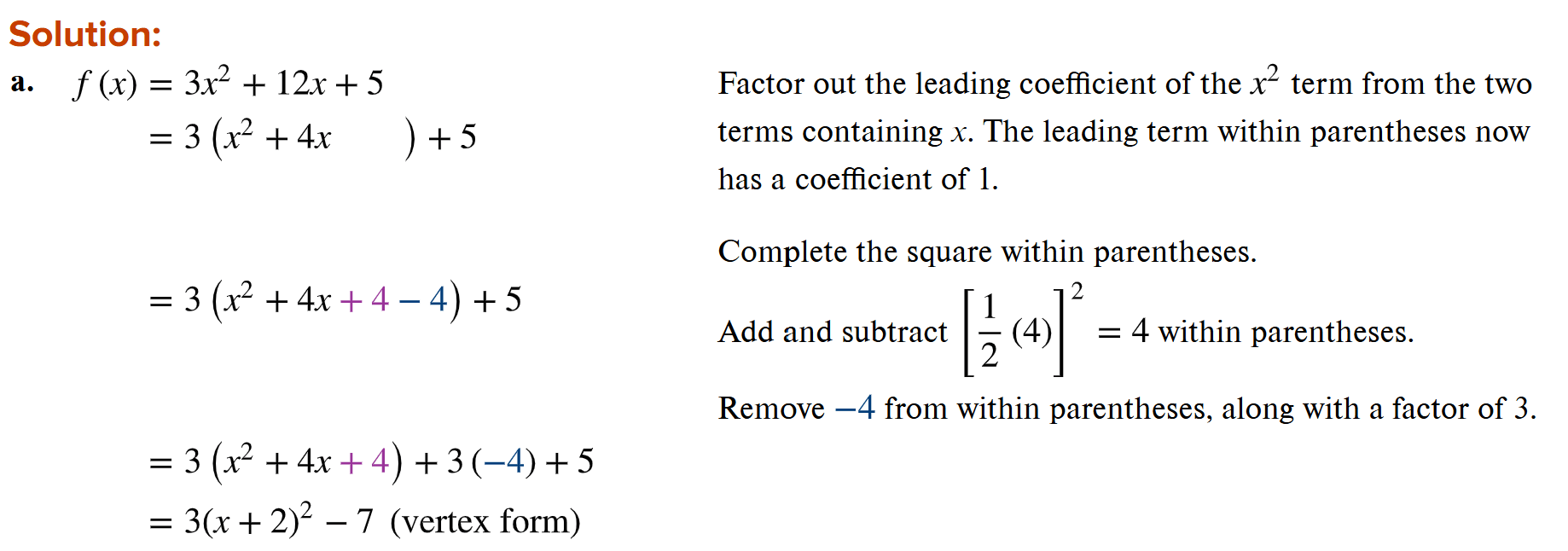
One option is that we can algebraically convert standard form to vertex form
To do this, we are going to use a similar method to completing the square

Ex.:
Classwork:
Directions: Rewrite each quadratic function in vertex form by completing the square.
1. \(f(x)=x^2+6x+4\)
2. \(g(x)=x^2-8x+11\)
3. \(h(x)=x^2+10x-3\)
4. \(p(x)=2x^2+12x+5\)
5. \(q(x)=-x^2+4x+7\)
6. \(r(x)=3x^2-18x+2\)
1. \(f(x)=x^2+6x+4\)
\(f(x)=(x^2+6x)+4\)
Take half of \(6\), then square it:
\(\left(\frac{6}{2}\right)^2=9\)
\(f(x)=(x^2+6x+9)-9+4\)
\(f(x)=(x+3)^2-5\)
2. \(g(x)=x^2-8x+11\)
\(g(x)=(x^2-8x)+11\)
Take half of \(-8\), then square it:
\(\left(\frac{-8}{2}\right)^2=16\)
\(g(x)=(x^2-8x+16)-16+11\)
\(g(x)=(x-4)^2-5\)
3. \(h(x)=x^2+10x-3\)
\(h(x)=(x^2+10x)-3\)
Take half of \(10\), then square it:
\(\left(\frac{10}{2}\right)^2=25\)
\(h(x)=(x^2+10x+25)-25-3\)
\(h(x)=(x+5)^2-28\)
4. \(p(x)=2x^2+12x+5\)
Factor \(2\) from the \(x\)-terms:
\(p(x)=2(x^2+6x)+5\)
Take half of \(6\), then square it:
\(\left(\frac{6}{2}\right)^2=9\)
\(p(x)=2(x^2+6x+9)-2(9)+5\)
\(p(x)=2(x+3)^2-18+5\)
\(p(x)=2(x+3)^2-13\)
5. \(q(x)=-x^2+4x+7\)
Factor \(-1\) from the \(x\)-terms:
\(q(x)=-(x^2-4x)+7\)
Take half of \(-4\), then square it:
\(\left(\frac{-4}{2}\right)^2=4\)
\(q(x)=-(x^2-4x+4)+4+7\)
\(q(x)=-(x-2)^2+11\)
6. \(r(x)=3x^2-18x+2\)
Factor \(3\) from the \(x\)-terms:
\(r(x)=3(x^2-6x)+2\)
Take half of \(-6\), then square it:
\(\left(\frac{-6}{2}\right)^2=9\)
\(r(x)=3(x^2-6x+9)-3(9)+2\)
\(r(x)=3(x-3)^2-27+2\)
\(r(x)=3(x-3)^2-25\)
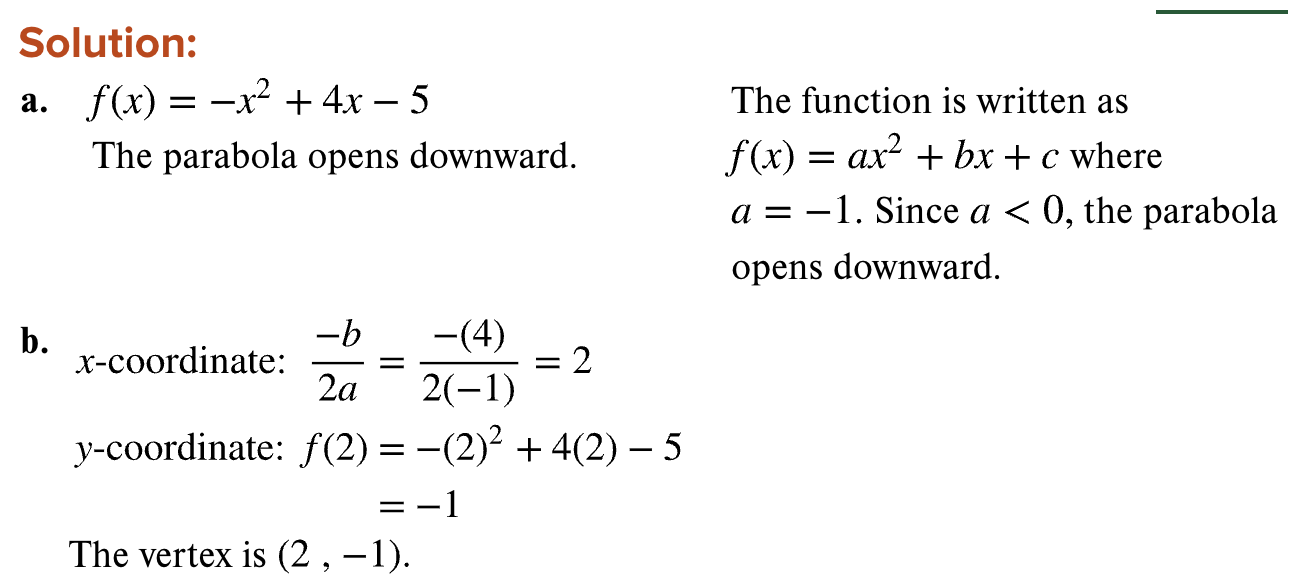
It turns out that another option for graphing a quadratic given in standard form is to use the vertex formula

Ex.:

Ex.:
Classwork
1. Given \(f(x)=x^2-6x+5\),
a. State whether the graph of the parabola opens upward or downward.
b. Determine the vertex of the parabola by using the vertex formula.
2. Given \(g(x)=-x^2+8x-10\),
a. State whether the graph of the parabola opens upward or downward.
b. Determine the vertex of the parabola by using the vertex formula.
3. Given \(h(x)=2x^2+12x+7\),
a. State whether the graph of the parabola opens upward or downward.
b. Determine the vertex of the parabola by using the vertex formula.
4. Given \(p(x)=-3x^2-6x+4\),
a. State whether the graph of the parabola opens upward or downward.
b. Determine the vertex of the parabola by using the vertex formula.
1. \(f(x)=x^2-6x+5\)
Since \(a=1\), the graph opens upward.
\(x=\frac{-b}{2a}=\frac{-(-6)}{2(1)}=\frac{6}{2}=3\)
\(f(3)=3^2-6(3)+5\)
\(f(3)=9-18+5=-4\)
Vertex: \((3,-4)\)
4. \(p(x)=-3x^2-6x+4\)
Since \(a=-3\), the graph opens downward.
\(x=\frac{-b}{2a}=\frac{-(-6)}{2(-3)}=\frac{6}{-6}=-1\)
\(p(-1)=-3(-1)^2-6(-1)+4\)
\(p(-1)=-3+6+4=7\)
Vertex: \((-1,7)\)

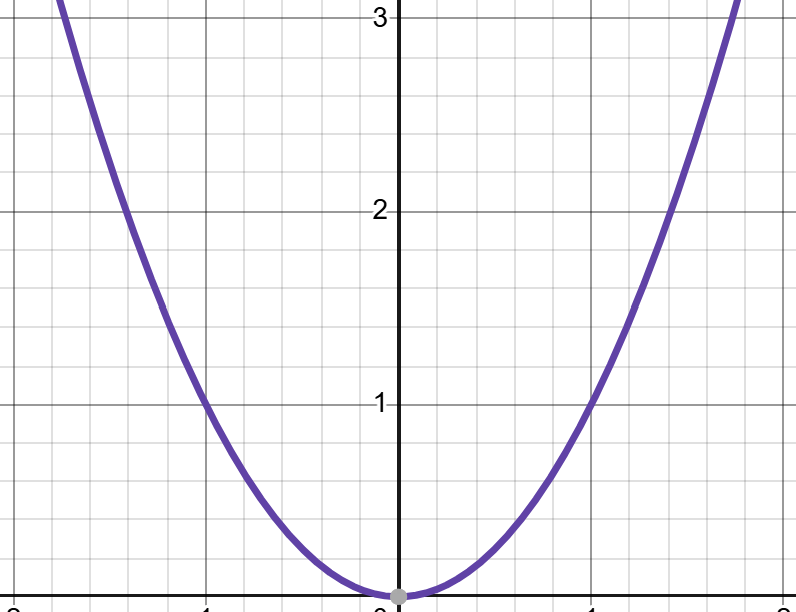
\(f(x)=x^2\)
\(b^2-4ac=0-0=0\)
One x-intercept
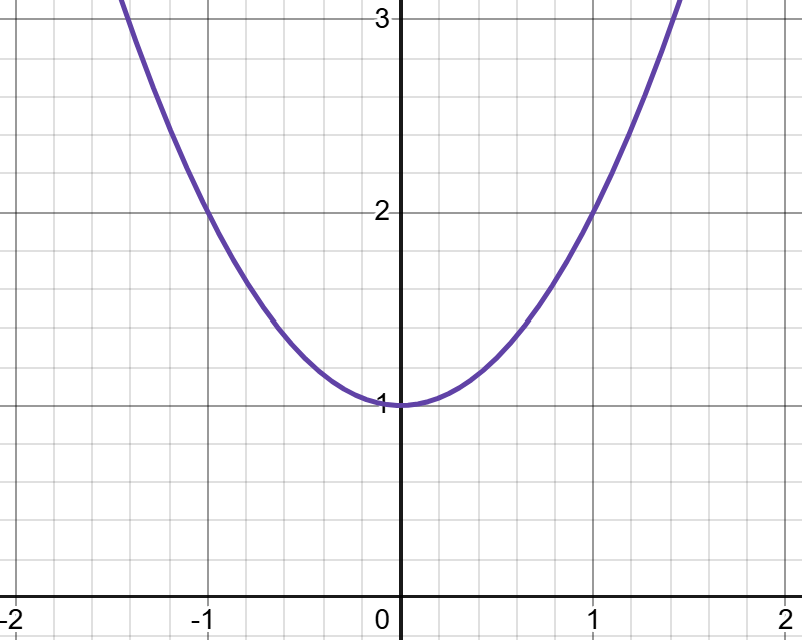
\(f(x)=x^2+1\)
\(b^2-4ac=0-1=-1<0\)
No x-intercept
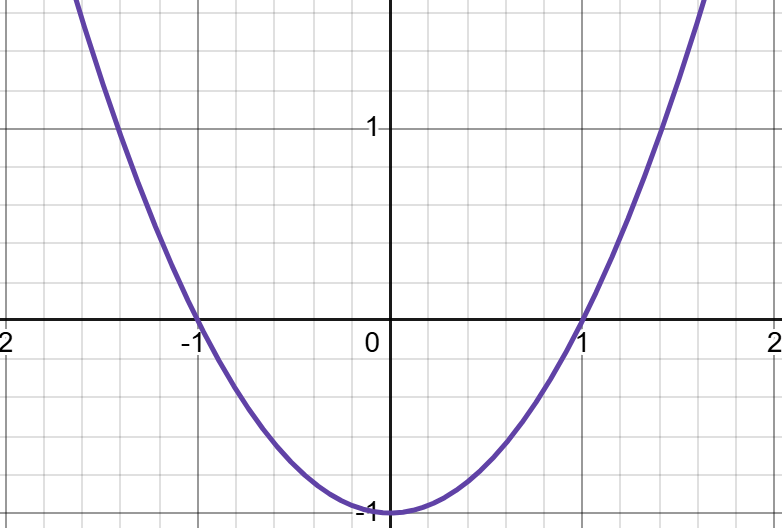
\(f(x)=x^2-1\)
\(b^2-4ac=0--11=1>0\)
2 x-intercepts
Classwork
Directions: For each quadratic function:
a. Use the discriminant to determine the number of \(x\)-intercepts.
b. Check by actually finding the \(x\)-intercept(s).
1. \(f(x)=x^2-6x+8\)
2. \(g(x)=x^2+4x+4\)
3. \(h(x)=x^2+2x+5\)
4. \(p(x)=2x^2-5x-3\)
1. \(f(x)=x^2-6x+8\)
Here, \(a=1\), \(b=-6\), and \(c=8\).
Discriminant:
\(b^2-4ac=(-6)^2-4(1)(8)\)
\(b^2-4ac=36-32\)
\(b^2-4ac=4\)
Since \(4>0\), the graph has two \(x\)-intercepts.
Now check by finding the \(x\)-intercepts:
\(0=x^2-6x+8\)
\(0=(x-2)(x-4)\)
\(x=2\) or \(x=4\)
\(x\)-intercepts: \((2,0)\) and \((4,0)\)
2. \(g(x)=x^2+4x+4\)
Here, \(a=1\), \(b=4\), and \(c=4\).
Discriminant:
\(b^2-4ac=(4)^2-4(1)(4)\)
\(b^2-4ac=16-16\)
\(b^2-4ac=0\)
Since the discriminant is \(0\), the graph has one \(x\)-intercept.
Now check by finding the \(x\)-intercept:
\(0=x^2+4x+4\)
\(0=(x+2)^2\)
\(x=-2\)
\(x\)-intercept: \((-2,0)\)
3. \(h(x)=x^2+2x+5\)
Here, \(a=1\), \(b=2\), and \(c=5\).
Discriminant:
\(b^2-4ac=(2)^2-4(1)(5)\)
\(b^2-4ac=4-20\)
\(b^2-4ac=-16\)
Since \(-16<0\), the graph has no \(x\)-intercepts.
Now check by trying to solve:
\(0=x^2+2x+5\)
Using the quadratic formula:
\(x=\frac{-2\pm\sqrt{-16}}{2}\)
Since we get a negative under the square root, there are no real solutions.
So there are no \(x\)-intercepts.
What about the variations that we saw earlier?
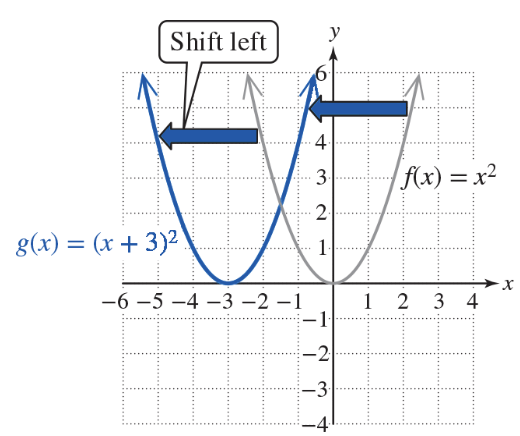
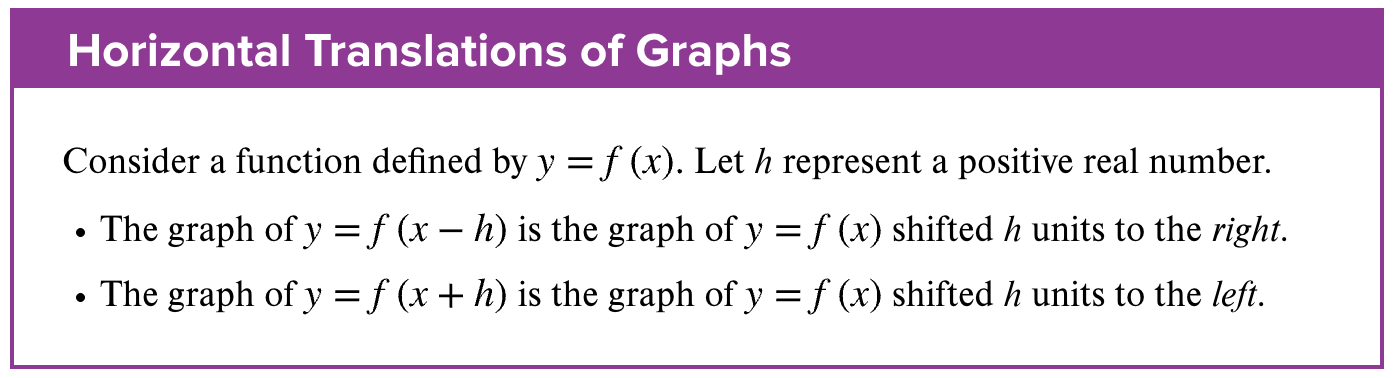
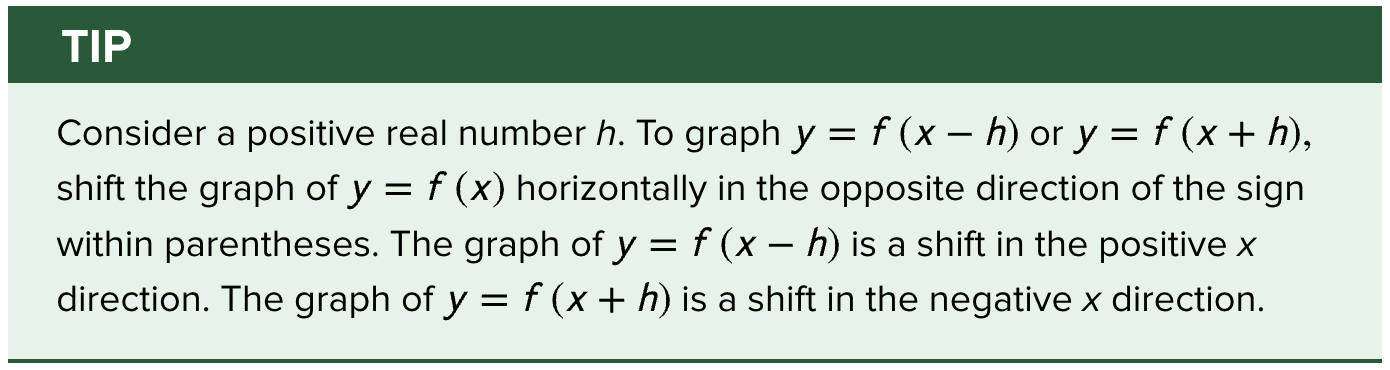
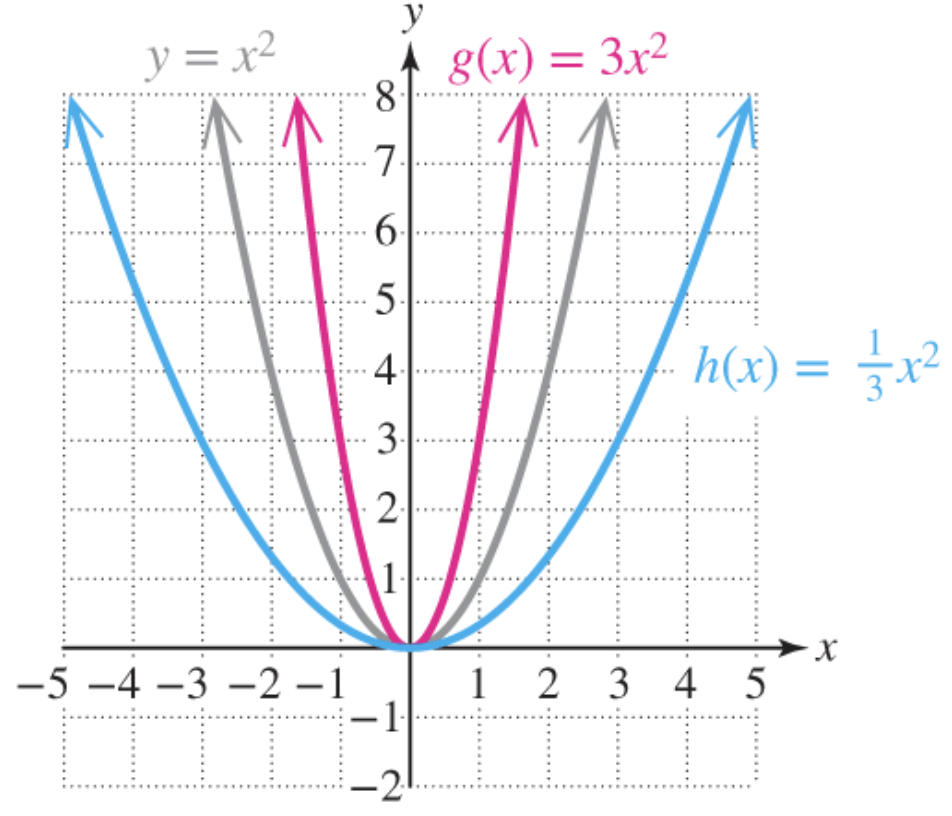
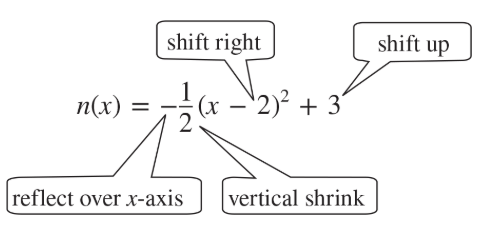
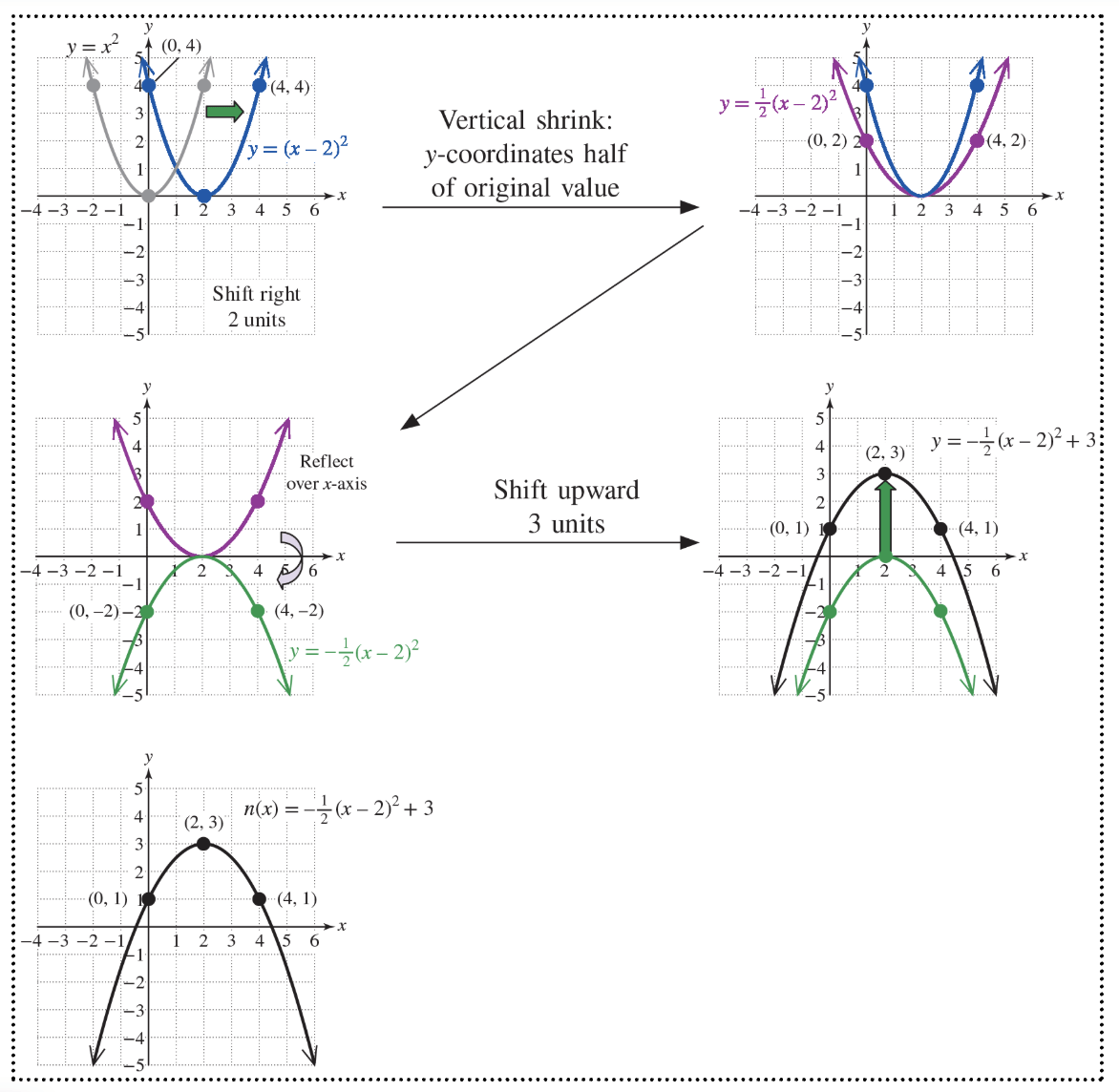
How do we know when a graph has been shifted left/right, up/down, ...?
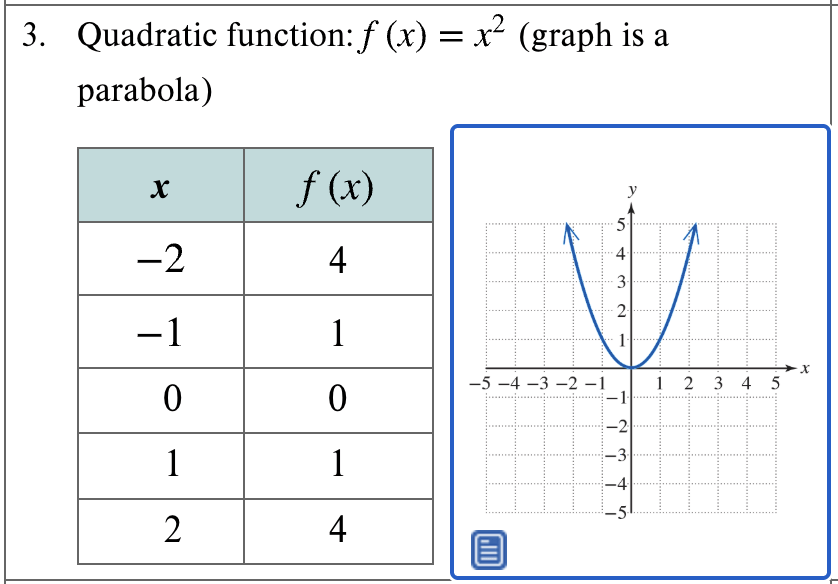
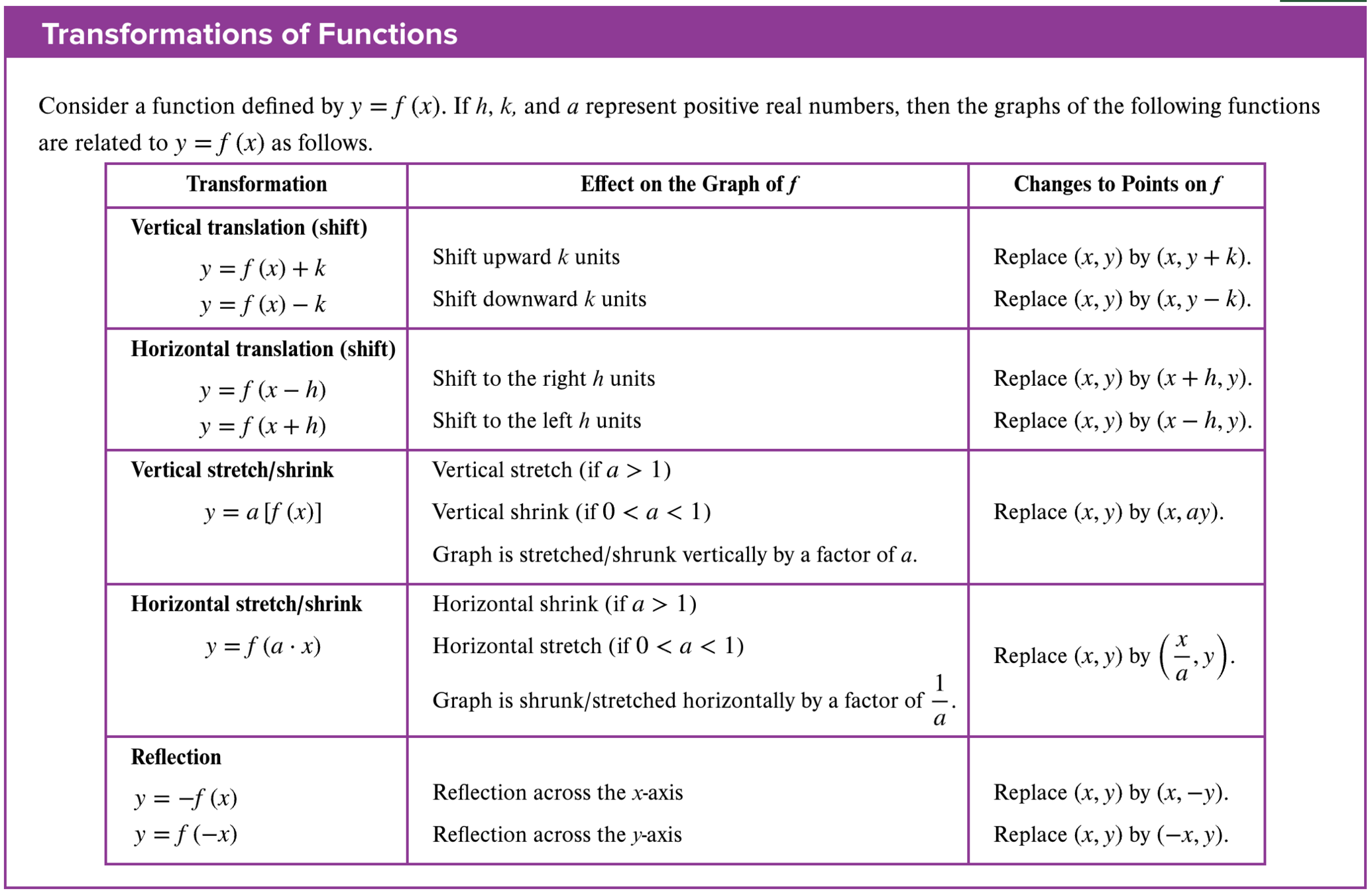
Start with the parent function
This is the simplest form of a quadratic function
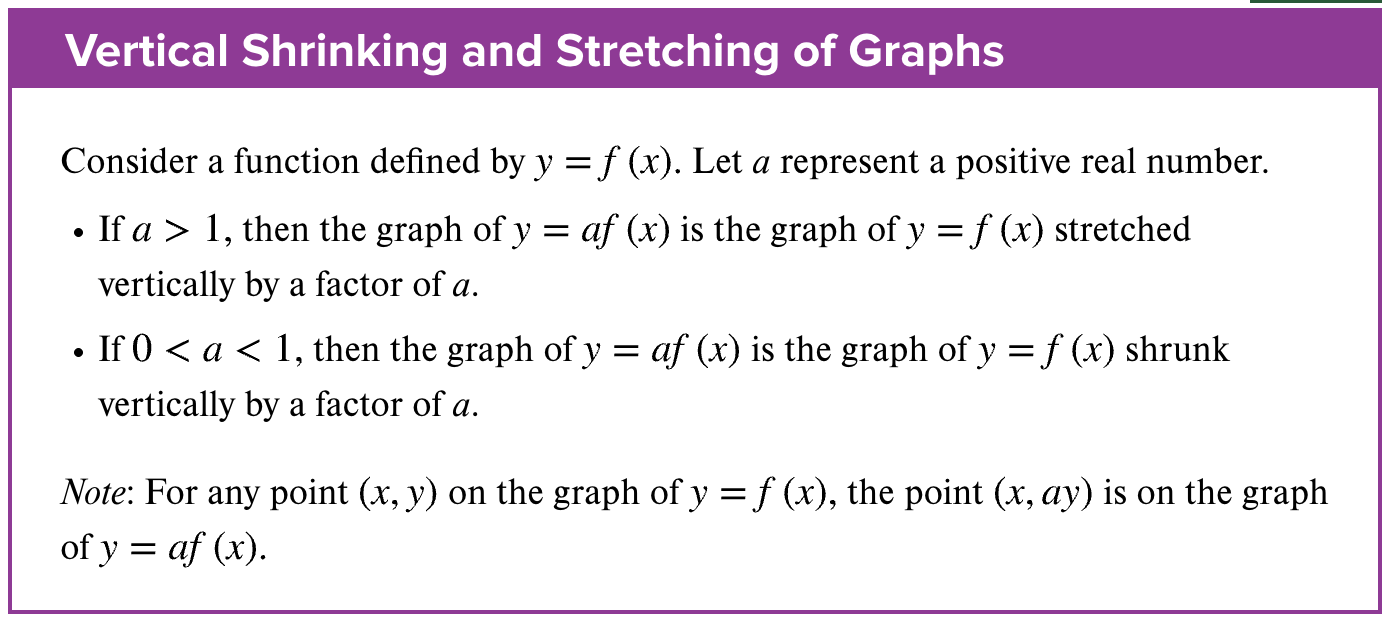
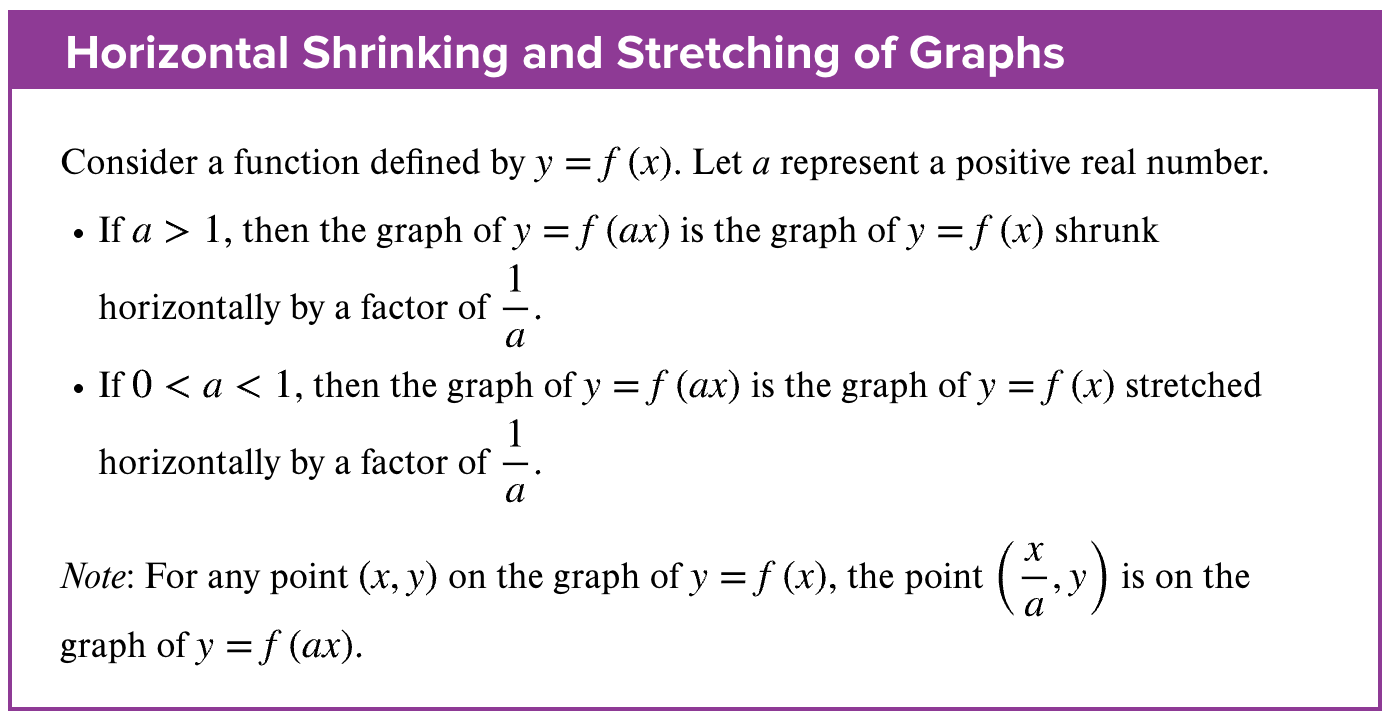
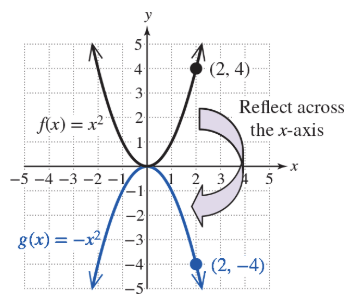
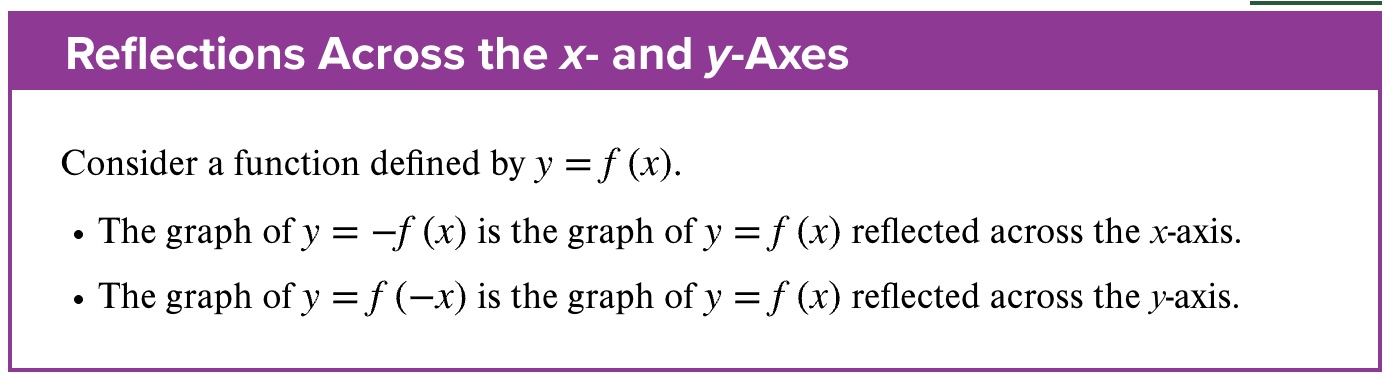
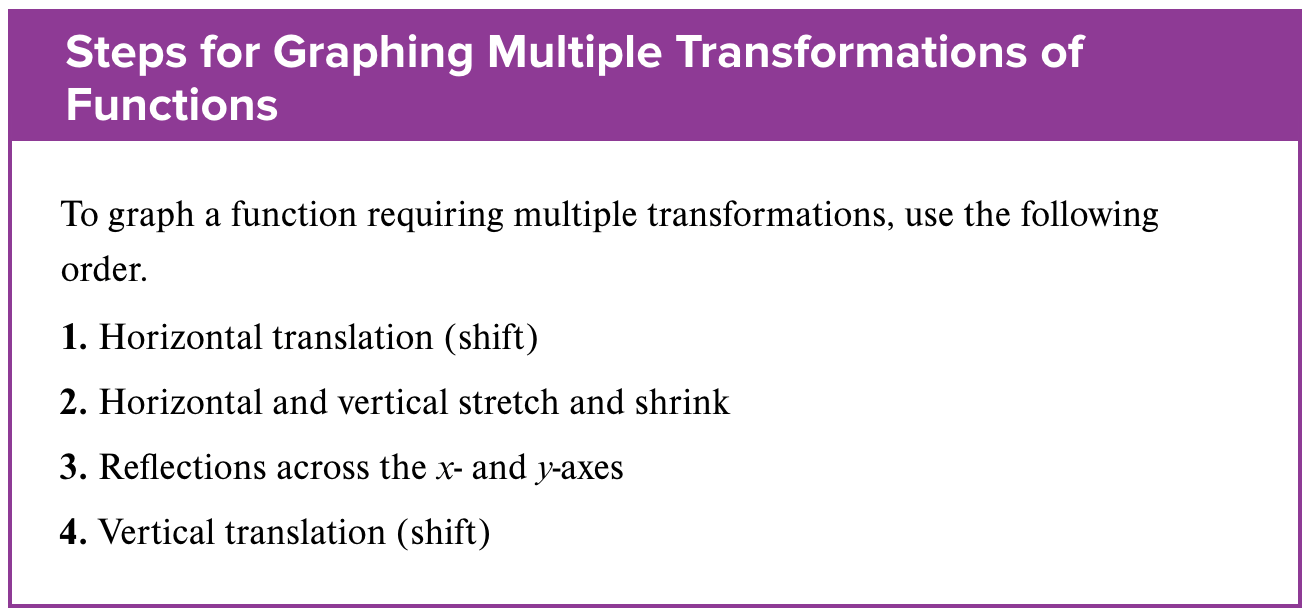
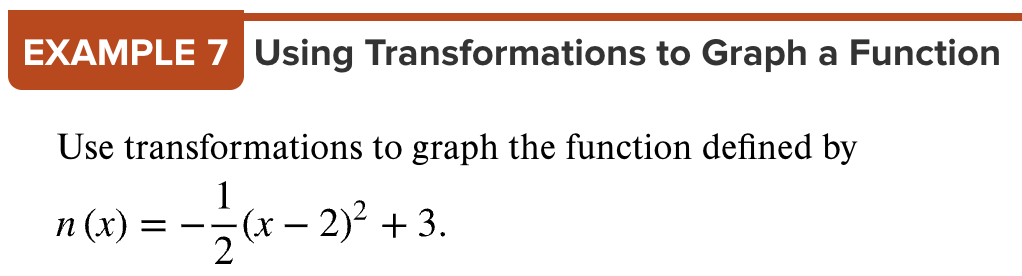
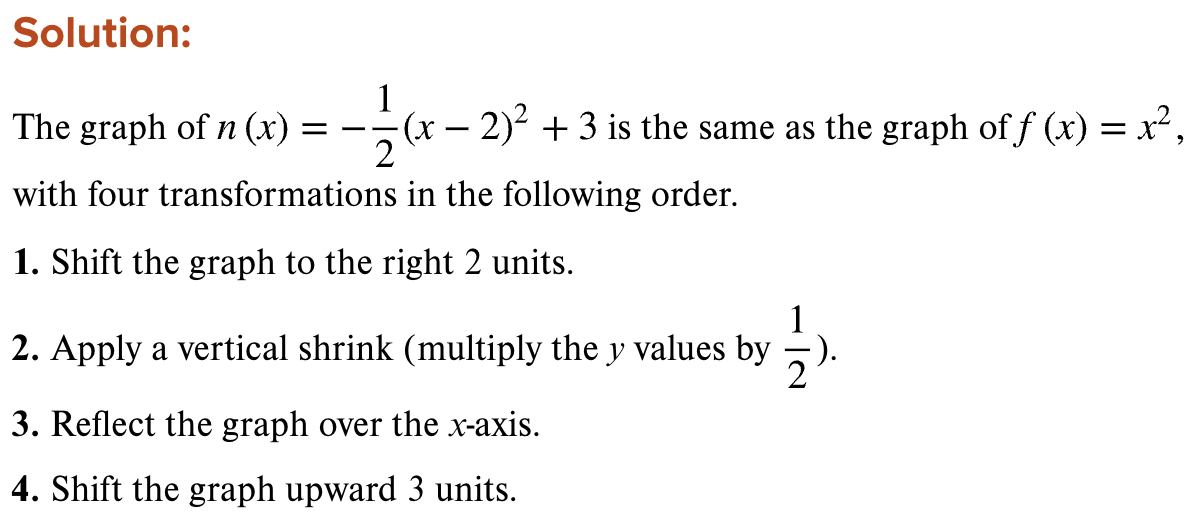
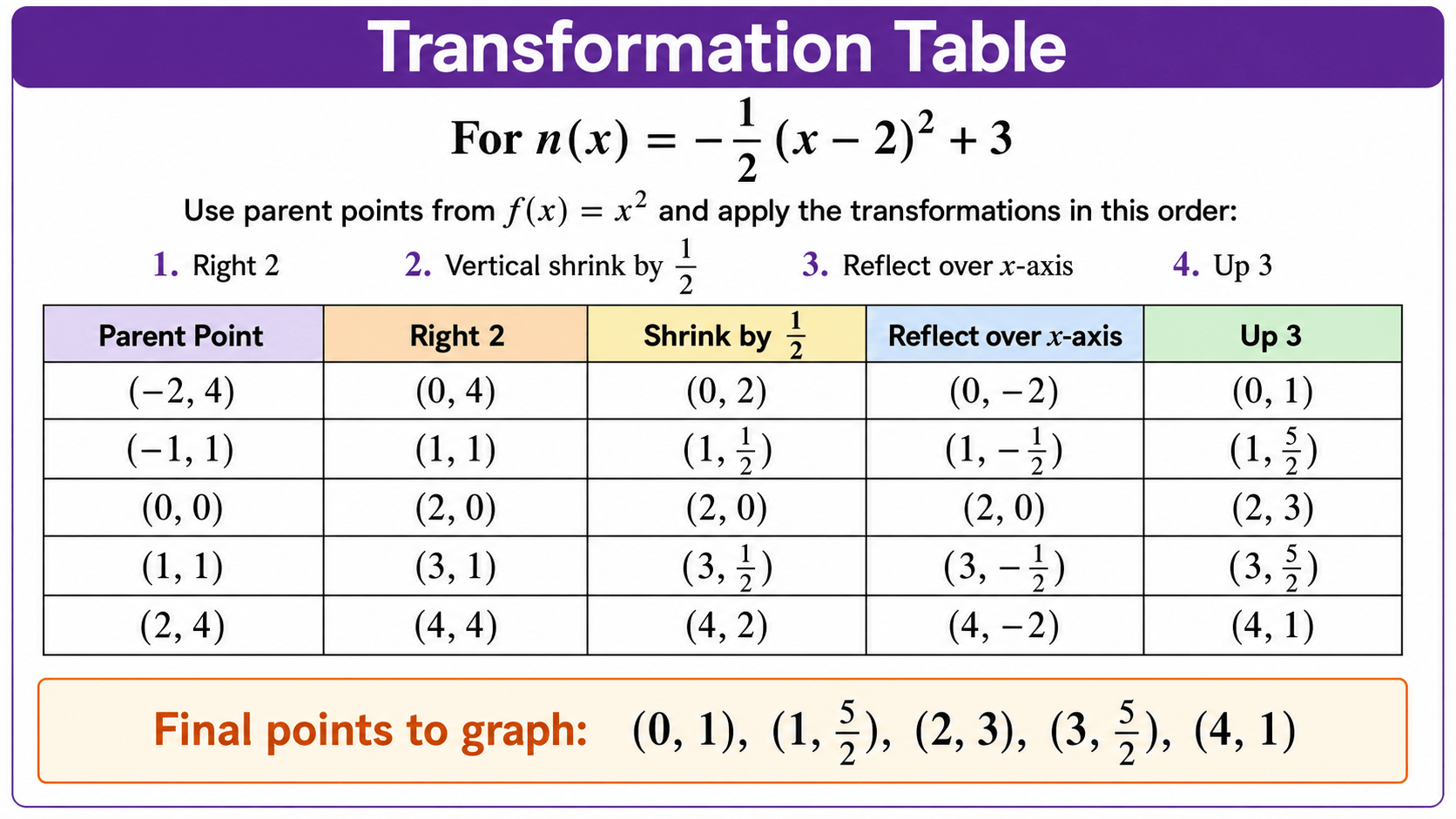
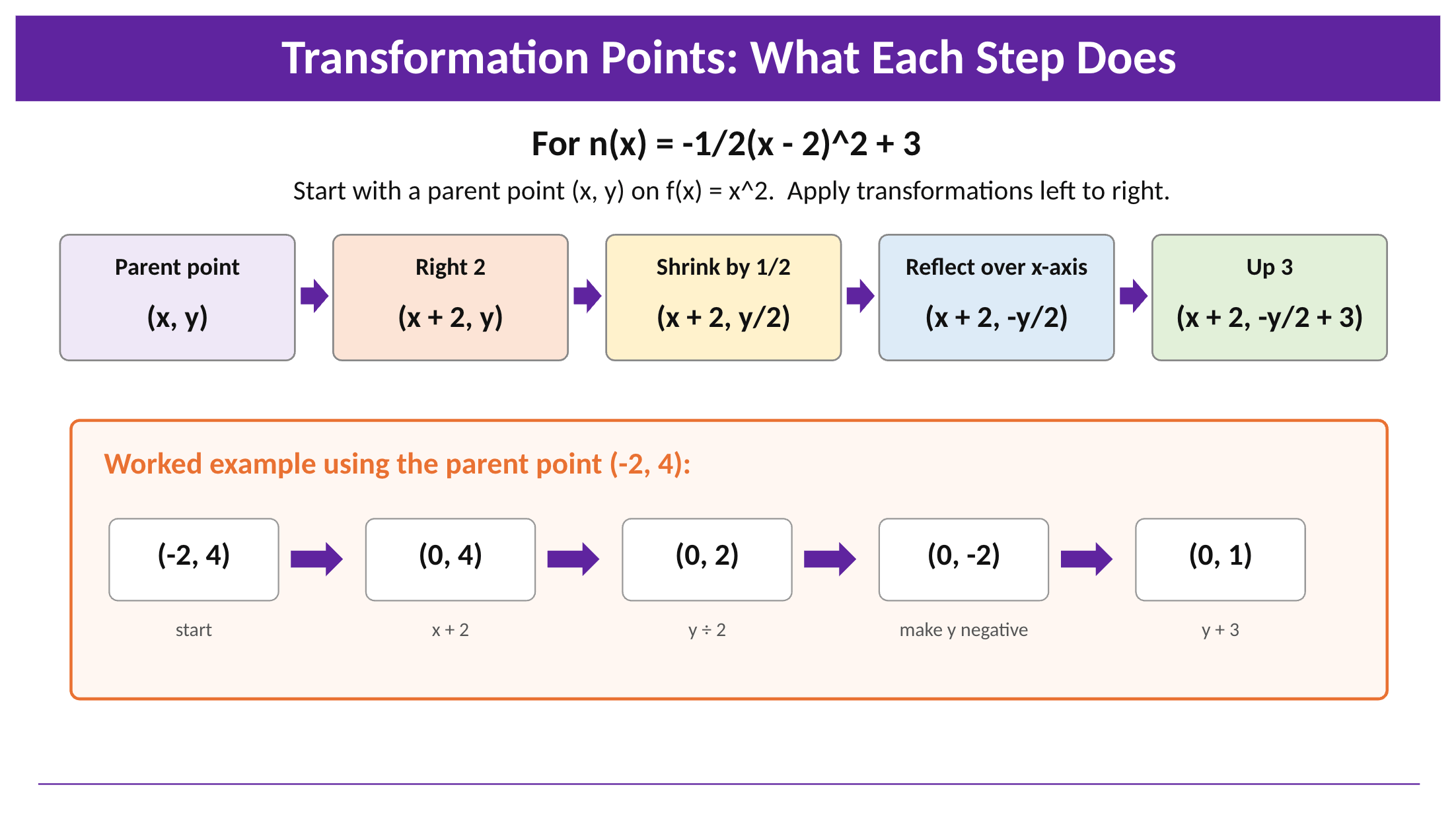
We then apply a series of transformations by algebraically altering the parent function
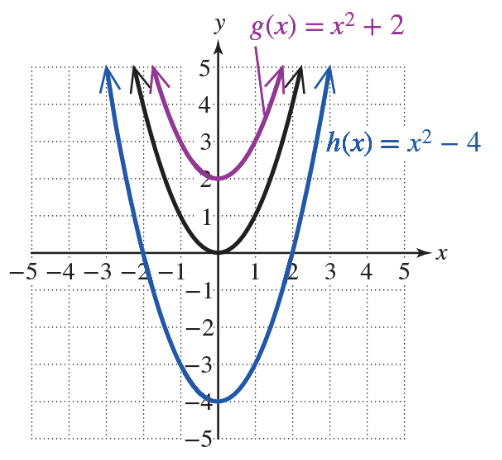
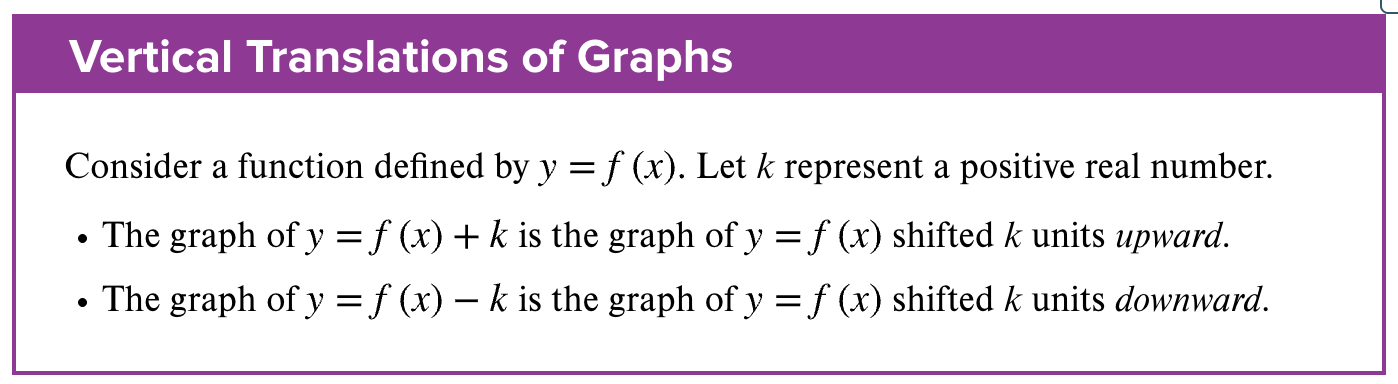
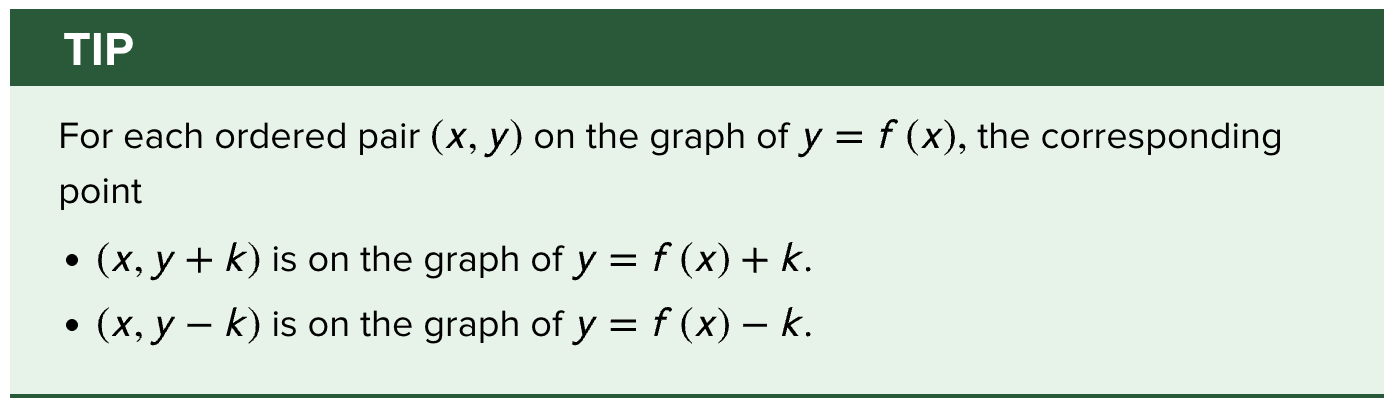
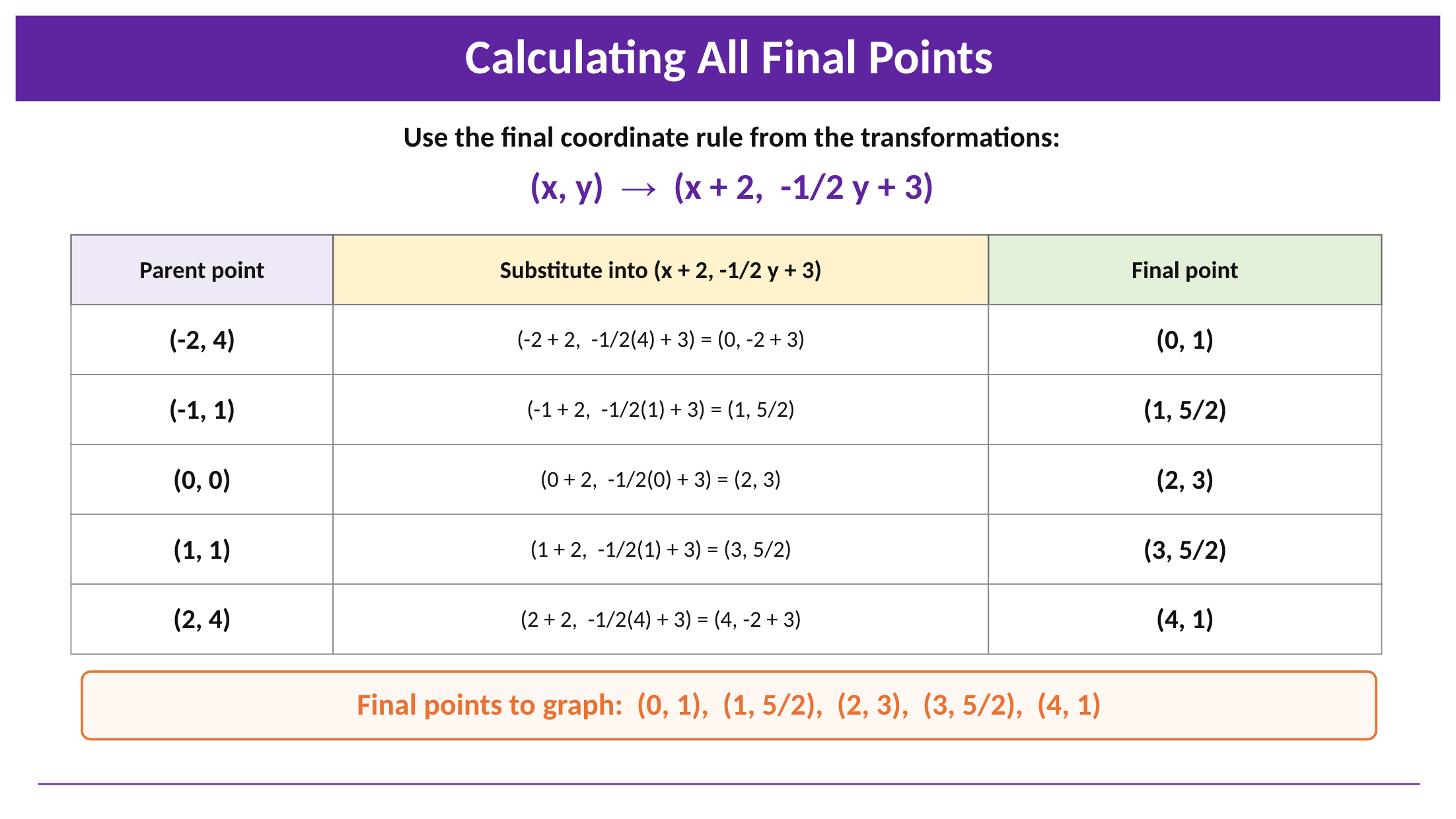
Classwork
Directions: For each function, start with parent points from \(f(x)=x^2\):
\((-2,4),\;(-1,1),\;(0,0),\;(1,1),\;(2,4)\)
Make a transformation table and graph the final points.
1. \(g(x)=2(x-3)^2-1\)
2. \(h(x)=-\frac{1}{2}(x+4)^2+2\)
3. \(p(x)=-(2x-2)^2+5\)
4. \(q(x)=\frac{1}{3}(x+1)^2-4\)
Applications of Quadratics
We've already seen applications of linear functions in modeling cost, revenue, and profit functions.
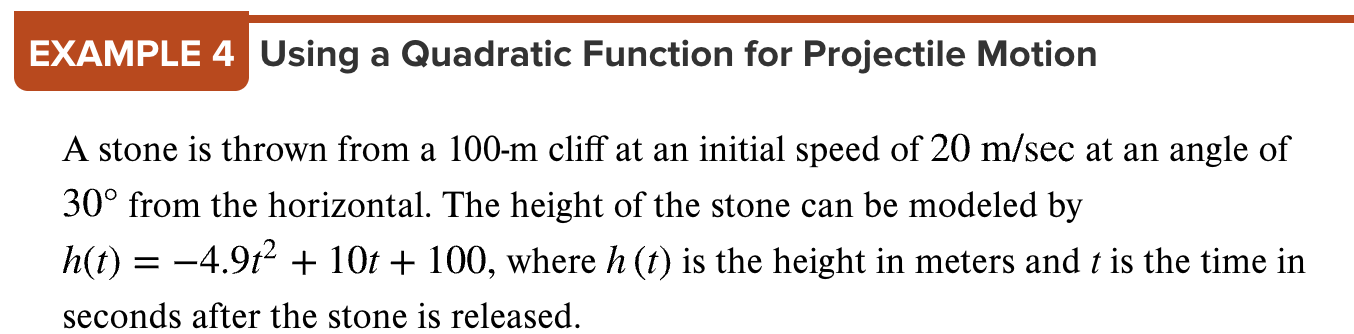
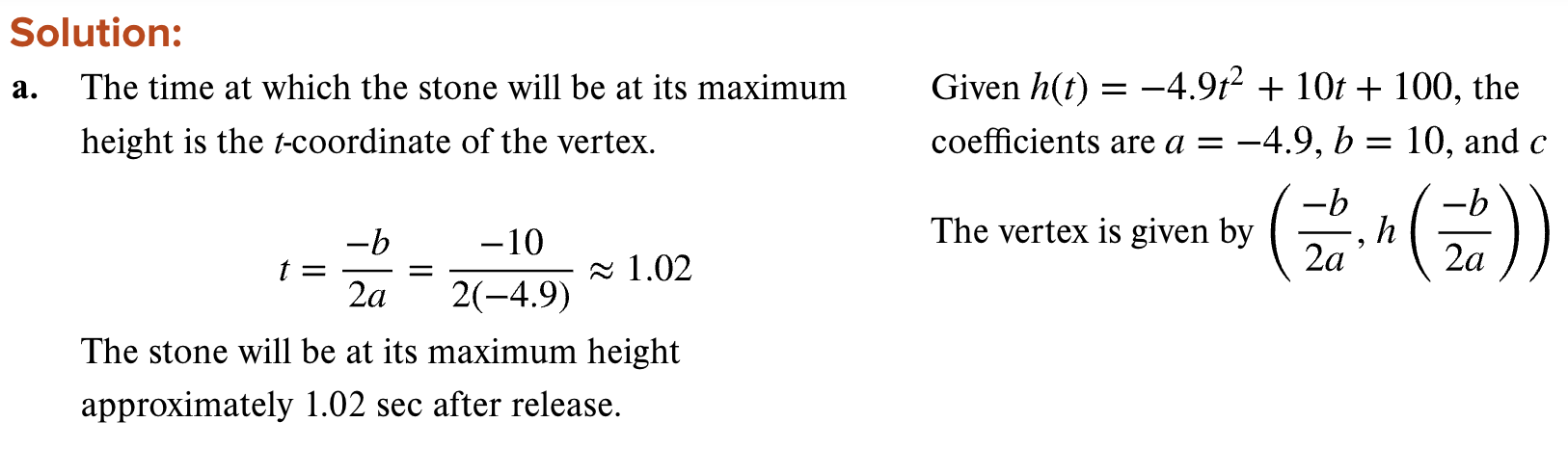
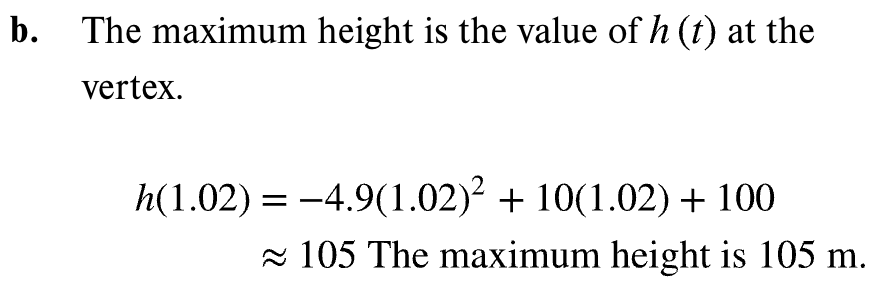
Quadratic functions can also be used to model real-world situations...
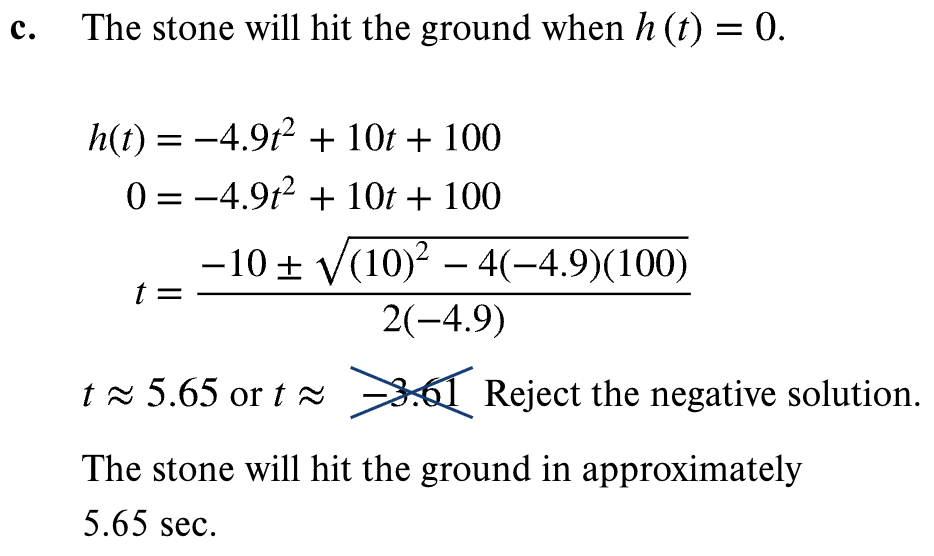
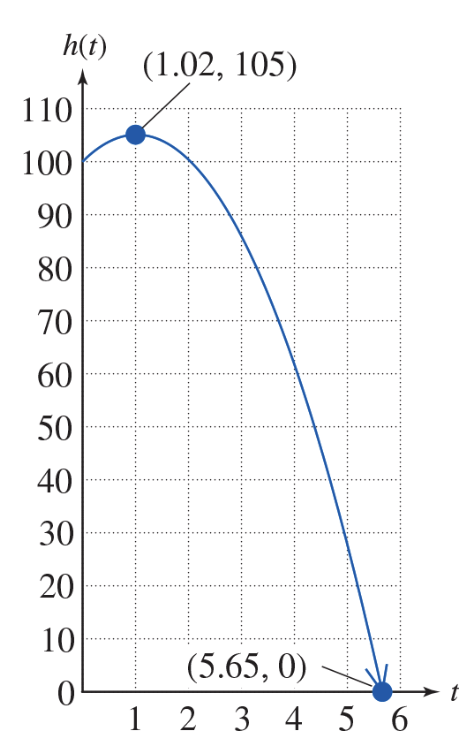
They are often used in optimization problems because the vertex of a parabola gives the maximum or minimum value of the dependent variable (y).
We will examine 2 types of optimization problem

Classwork
A T-shirt is launched into the stands from a platform \(6\) feet above the ground. Its height can be modeled by
\(h(t)=-16t^2+48t+6\),
where \(h(t)\) is the height in feet and \(t\) is the time in seconds after the T-shirt is launched.
a. Determine the time at which the T-shirt reaches its maximum height.
b. Determine the maximum height.
c. Determine the time at which the T-shirt hits the ground.
a. Find the time of the maximum height.
\(t=\frac{-b}{2a}\)
\(t=\frac{-48}{2(-16)}\)
\(t=\frac{-48}{-32}\)
\(t=1.5\)
The T-shirt reaches its maximum height after \(1.5\) seconds.
b. Find the maximum height.
\(h(1.5)=-16(1.5)^2+48(1.5)+6\)
\(h(1.5)=-16(2.25)+72+6\)
\(h(1.5)=-36+72+6\)
\(h(1.5)=42\)
The maximum height is \(42\) feet.
c. Find when the T-shirt hits the ground.
The T-shirt hits the ground when \(h(t)=0\).
\(0=-16t^2+48t+6\)
Use the quadratic formula:
\(t=\frac{-48\pm\sqrt{48^2-4(-16)(6)}}{2(-16)}\)
\(t=\frac{-48\pm\sqrt{2304+384}}{-32}\)
\(t=\frac{-48\pm\sqrt{2688}}{-32}\)
\(t\approx -0.12\) or \(t\approx 3.12\)
Since time cannot be negative, we use the positive answer. The T-shirt hits the ground after about \(3.12\) seconds.
A baseball is hit from a height of 4 feet above the ground. Its height can be modeled by
\(h(x)=-0.012x^2+0.72x+4\),
where \(h(x)\) is the height of the baseball in feet at a point \(x\) feet horizontally from where it was hit.
(a) Determine the horizontal distance from where the baseball was hit at which the maximum height occurs.
(b) Determine the maximum height of the baseball.
(c) Determine the horizontal distance from where the baseball was hit when it lands on the ground.
Classwork
Solutions
Given:
\(h(x)=-0.012x^2+0.72x+4\)
So
\(a=-0.012\), \(b=0.72\), and \(c=4\).
a) Horizontal distance of maximum height
Use the vertex formula:
\(x=\frac{-b}{2a}\)
\(x=\frac{-(0.72)}{2(-0.012)}\)
\(x=\frac{-0.72}{-0.024}\)
\(x=30\)
The maximum height occurs at \(30.0\) feet.
(b) Maximum height
Evaluate \(h(x)\) at \(x=30\).
\(h(30)=-0.012(30)^2+0.72(30)+4\)
\(h(30)=-0.012(900)+21.6+4\)
\(h(30)=-10.8+21.6+4\)
\(h(30)=14.8\)
The maximum height is \(14.8\) feet.
(c) Horizontal distance when the baseball lands
The baseball lands when \(h(x)=0\).
\(-0.012x^2+0.72x+4=0\)
Use the quadratic formula:
\(x=\frac{-b\pm\sqrt{b^2-4ac}}{2a}\)
\(x=\frac{-0.72\pm\sqrt{(0.72)^2-4(-0.012)(4)}}{2(-0.012)}\)
\(x=\frac{-0.72\pm\sqrt{0.5184+0.192}}{-0.024}\)
\(x=\frac{-0.72\pm\sqrt{0.7104}}{-0.024}\)
\(x=\frac{-0.72\pm0.843}{-0.024}\)
The positive answer is:
\(x=\frac{-0.72-0.843}{-0.024}\)
\(x=\frac{-1.563}{-0.024}\)
\(x\approx65.1\)
The baseball lands about \(65.1\) feet from where it was hit.











Standard Forms
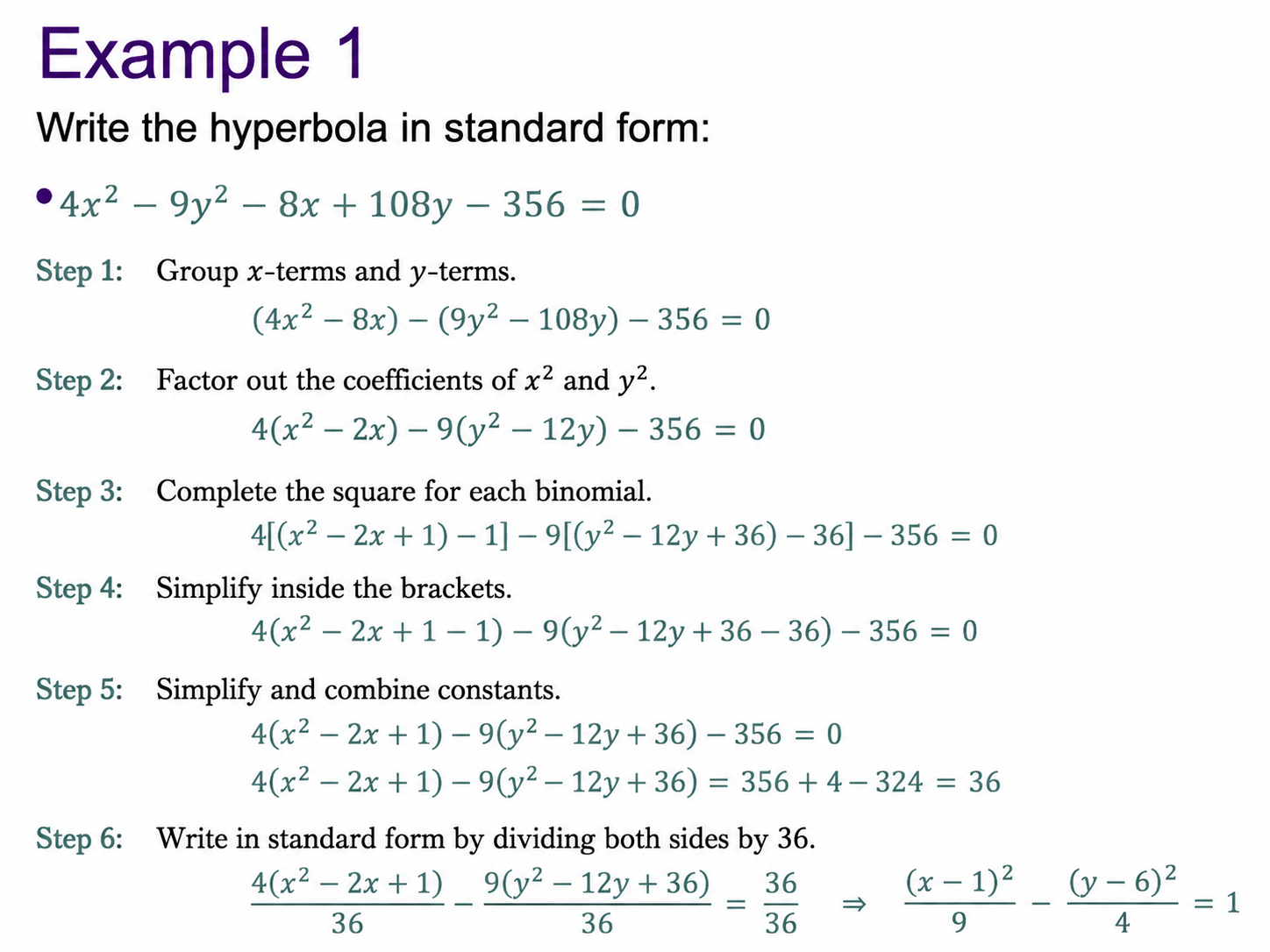
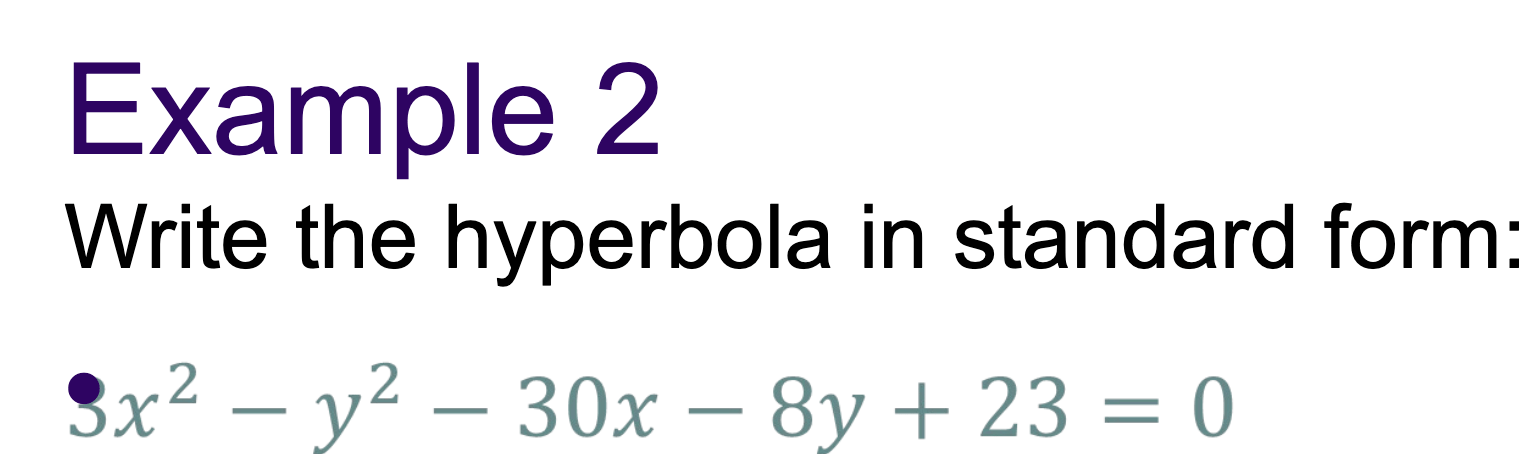
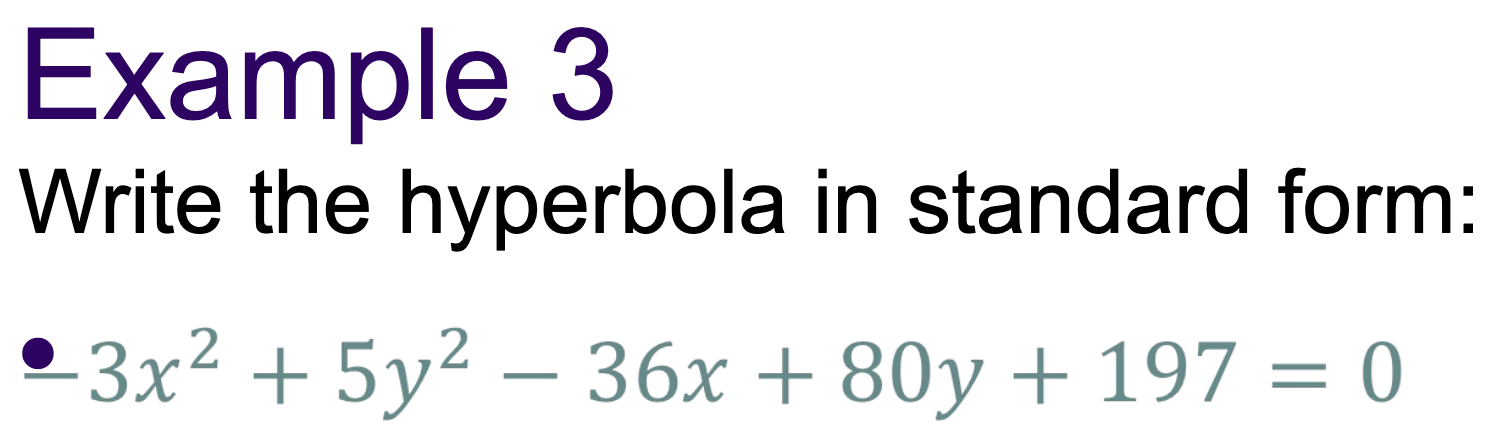
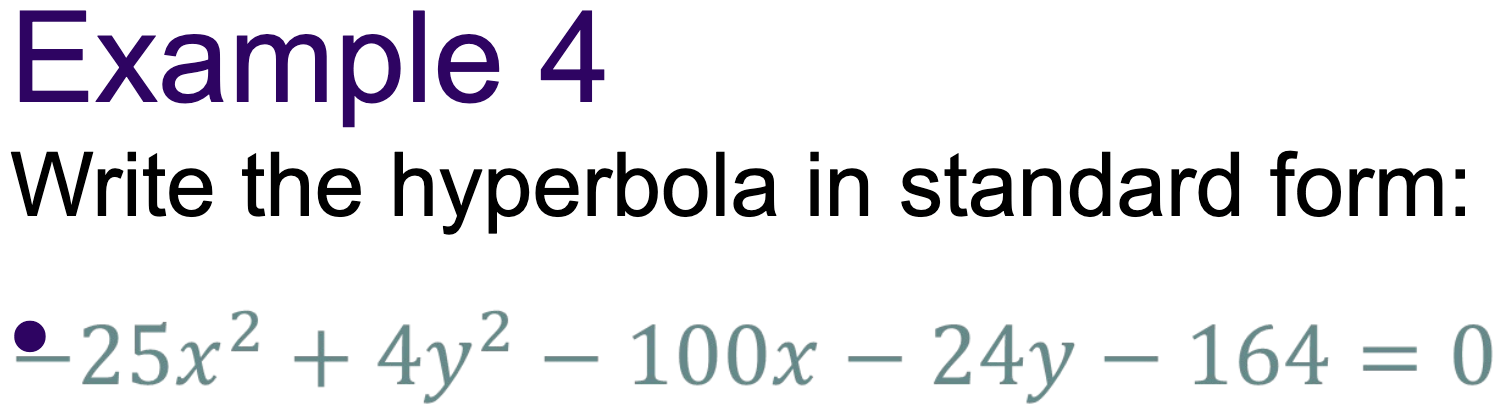
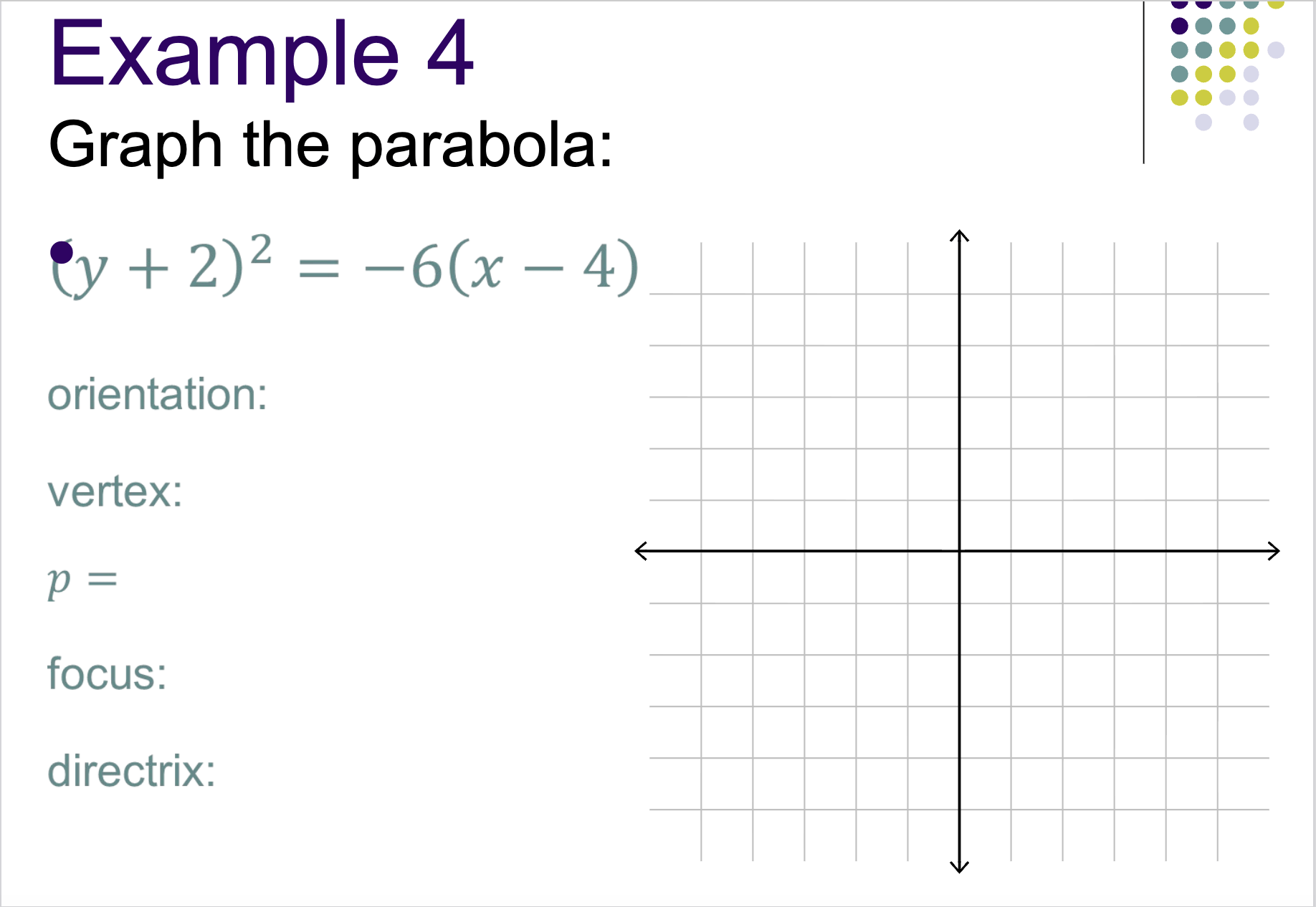
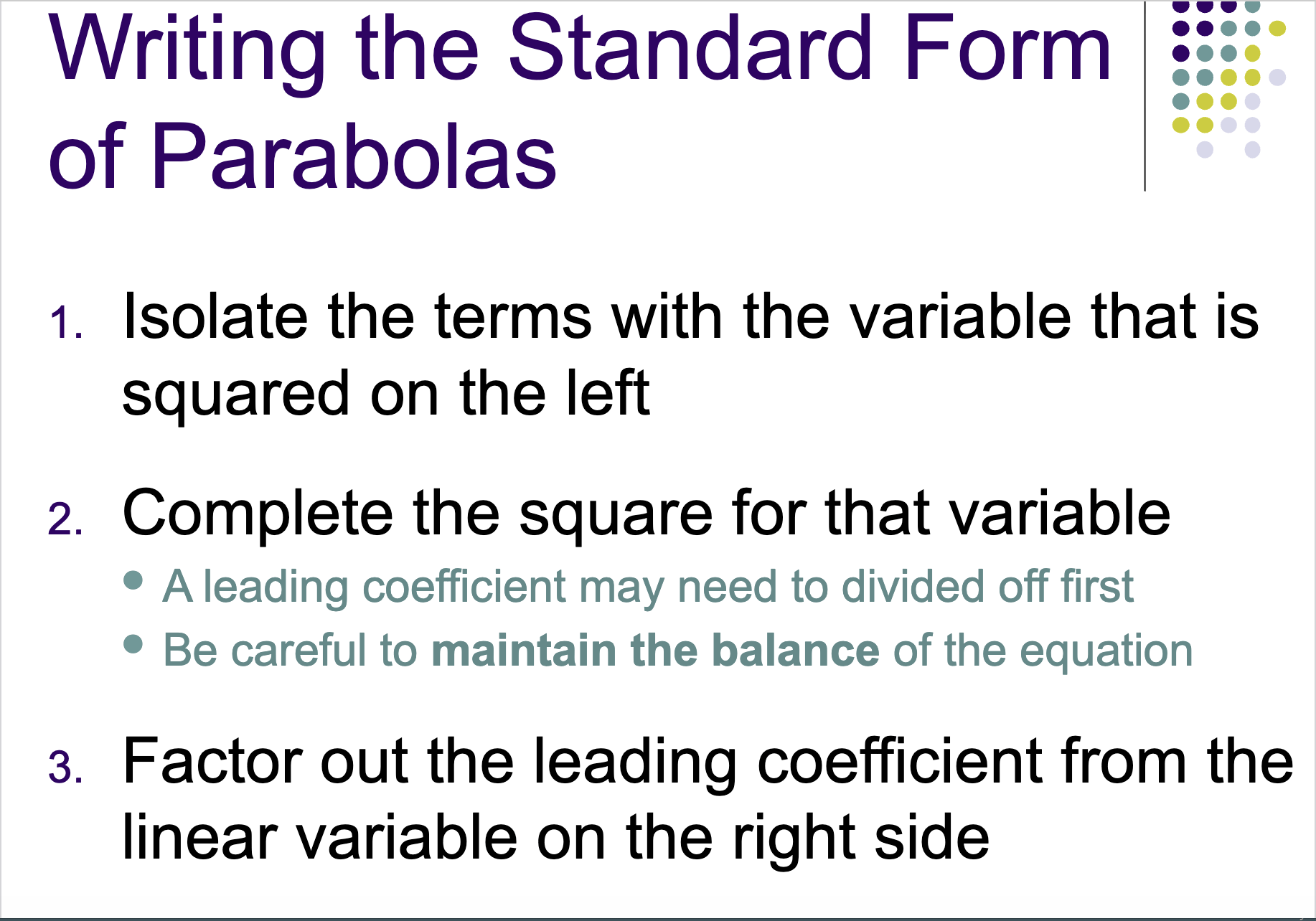
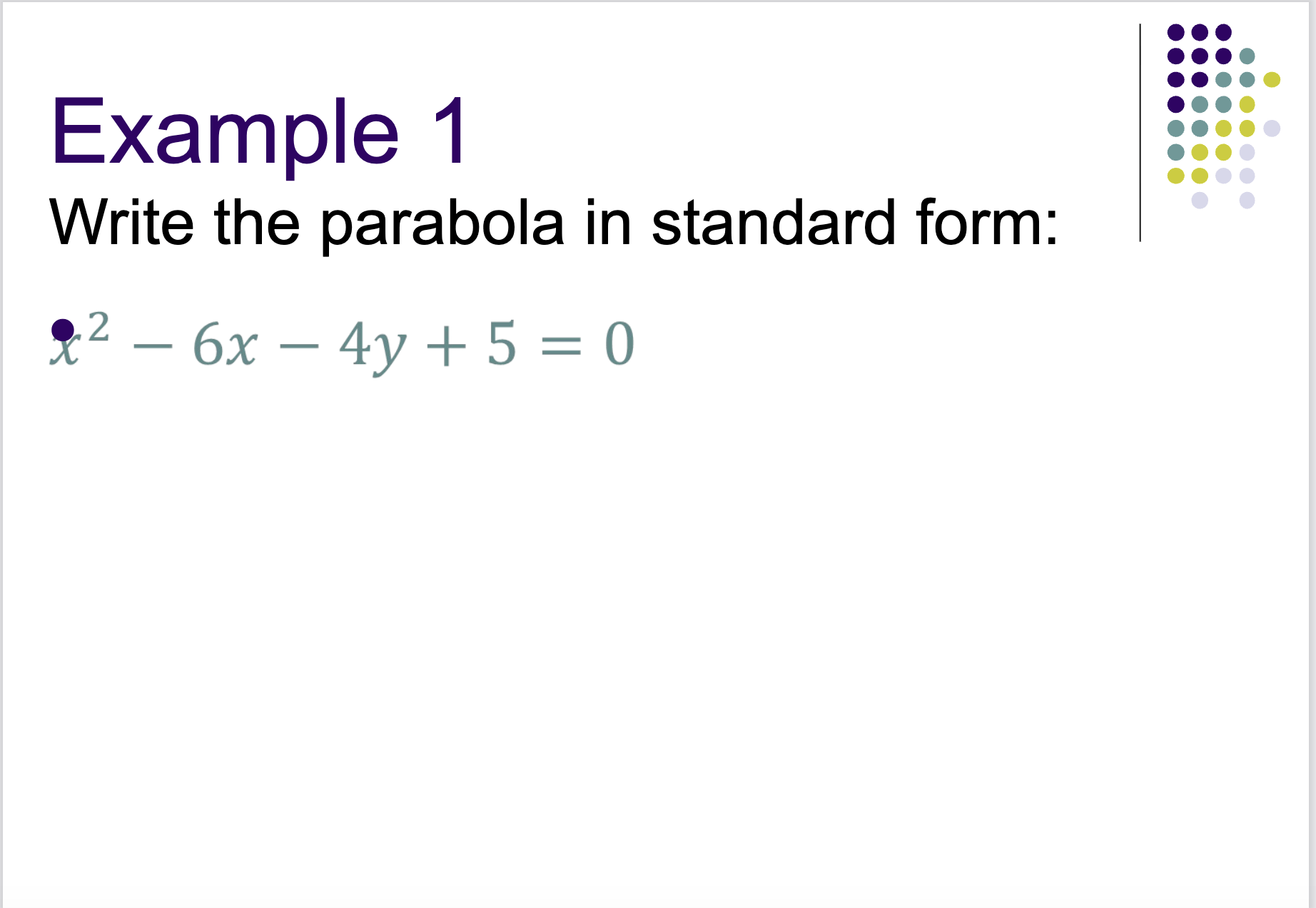
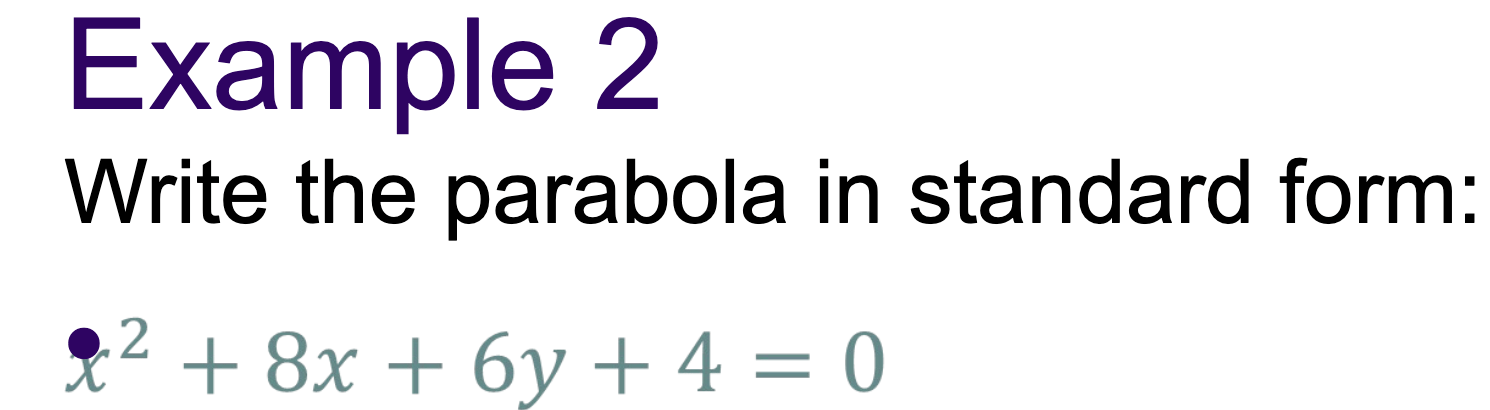
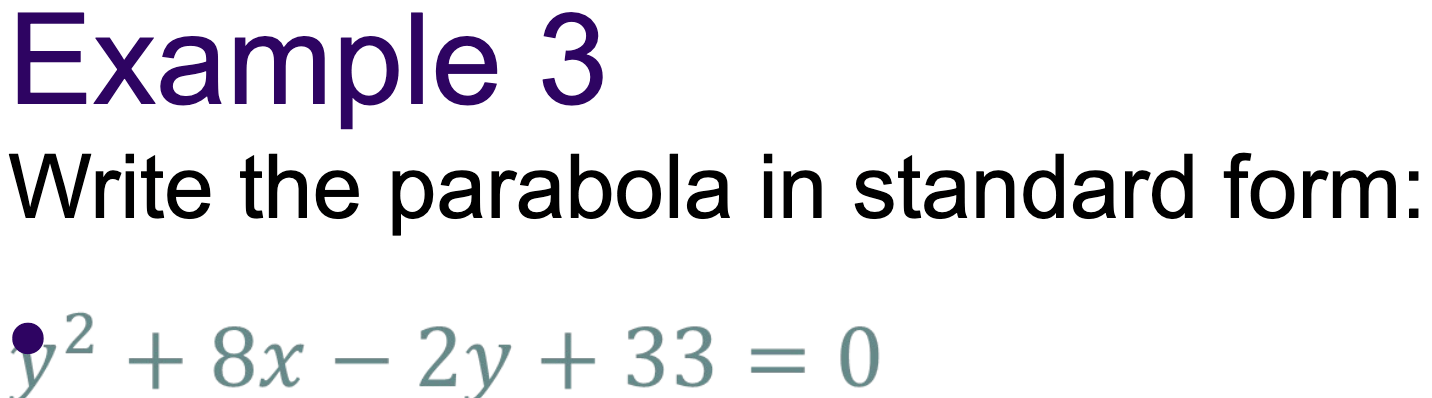
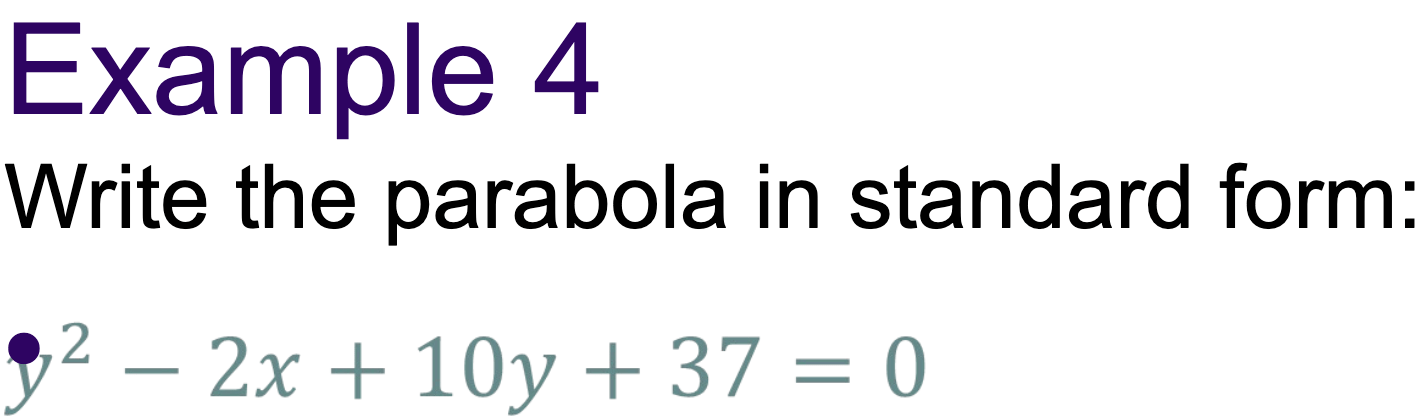
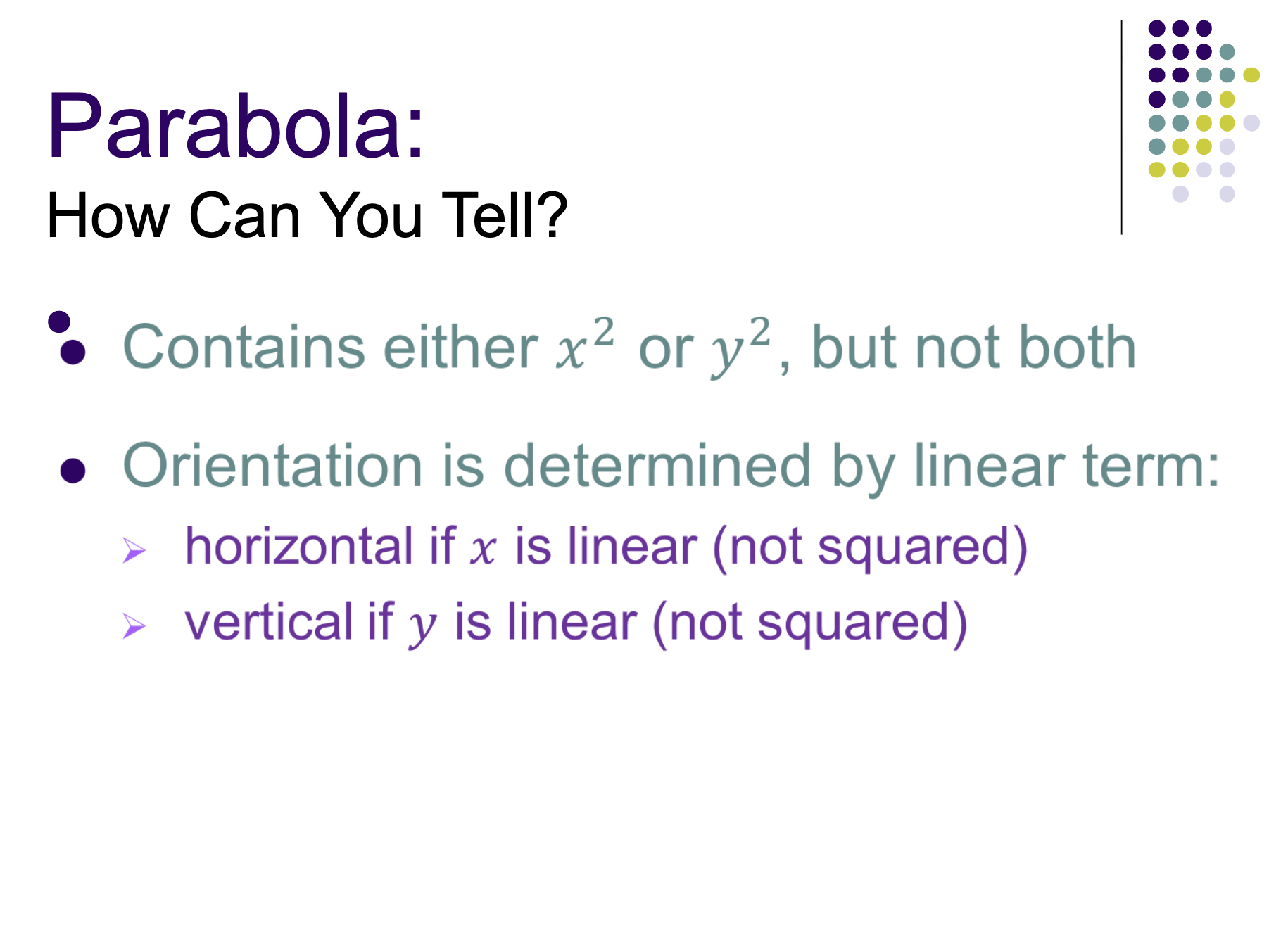
Teacher Version
By Sean