Learning Riemannian Metrics from Gravitational Waves
Ref Bari, Brown University

Advisor: Prof. Brendan Keith

Acknowledgements







Brendan Keith
Scott Field
Collin Capano
Michael Pürrer
Pranav Vinod
Morgan Beck




Acknowledgements

Neural ODE DynAMO
NSF Award 2407452
For Data-Driven Discovery of
Astrophysical Models and Orbits
Motivation
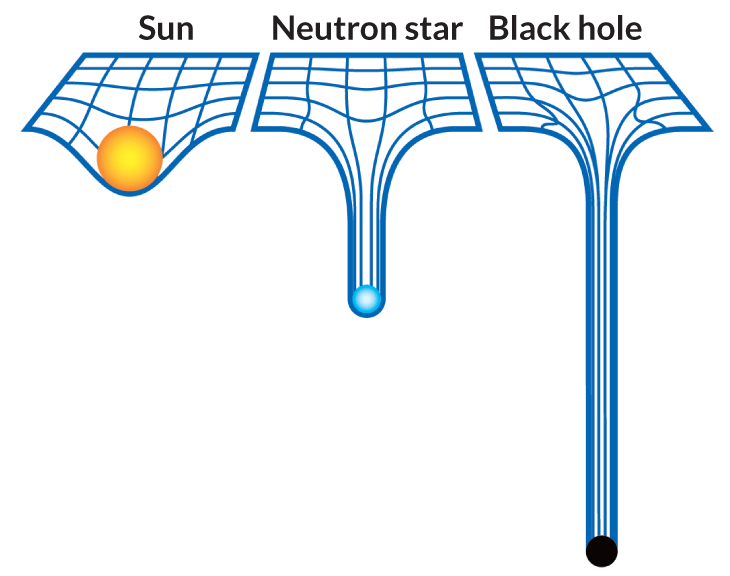
Motivation
Motivation
R
Event Horizon
Singularity
Motivation
The Inverse Problem
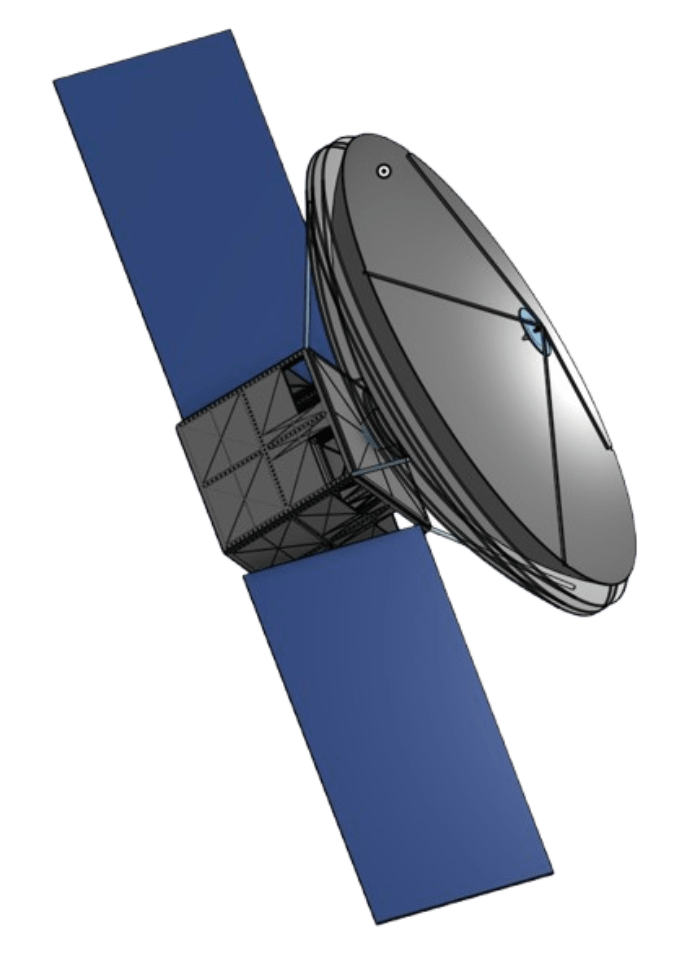
The Imaging Problem
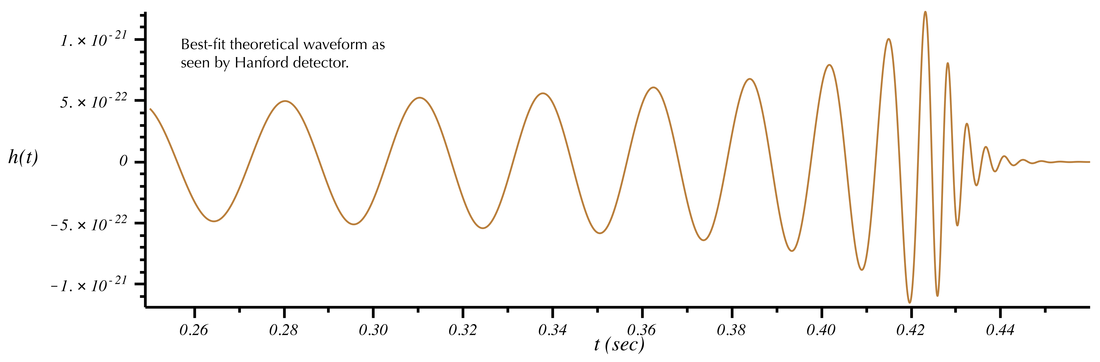
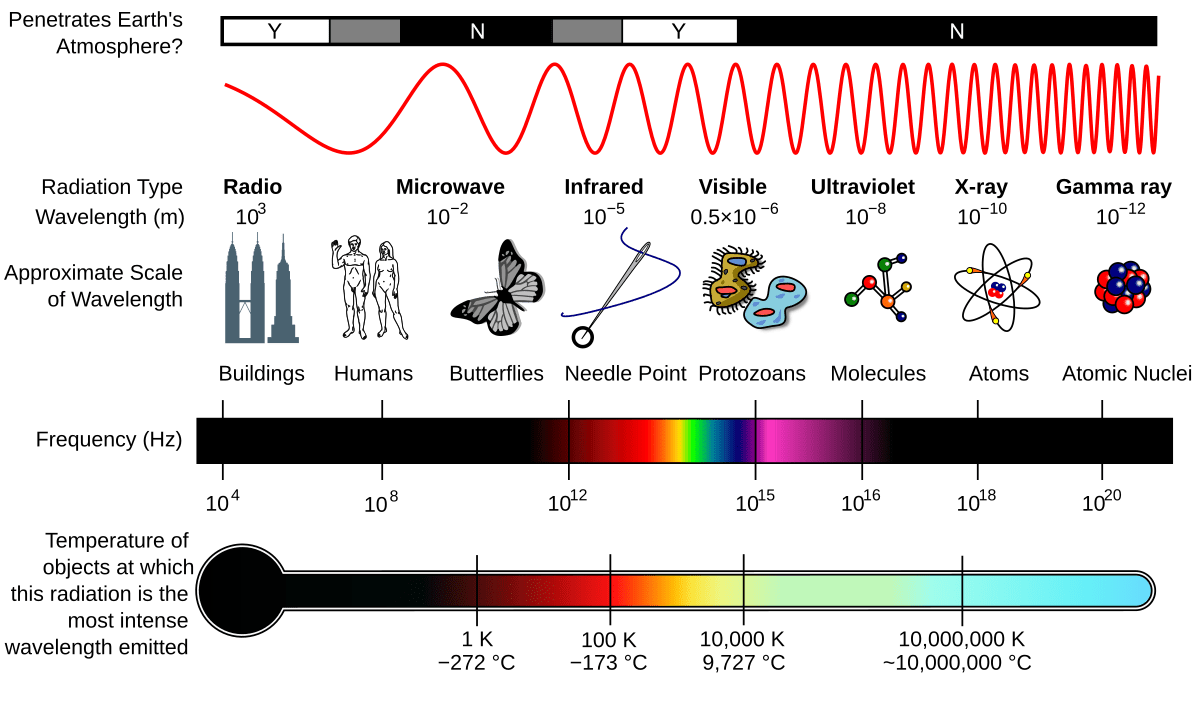
h(t)\to \{x(t),y(t)\}
T_{res}=P/4
Motivation
The Inverse Problem
The Imaging Problem
h(t)\to \{x(t),y(t)\}
T_{res}=P/4
Motivation


for decisive contributions to the LIGO detector and the observation of gravitational waves
2017 Nobel Prize in Physics
Question
h(t)
r(t),\phi(t)
g_{\mu\nu}
?
?
Answer
h(t)
r(t),\phi(t)
g_{\mu\nu}

Summary
Conservative Dynamics: We created a NN which can learn solutions to Einstein's Field Equations (Schwarzschild Metric) from only gravitational waves
Dissipative Dynamics: NN can learn both conservative and dissipative dynamics of a binary black hole inspiral for the synthetic dissipation case.
Approach
The Forward Problem
The Inverse Problem
Approach
The Inverse Problem
The Forward Problem
Metric
Orbits
Waveforms
Approach
The Forward Problem
The Inverse Problem
Metric
Orbits
Waveforms
GENERIC Formalism
Einstein's Field Equations
GENERIC Formalism
GENERIC Formalism
GENERIC Formalism
Synthetic Dissipation
Simulated Dissipation
Birkhoff's Theorem
Ricci Tensor
Approach
The Forward Problem
The Inverse Problem
Approach
The Forward Problem
The Inverse Problem
\{x(t),y(t)\} \to h(t)
Approach
The Forward Problem
\{x(t),y(t)\} \to h(t)
The Inverse Problem
h(t)\to \{x(t),y(t)\}
Forward Problem
The Inverse Problem
The Imaging Problem
h(t)\to \{x(t),y(t)\}
T_{res}=P/4
m_1
m_2
Forward Problem
The Inverse Problem
The Imaging Problem
h(t)\to \{x(t),y(t)\}
T_{res}=P/4
m_1
m_2
M
m_1
m_2
M=m_1+m_2
\vec{r}_1=\frac{m_2}{M}\vec{r}
\vec{r}_2=-\frac{m_1}{M}\vec{r}
Forward Problem
The Inverse Problem
The Imaging Problem
h(t)\to \{x(t),y(t)\}
T_{res}=P/4
The Forward Problem
Metric
Orbits
Waveforms
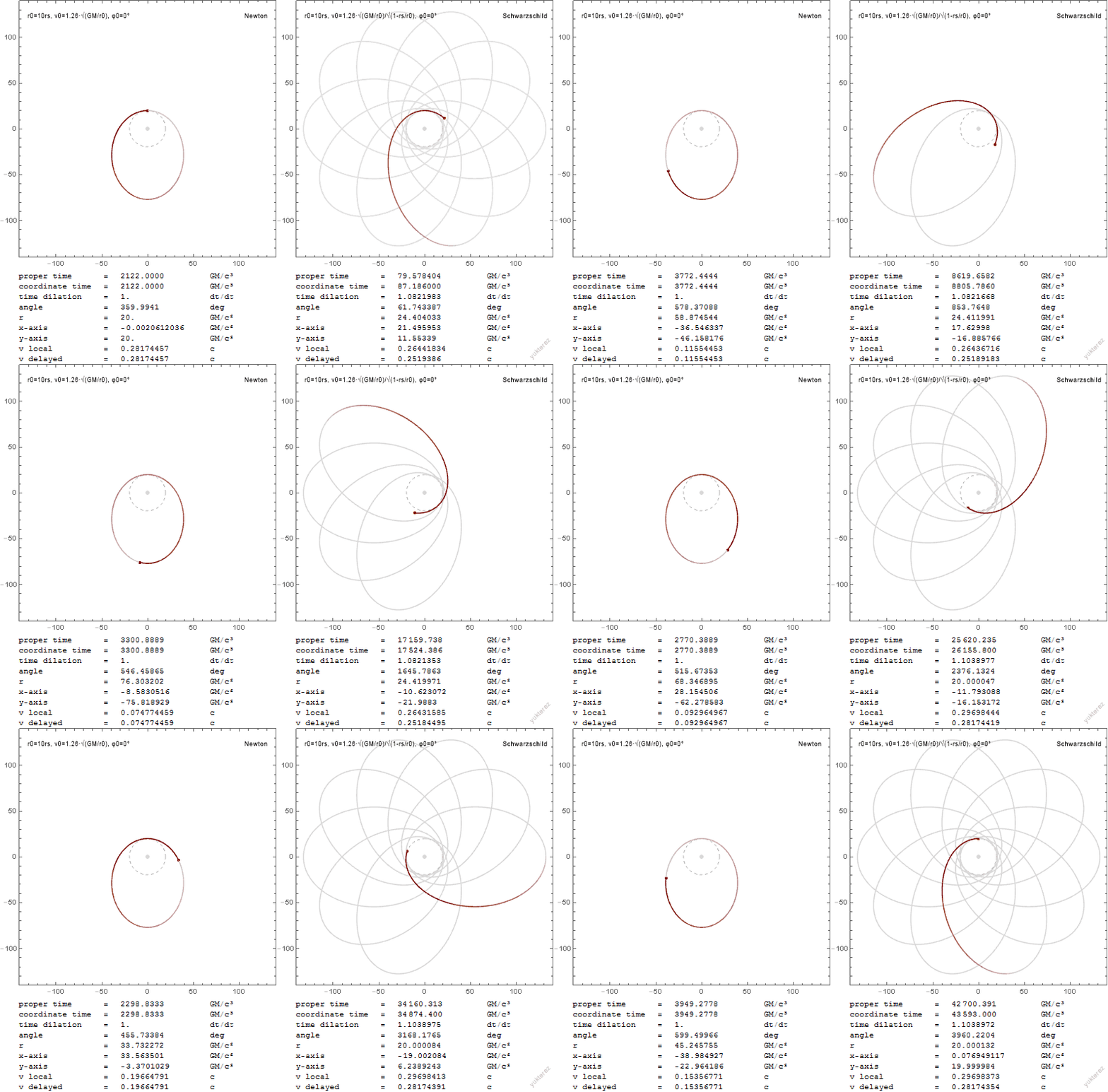
Credit: Wikipedia, Schwarzschild Geodesics
Forward Problem
The Inverse Problem
The Imaging Problem
h(t)\to \{x(t),y(t)\}
T_{res}=P/4
The Forward Problem
Metric
Orbits
Waveforms
g_{\mu\nu}
H
\vec{x}_i
\{\dot r, \dot \phi, \dot p_r, \dot p_\phi \}
h(t)
State Variables
r
\phi
Forward Problem
The Inverse Problem
The Imaging Problem
h(t)\to \{x(t),y(t)\}
T_{res}=P/4
The Forward Problem
Metric
Orbits
Waveforms
g_{\mu\nu}
H
\vec{x}_i
\{\dot r, \dot \phi, \dot p_r, \dot p_\phi \}
h(t)
Metric
Forward Problem
The Inverse Problem
The Imaging Problem
h(t)\to \{x(t),y(t)\}
T_{res}=P/4
The Forward Problem
Metric
Orbits
Waveforms
g_{\mu\nu}
H
\vec{x}_i
\{\dot r, \dot \phi, \dot p_r, \dot p_\phi \}
h(t)
Hamiltonian
Forward Problem
The Inverse Problem
The Imaging Problem
h(t)\to \{x(t),y(t)\}
T_{res}=P/4
The Forward Problem
Metric
Orbits
Waveforms
g_{\mu\nu}
H
\vec{x}_i
\{\dot r, \dot \phi, \dot p_r, \dot p_\phi \}
h(t)
Equations of Motion
Forward Problem
The Inverse Problem
The Imaging Problem
h(t)\to \{x(t),y(t)\}
T_{res}=P/4
The Forward Problem
Metric
Orbits
Waveforms
g_{\mu\nu}
H
\vec{x}_i
\{\dot r, \dot \phi, \dot p_r, \dot p_\phi \}
h(t)
Gravitational Waveform
Forward Problem
The Inverse Problem
The Imaging Problem
h(t)\to \{x(t),y(t)\}
T_{res}=P/4
The Forward Problem
Metric
Orbits
Waveforms
g_{\mu\nu}=
\begin{pmatrix}
-(1-\frac{2}{r}) & 0 & 0 & 0 \\
0 & (1-\frac{2}{r})^{-1} & 0 & 0 \\
0 & 0 & r^2 & 0 \\
0 & 0 & 0 & r^2 \sin^2\theta
\end{pmatrix}
Schwarzschild Metric
r
\phi
Forward Problem
The Inverse Problem
The Imaging Problem
h(t)\to \{x(t),y(t)\}
T_{res}=P/4
The Forward Problem
Metric
Orbits
Waveforms
g_{\mu\nu}=
\begin{pmatrix}
-(1-\frac{2}{r}) & 0 & 0 & 0 \\
0 & (1-\frac{2}{r})^{-1} & 0 & 0 \\
0 & 0 & r^2 & 0 \\
0 & 0 & 0 & r^2
\end{pmatrix}
Schwarzschild Metric
r
\phi
p^{\mu}
Forward Problem
The Inverse Problem
The Imaging Problem
h(t)\to \{x(t),y(t)\}
T_{res}=P/4
The Forward Problem
Metric
Orbits
Waveforms
r
\phi
p_{\mu}=(p^t, p^r, p^\theta, p^\phi)
g_{\mu\nu}=
\begin{pmatrix}
-(1-\frac{2}{r}) & 0 & 0 & 0 \\
0 & (1-\frac{2}{r})^{-1} & 0 & 0 \\
0 & 0 & r^2 & 0 \\
0 & 0 & 0 & r^2
\end{pmatrix}
Schwarzschild Metric
Forward Problem
The Inverse Problem
The Imaging Problem
h(t)\to \{x(t),y(t)\}
T_{res}=P/4
The Forward Problem
Metric
Orbits
Waveforms
r
\phi
H = \frac{1}{2}p_{\mu} g^{-1}_{\mu\nu} p_{\nu}
g^{-1}_{\mu\nu}
Hamiltonian
p_{\nu}
p_{\mu}
Forward Problem
The Inverse Problem
The Imaging Problem
h(t)\to \{x(t),y(t)\}
T_{res}=P/4
The Forward Problem
Metric
Orbits
Waveforms
r
\phi
H = \frac{1}{2}\left[-\left(1-\frac{2M}{r}\right)^{-1}(p_t)^2+
\left(1-\frac{2M}{r}\right)(p_r)^2+ r^{-2}(p_\phi)^2\right]
Hamiltonian
H = \frac{1}{2}\left[-\left(1-\frac{2M}{r}\right)^{-1}(p_t)^2+
\left(1-\frac{2M}{r}\right)(p_r)^2+ r^{-2}(p_\phi)^2\right]
Forward Problem
The Inverse Problem
The Imaging Problem
h(t)\to \{x(t),y(t)\}
T_{res}=P/4
r
\phi
\dot{q}=\frac{\partial H}{\partial p}
Hamiltonian Equations
\dot{p}=-\frac{\partial H}{\partial q}
The Forward Problem
Metric
Orbits
Waveforms
Forward Problem
The Inverse Problem
The Imaging Problem
h(t)\to \{x(t),y(t)\}
T_{res}=P/4
r
\phi
\dot{r}=g^{rr}p_r
\dot{p}_r=-\frac{\partial H}{\partial r}
The Forward Problem
Metric
Orbits
Waveforms
\dot{\phi} = g^{\phi\phi}p_\phi
\dot{p_\phi} =\dot{L}
r Equations of Motion
Φ Equations of Motion
Forward Problem
The Inverse Problem
The Imaging Problem
h(t)\to \{x(t),y(t)\}
T_{res}=P/4
r
\phi
The Forward Problem
Metric
Orbits
Waveforms
h(t)=\frac{\ddot{Q}}{R}
= \int \rho (r_ir_j-\frac{1}{3}r^2 \delta_{ij})
Q_{ij}
Forward Problem
The Inverse Problem
The Imaging Problem
h(t)\to \{x(t),y(t)\}
T_{res}=P/4
r
\phi
The Forward Problem
Metric
Orbits
Waveforms
h(t)=\frac{\ddot{Q}}{R}
\sim mr^2\sin(\omega t)
Q_{ij}
Forward Problem
The Inverse Problem
The Imaging Problem
h(t)\to \{x(t),y(t)\}
T_{res}=P/4
r
\phi
The Forward Problem
Metric
Orbits
Waveforms
h(t)=\frac{\ddot{Q}}{R}
\sim mr^2 \omega^2 \sin(\omega t)
\ddot{Q}_{ij}
Forward Problem
The Inverse Problem
The Imaging Problem
h(t)\to \{x(t),y(t)\}
T_{res}=P/4
The Forward Problem
Metric
Orbits
Waveforms
\sim mr^2 \omega^2 \sin(\omega t)
\ddot{Q}_{ij}
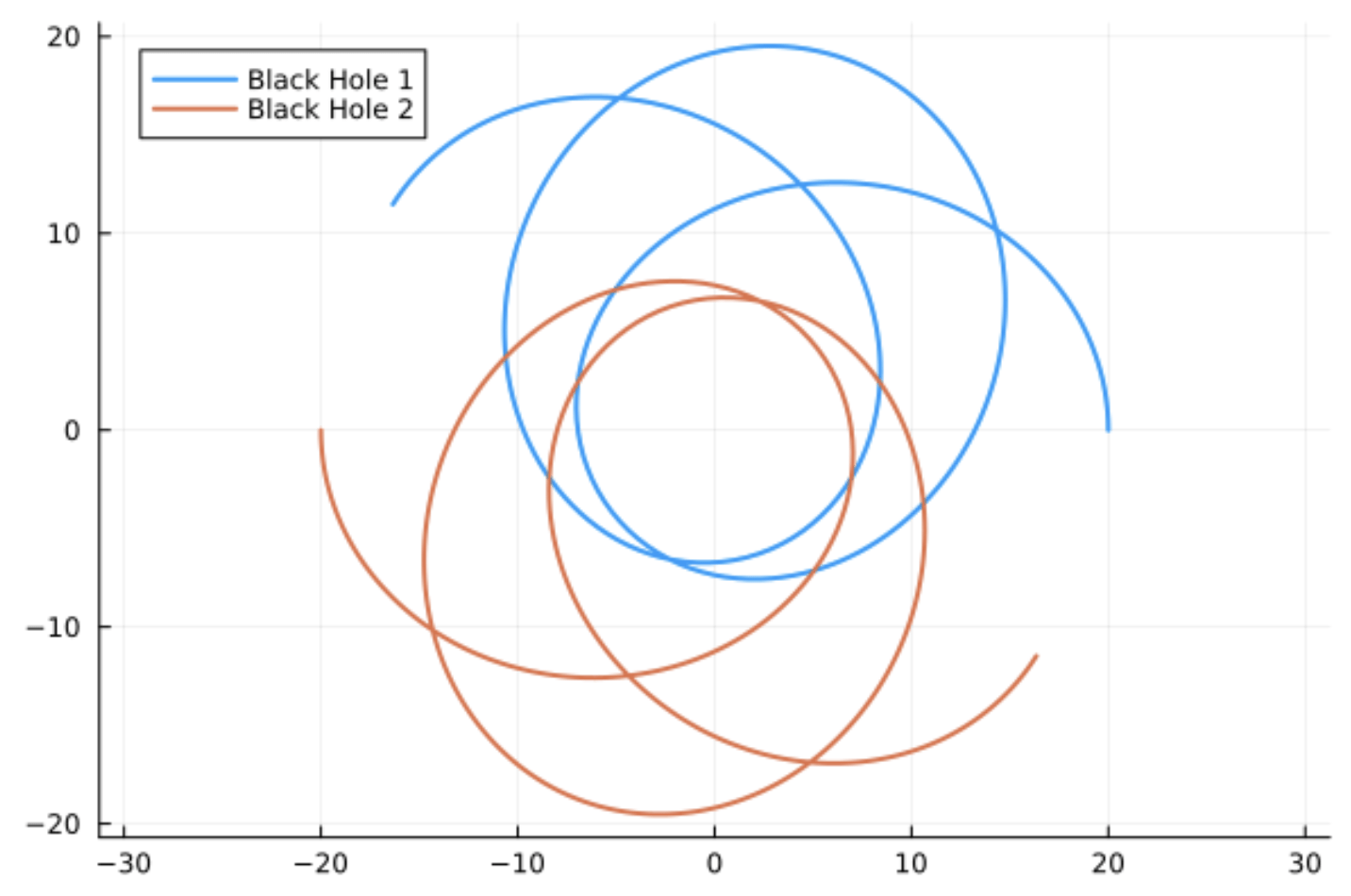
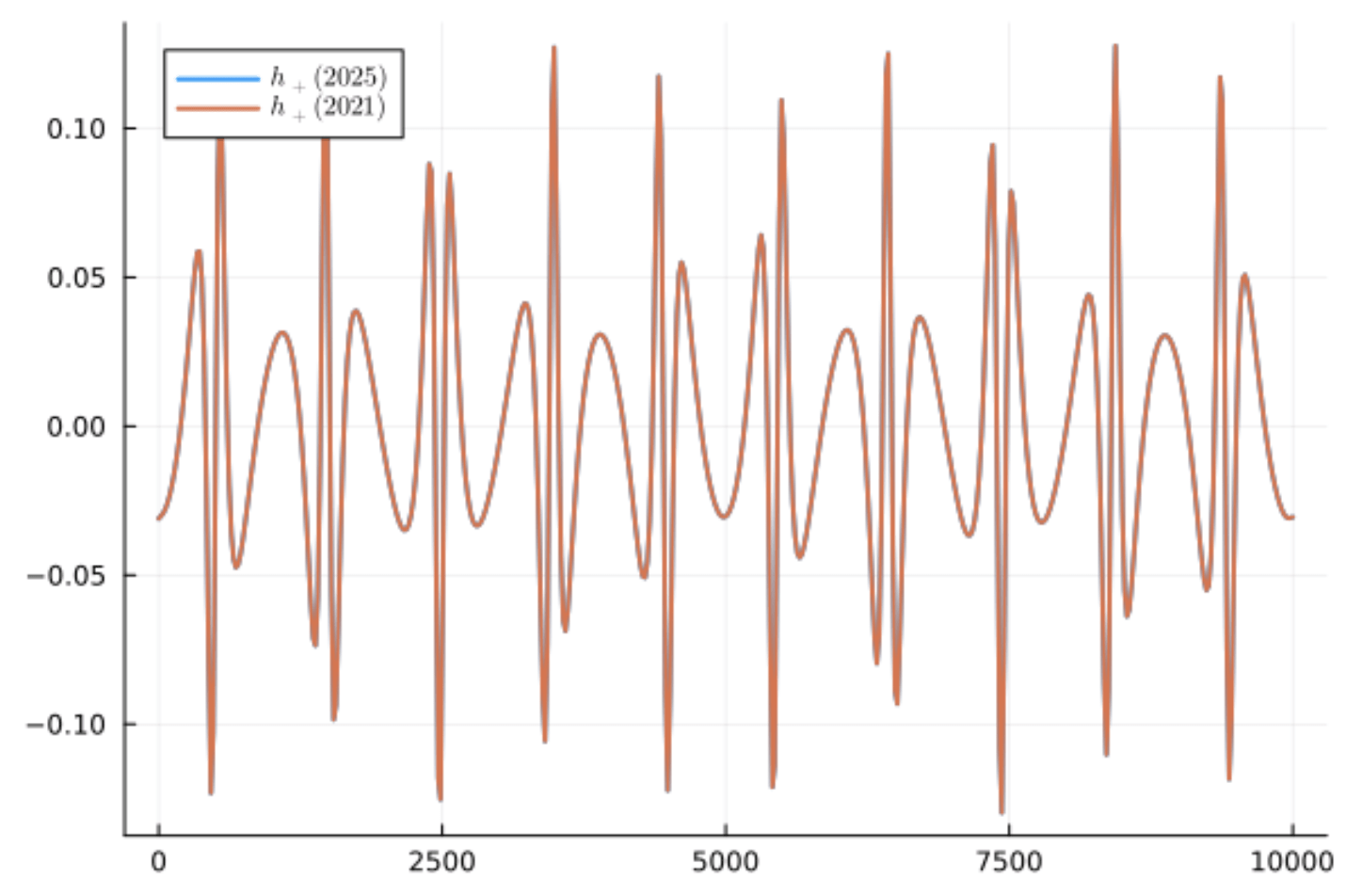
Forward Problem
The Inverse Problem
The Imaging Problem
h(t)\to \{x(t),y(t)\}
T_{res}=P/4
The Forward Problem
Metric
Orbits
Waveforms
\sim mr^2 \omega^2 \sin(\omega t)
\ddot{Q}_{ij}
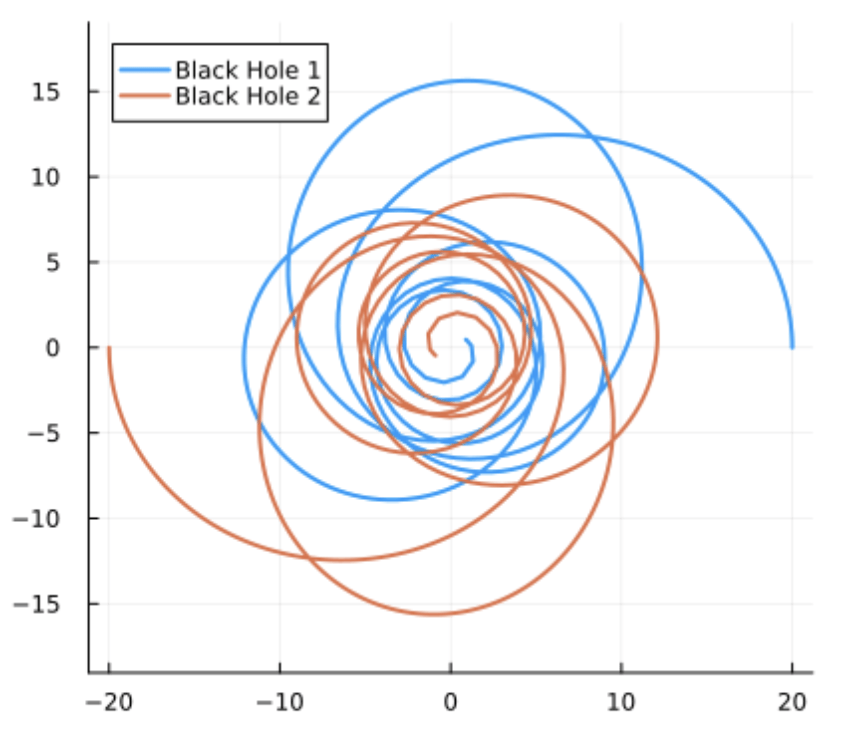
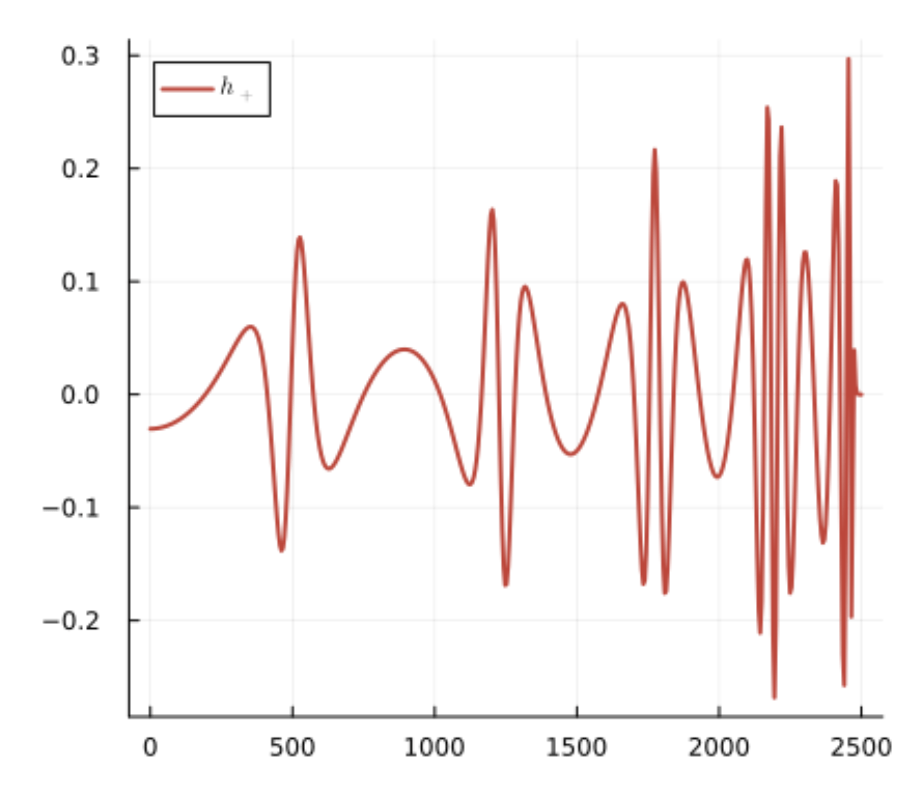
\dot{p_\phi} =\dot{L}-\Phi_L
Angular Momentum Flux
Forward Problem
The Inverse Problem
The Imaging Problem
h(t)\to \{x(t),y(t)\}
T_{res}=P/4
Metric
Orbits
Waveforms
Conservative Dynamics
The Forward Problem
Dissipative Dynamics
Approach
The Forward Problem
\{x(t),y(t)\} \to h(t)
The Inverse Problem
h(t)\to \{x(t),y(t)\}
Approach
The Inverse Problem
GENERIC Formalism
Einstein's Field Equations
GENERIC Formalism
GENERIC Formalism
GENERIC Formalism
Synthetic Dissipation
Birkhoff's Theorem
Ricci Tensor
h(t)
r(t),\phi(t)
g_{\mu\nu}
Approach
The Inverse Problem
GENERIC Formalism
Einstein's Field Equations
GENERIC Formalism
GENERIC Formalism
GENERIC Formalism
Synthetic Dissipation
Simulated Dissipation
Birkhoff's Theorem
Ricci Tensor
dU = \underbrace{dW} +\underbrace{dQ}
conservative
dissipative
Equilibrium Thermodynamics
Approach
The Inverse Problem
GENERIC Formalism
Einstein's Field Equations
GENERIC Formalism
GENERIC Formalism
GENERIC Formalism
Synthetic Dissipation
Simulated Dissipation
Birkhoff's Theorem
Ricci Tensor
dU = \underbrace{dW} +\underbrace{dQ}
conservative
dissipative
dU = {-p dV} +{T dS}
Equilibrium Thermodynamics
Approach
The Inverse Problem
GENERIC Formalism
Einstein's Field Equations
GENERIC Formalism
GENERIC Formalism
GENERIC Formalism
Synthetic Dissipation
Simulated Dissipation
Birkhoff's Theorem
Ricci Tensor
Inequilibrium Thermodynamics
\dot{x} = \dot{x}_{\text{R}} + \dot{x}_{\text{I}}
\dot{x} = L \nabla E + M \nabla S
conservative
dissipative
L
\nabla E
Approach
The Inverse Problem
GENERIC Formalism
Einstein's Field Equations
GENERIC Formalism
GENERIC Formalism
GENERIC Formalism
Synthetic Dissipation
Simulated Dissipation
Birkhoff's Theorem
Ricci Tensor
Inequilibrium Thermodynamics
\dot{x} = \dot{x}_{\text{R}} + \dot{x}_{\text{I}}
\dot{x} = L \nabla E + M \nabla S
conservative
dissipative
\begin{pmatrix}
\dot{r} \\
\dot{\phi} \\
\dot{p_r} \\
\dot{p_\phi}
\end{pmatrix} =
\begin{pmatrix}
0 & I\\
-I & 0
\end{pmatrix}
\begin{pmatrix}
\partial H / \partial {r} \\
\partial H / \partial {\phi} \\
\partial H / \partial {p_r} \\
\partial H / \partial {p_\phi}
\end{pmatrix}
L
\nabla E
\dot{x}
Approach
The Inverse Problem
GENERIC Formalism
Einstein's Field Equations
GENERIC Formalism
GENERIC Formalism
GENERIC Formalism
Synthetic Dissipation
Simulated Dissipation
Birkhoff's Theorem
Ricci Tensor
Inequilibrium Thermodynamics
\dot{x} = \dot{x}_{\text{R}} + \dot{x}_{\text{I}}
\dot{x} = L \nabla E + M \nabla S
conservative
dissipative
\begin{pmatrix}
\dot{r} \\
\dot{\phi} \\
\dot{p_r} \\
\dot{p_\phi}
\end{pmatrix} =
\begin{pmatrix}
0 \\
0 \\
0 \\
-\Phi_L
\end{pmatrix}
M\nabla S
\dot{x}
Approach
The Inverse Problem
GENERIC Formalism
Einstein's Field Equations
GENERIC Formalism
GENERIC Formalism
GENERIC Formalism
Synthetic Dissipation
Simulated Dissipation
Birkhoff's Theorem
Ricci Tensor
Inequilibrium Thermodynamics
\dot{x} = \dot{x}_{\text{R}} + \dot{x}_{\text{I}}
\dot{x} = L \nabla E + M \nabla S
conservative
dissipative
\begin{pmatrix}
\dot{r} \\
\dot{\phi} \\
\dot{p_r} \\
\dot{p_\phi}
\end{pmatrix} =
\begin{pmatrix}
0 & I\\
-I & 0
\end{pmatrix}
\begin{pmatrix}
\partial H / \partial {r} \\
\partial H / \partial {\phi} \\
\partial H / \partial {p_r} \\
\partial H / \partial {p_\phi}
\end{pmatrix}+
\begin{pmatrix}
0 \\
0 \\
0 \\
-\Phi_L
\end{pmatrix}
L
\nabla E
\dot{x}
M\nabla S
Approach
The Inverse Problem
GENERIC Formalism
Einstein's Field Equations
GENERIC Formalism
GENERIC Formalism
GENERIC Formalism
Synthetic Dissipation
Simulated Dissipation
Birkhoff's Theorem
Ricci Tensor
R_{\mu\nu}-\frac{1}{2}Rg_{\mu\nu}=\frac{8\pi G}{c^4}T_{\mu\nu}
Approach
The Inverse Problem
GENERIC Formalism
Einstein's Field Equations
GENERIC Formalism
GENERIC Formalism
GENERIC Formalism
Synthetic Dissipation
Simulated Dissipation
Birkhoff's Theorem
Ricci Tensor
f(g_{\mu\nu})=T_{\mu\nu}
g_{\text{Kerr}}
g_{\text{Schwarzschild}}
g_{\text{Newtonian}}
g_{\text{Minkowski}}
Approach
The Inverse Problem
GENERIC Formalism
Einstein's Field Equations
GENERIC Formalism
GENERIC Formalism
GENERIC Formalism
Synthetic Dissipation
Simulated Dissipation
Birkhoff's Theorem
Ricci Tensor
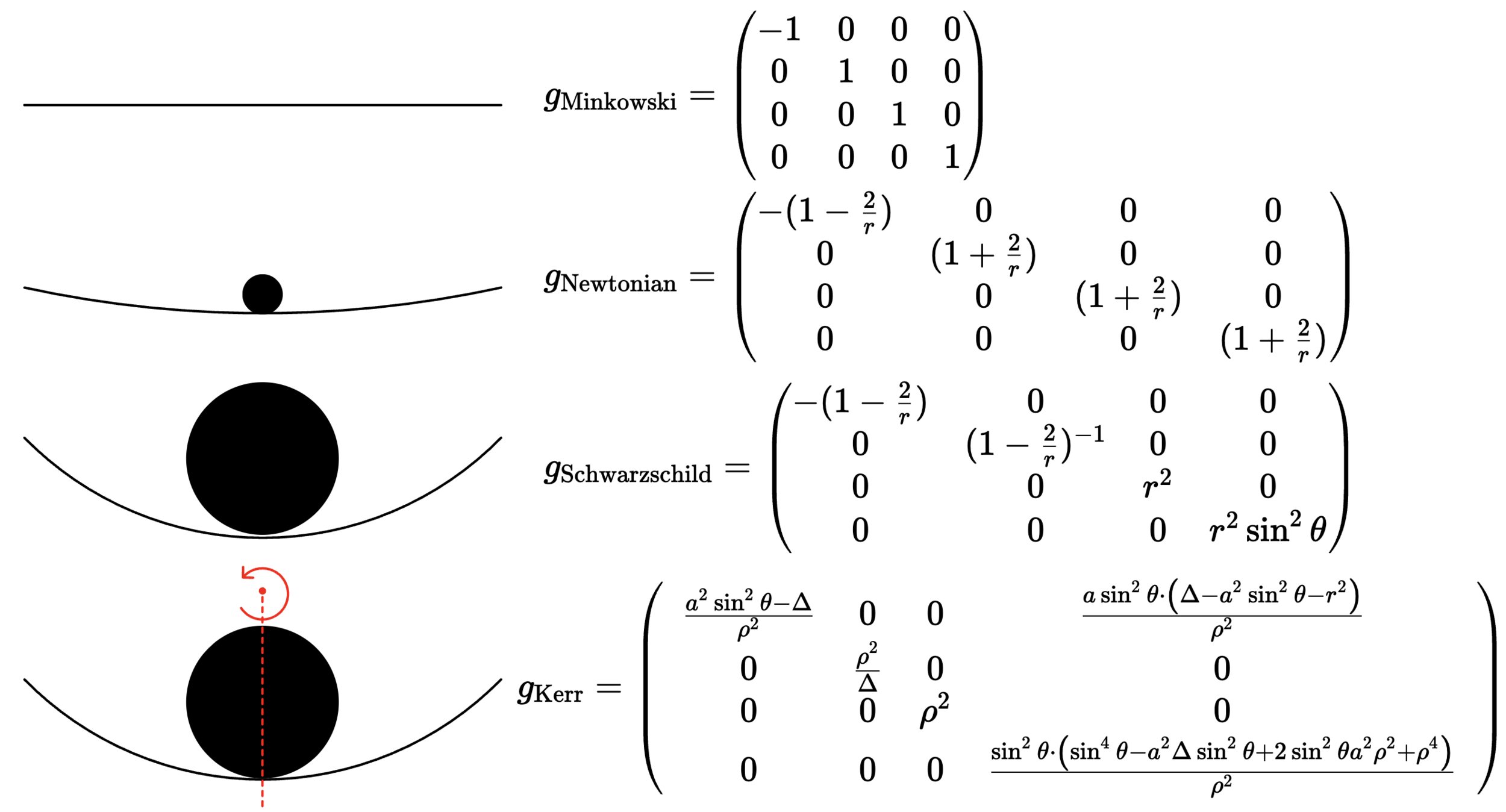
g_{\text{Kerr}}
g_{\text{Schwarzschild}}
g_{\text{Newtonian}}
g_{\text{Minkowski}}
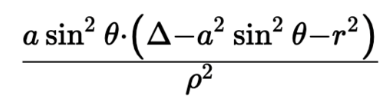
Approach
The Inverse Problem
GENERIC Formalism
Einstein's Field Equations
GENERIC Formalism
GENERIC Formalism
GENERIC Formalism
Synthetic Dissipation
Simulated Dissipation
Birkhoff's Theorem
Ricci Tensor
R_{\mu\nu}-\frac{1}{2}Rg_{\mu\nu}=\frac{8\pi G}{c^4}T_{\mu\nu}
If a metric is a solution to
Einstein's Field Equations,
then R = 0
R^{\mu\nu}R_{\mu\nu}=0
Approach
The Inverse Problem
GENERIC Formalism
Einstein's Field Equations
GENERIC Formalism
GENERIC Formalism
GENERIC Formalism
Synthetic Dissipation
Simulated Dissipation
Birkhoff's Theorem
Ricci Tensor
R_{\mu\nu}-\frac{1}{2}Rg_{\mu\nu}=\frac{8\pi G}{c^4}T_{\mu\nu}
R-\frac{1}{2}R\cdot 4 = 0
g^{\mu\nu}(R_{\mu\nu}-\frac{1}{2}Rg_{\mu\nu}=0)
R_{\mu\nu}-\frac{1}{2}Rg_{\mu\nu}=0
-2R = 0 \to R = 0
The Inverse Problem
GENERIC Formalism
Einstein's Field Equations
GENERIC Formalism
GENERIC Formalism
GENERIC Formalism
Synthetic Dissipation
Simulated Dissipation
Birkhoff's Theorem
Ricci Tensor
Approach
R_{\mu\nu}-\frac{1}{2}Rg_{\mu\nu}=\frac{8\pi G}{c^4}T_{\mu\nu}
The unique spherically symmetric solution to Einstein's Field Equations is a static and asymptotically flat metric"
On the discovery of Birkhoff's theorem (Johansen, F Ravndal, 2005)
g_{\mu\nu}
\Gamma^{\alpha}_{ \mu\nu}
R^{\alpha}_{ \mu\nu\rho}
R_{ \mu\nu}
R
Metric
Christoffel Symbols
Riemann Curvature Tensor
Ricci Curvature Tensor
Ricci Scalar
Einstein's Field Equations: A Brief Intro
g_{\mu\nu}
\Gamma^{\alpha}_{ \mu\nu}
R^{\alpha}_{ \mu\nu\rho}
R_{ \mu\nu}
R
Metric
Christoffel Symbols
Riemann Curvature Tensor
Ricci Curvature Tensor
Ricci Scalar
Einstein's Field Equations: A Brief Intro
Coordinate-Dependent!
g_{\mu\nu}
\Gamma^{\alpha}_{ \mu\nu}
R^{\alpha}_{ \mu\nu\rho}
R_{ \mu\nu}
R
Metric
Christoffel Symbols
Riemann Curvature Tensor
Ricci Curvature Tensor
Ricci Scalar
Einstein's Field Equations: A Brief Intro
Coordinate-Independent!
g_{\mu\nu}
\Gamma^{\alpha}_{ \mu\nu}
R^{\alpha}_{ \mu\nu\rho}
R_{ \mu\nu}
R
R_{\beta \mu \nu}^\alpha=\Gamma_{\beta \nu, \mu}^\alpha-\Gamma_{\beta \mu, \nu}^\alpha+\Gamma_{\mu \rho}^\alpha \Gamma_{\beta \nu}^\rho-\Gamma_{\nu \rho}^\alpha \Gamma_{\beta \mu}^\rho
R_{\mu\nu}=R^{\alpha}_{\mu\alpha\nu}
R = g^{\mu\nu}R_{\mu\nu}
Metric
Christoffel Symbols
Riemann Curvature Tensor
Ricci Curvature Tensor
Ricci Scalar
\Gamma_{\mu \nu}^\alpha=\frac{1}{2} g^{\alpha \beta}\left(g_{\beta \mu, \nu}+g_{\beta \nu, \mu}-g_{\mu \nu, \beta}\right)
Einstein's Field Equations: A Brief Intro
R_{\mu\nu}-\frac{1}{2}Rg_{\mu\nu}=\frac{8\pi G}{c^4}T_{\mu\nu}
g_{\mu\nu}
\Gamma^{\alpha}_{ \mu\nu}
R^{\alpha}_{ \mu\nu\rho}
R_{ \mu\nu}
R
R_{\beta \mu \nu}^\alpha=\Gamma_{\beta \nu, \mu}^\alpha-\Gamma_{\beta \mu, \nu}^\alpha+\Gamma_{\mu \rho}^\alpha \Gamma_{\beta \nu}^\rho-\Gamma_{\nu \rho}^\alpha \Gamma_{\beta \mu}^\rho
R_{\mu\nu}=R^{\alpha}_{\mu\alpha\nu}
R = g^{\mu\nu}R_{\mu\nu}
Metric
Christoffel Symbols
Riemann Curvature Tensor
Ricci Curvature Tensor
Ricci Scalar
\Gamma_{\mu \nu}^\alpha=\frac{1}{2} g^{\alpha \beta}\left(g_{\beta \mu, \nu}+g_{\beta \nu, \mu}-g_{\mu \nu, \beta}\right)
Einstein's Field Equations: A Brief Intro
Ref Bari
R_{\mu\nu}-\frac{1}{2}Rg_{\mu\nu}=\frac{8\pi G}{c^4}T_{\mu\nu}
g_{\mu\nu}
\Gamma^{\alpha}_{ \mu\nu}
R^{\alpha}_{ \mu\nu\rho}
R_{ \mu\nu}
R
R_{\beta \mu \nu}^\alpha=\Gamma_{\beta \nu, \mu}^\alpha-\Gamma_{\beta \mu, \nu}^\alpha+\Gamma_{\mu \rho}^\alpha \Gamma_{\beta \nu}^\rho-\Gamma_{\nu \rho}^\alpha \Gamma_{\beta \mu}^\rho
R_{\mu\nu}=R^{\alpha}_{\mu\alpha\nu}
R = g^{\mu\nu}R_{\mu\nu}
Metric
Christoffel Symbols
Riemann Curvature Tensor
Ricci Curvature Tensor
Ricci Scalar
Einstein's Field Equations: A Brief Intro
\Gamma_{\mu \nu}^\alpha=\frac{1}{2} g^{\alpha \beta}\left(g_{\beta \mu, \nu}+g_{\beta \nu, \mu}-g_{\mu \nu, \beta}\right)
R_{\mu\nu}-\frac{1}{2}Rg_{\mu\nu}=\frac{8\pi G}{c^4}T_{\mu\nu}
g_{\mu\nu}
\Gamma^{\alpha}_{ \mu\nu}
R^{\alpha}_{ \mu\nu\rho}
R_{ \mu\nu}
R
R_{\beta \mu \nu}^\alpha=\Gamma_{\beta \nu, \mu}^\alpha-\Gamma_{\beta \mu, \nu}^\alpha+\Gamma_{\mu \rho}^\alpha \Gamma_{\beta \nu}^\rho-\Gamma_{\nu \rho}^\alpha \Gamma_{\beta \mu}^\rho
R_{\mu\nu}=R^{\alpha}_{\mu\alpha\nu}
R = g^{\mu\nu}R_{\mu\nu}
Metric
Christoffel Symbols
Riemann Curvature Tensor
Ricci Curvature Tensor
Ricci Scalar
Einstein's Field Equations: A Brief Intro
\Gamma_{\mu \nu}^\alpha=\frac{1}{2} g^{\alpha \beta}\left(g_{\beta \mu, \nu}+g_{\beta \nu, \mu}-g_{\mu \nu, \beta}\right)
R_{\mu\nu}-\frac{1}{2}Rg_{\mu\nu}=\frac{8\pi G}{c^4}T_{\mu\nu}
g_{\mu\nu}
\Gamma^{\alpha}_{ \mu\nu}
R^{\alpha}_{ \mu\nu\rho}
R_{ \mu\nu}
R
R_{\beta \mu \nu}^\alpha=\Gamma_{\beta \nu, \mu}^\alpha-\Gamma_{\beta \mu, \nu}^\alpha+\Gamma_{\mu \rho}^\alpha \Gamma_{\beta \nu}^\rho-\Gamma_{\nu \rho}^\alpha \Gamma_{\beta \mu}^\rho
R_{\mu\nu}=R^{\alpha}_{\mu\alpha\nu}
R = g^{\mu\nu}R_{\mu\nu}
Metric
Christoffel Symbols
Riemann Curvature Tensor
Ricci Curvature Tensor
Ricci Scalar
Einstein's Field Equations: A Brief Intro
0 for vacuum
solutions of
field equations!
\Gamma_{\mu \nu}^\alpha=\frac{1}{2} g^{\alpha \beta}\left(g_{\beta \mu, \nu}+g_{\beta \nu, \mu}-g_{\mu \nu, \beta}\right)
R_{\mu\nu}-\frac{1}{2}Rg_{\mu\nu}=8\pi G
R_{\mu\nu}-\frac{1}{2}Rg_{\mu\nu}=8\pi G T_{\mu\nu}
T_{\mu\nu}(x^{\mu})\neq0
g_{\mu\nu}(x^{\mu})\neq0
R_{\mu\nu}(x^{\mu})\neq0
x^{\mu}=(t_0, r_0, \theta_0, \phi_0)
x^{\mu}=(t_1, r_1, \theta_1, \phi_1)
T_{\mu\nu}(x^{\mu})=0
g_{\mu\nu}(x^{\mu})\neq0
R_{\mu\nu}(x^{\mu})=0
Einstein's Field Equations: A Brief Intro
Approach
R_{\mu\nu}-\frac{1}{2}Rg_{\mu\nu}=\frac{8\pi G}{c^4}T_{\mu\nu}
The Inverse Problem
GENERIC Formalism
Einstein's Field Equations
GENERIC Formalism
GENERIC Formalism
GENERIC Formalism
Synthetic Dissipation
Simulated Dissipation
Birkhoff's Theorem
Ricci Tensor
R^{\mu\nu}R_{ \mu\nu}=0
if Neural Network
predicts correct solution
to Einstein's Field Equations!
h(t)\to \{x(t),y(t)\}
H_{Minkowski} = -p_t^2 + p_r^2 + r^2 p_\theta^2+r^2\sin^2\theta p_\phi^2
H_{Schwarzschild} = - \left(1-\frac{2M}{r}\right)^{-1}\frac{p_t^2}{2} + \left(1-\frac{2M}{r}\right) \frac{p_r^2}{2} + \frac{p_φ^2}{2r^2}
Neural ODE
Approach
h(t)\to \{x(t),y(t)\}
H_{Schwarzschild} = - \left(1-\frac{2M}{r}\right)^{-1}\frac{p_t^2}{2} + \left(1-\frac{2M}{r}\right) \frac{p_r^2}{2} + \frac{p_φ^2}{2r^2}
Neural ODE:
Training Data
\dot x=L\nabla E \to \dot x = J \nabla H_{total}

Approach
H_{Minkowski} = -p_t^2 + p_r^2 + r^2 p_\theta^2+r^2\sin^2\theta p_\phi^2
h(t)\to \{x(t),y(t)\}
H_{Minkowski} = -p_t^2 + p_r^2 + r^2 p_\theta^2+r^2\sin^2\theta p_\phi^2
H_{Schwarzschild} = - \left(1-\frac{2M}{r}\right)^{-1}\frac{p_t^2}{2} + \left(1-\frac{2M}{r}\right) \frac{p_r^2}{2} + \frac{p_φ^2}{2r^2}
Neural ODE:
Training Data
\dot x=L\nabla E \to \dot x = J \nabla H_{total} \to \dot x = J \nabla (H_{Mink} + f_{NN}(\theta))
Approach
h(t)\to \{x(t),y(t)\}
H_{Minkowski} = -p_t^2 + p_r^2 + r^2 p_\theta^2+r^2\sin^2\theta p_\phi^2
H_{Schwarzschild} = - \left(1-\frac{2M}{r}\right)^{-1}\frac{p_t^2}{2} + \left(1-\frac{2M}{r}\right) \frac{p_r^2}{2} + \frac{p_φ^2}{2r^2}
Neural ODE:
Training Data
\dot x=L\nabla E \to \dot x = J \nabla H_{total} \to \dot x = J \nabla (H_{Mink} + f_{NN}(\theta))
ODE Solver:
u(t) = [t(t), r(t), \theta(t), \phi(t), p_t(t), p_r(t), p_\theta(t), p_\phi(t)]
Approach
h(t)\to \{x(t),y(t)\}
H_{Minkowski} = -p_t^2 + p_r^2 + r^2 p_\theta^2+r^2\sin^2\theta p_\phi^2
H_{Schwarzschild} = - \left(1-\frac{2M}{r}\right)^{-1}\frac{p_t^2}{2} + \left(1-\frac{2M}{r}\right) \frac{p_r^2}{2} + \frac{p_φ^2}{2r^2}
Neural ODE:
Training Data
\dot x=L\nabla E \to \dot x = J \nabla H_{total} \to \dot x = J \nabla (H_{Mink} + f_{NN}(\theta))
ODE Solver:
u(t) = [t(t), r(t), \theta(t), \phi(t), p_t(t), p_r(t), p_\theta(t), p_\phi(t)]
(r(t), \phi(t)) \to (x(t), y(t)) \to h(t)
Approach
H_{Minkowski} = -p_t^2 + p_r^2 + r^2 p_\theta^2+r^2\sin^2\theta p_\phi^2
H_{Schwarzschild} = - \left(1-\frac{2M}{r}\right)^{-1}\frac{p_t^2}{2} + \left(1-\frac{2M}{r}\right) \frac{p_r^2}{2} + \frac{p_φ^2}{2r^2}
Neural ODE:
Training Data
\dot x=L\nabla E \to \dot x = J \nabla H_{total} \to \dot x = J \nabla (H_{Mink} + f_{NN}(\theta))
ODE Solver:
u(t) = [t(t), r(t), \theta(t), \phi(t), p_t(t), p_r(t), p_\theta(t), p_\phi(t)]
(r(t), \phi(t)) \to (x(t), y(t)) \to h(t)
BFGS Optimizer:
\begin{align*}\text{min}_{\eta} \sum &(h_{pred}-h_{true})^2 + \text{(NN\_params)}^2+R^{\mu\nu}R_{\mu\nu} \end{align*}
Neural ODE:
Training Data:
H_{pred} = \frac{1}{2}p^T g_{pred} p = \frac{1}{2}p^T [g_{Mink}+f_{NN}] p \to \dot x = L\nabla H_{pred}
ODE Solver:
u(t) = [t(t), r(t), \theta(t), \phi(t), p_t(t), p_r(t), p_\theta(t), p_\phi(t)]
(r(t), \phi(t)) \to (x(t), y(t)) \to h(t)
BFGS Optimizer:
\begin{align*}\text{min}_{\eta} \sum &(h_{pred}-h_{true})^2 + \text{(NN\_params)}^2+R^{\mu\nu}R_{\mu\nu} \end{align*}
\frac{du}{d\tau} = L \nabla H_{Schwarzschild} \to \frac{du}{dt} = \frac{du}{d\tau}\frac{d\tau}{dt} \to u(t) \to h(t)
g_{Minkowski}=\begin{pmatrix}
-1 & 0 & 0 & 0\\
0 & 1 & 0 & 0\\
0 & 0 & r^2 & 0 \\
0 & 0 & 0 & r^{2}\sin^2\theta
\end{pmatrix}
g_{Schwarzschild} = \begin{pmatrix}
-\left(1-\frac{2M}{r} \right) & 0 & 0 & 0 \\
0 & \left(1-\frac{2M}{r} \right)^{-1} & 0 & 0 \\
0 & 0 & r^2 & 0 \\
0 & 0 & 0 & r^2
\end{pmatrix}
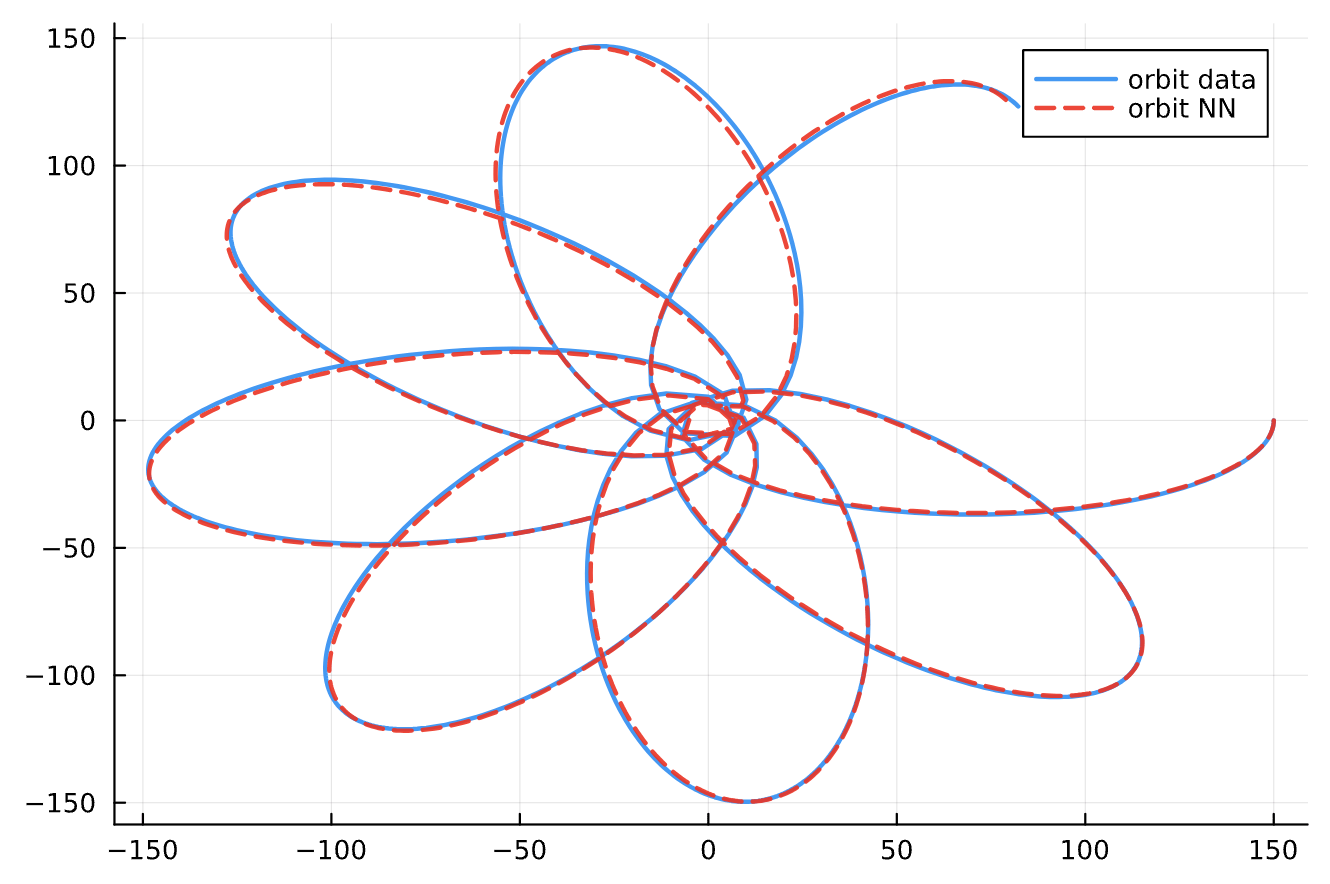
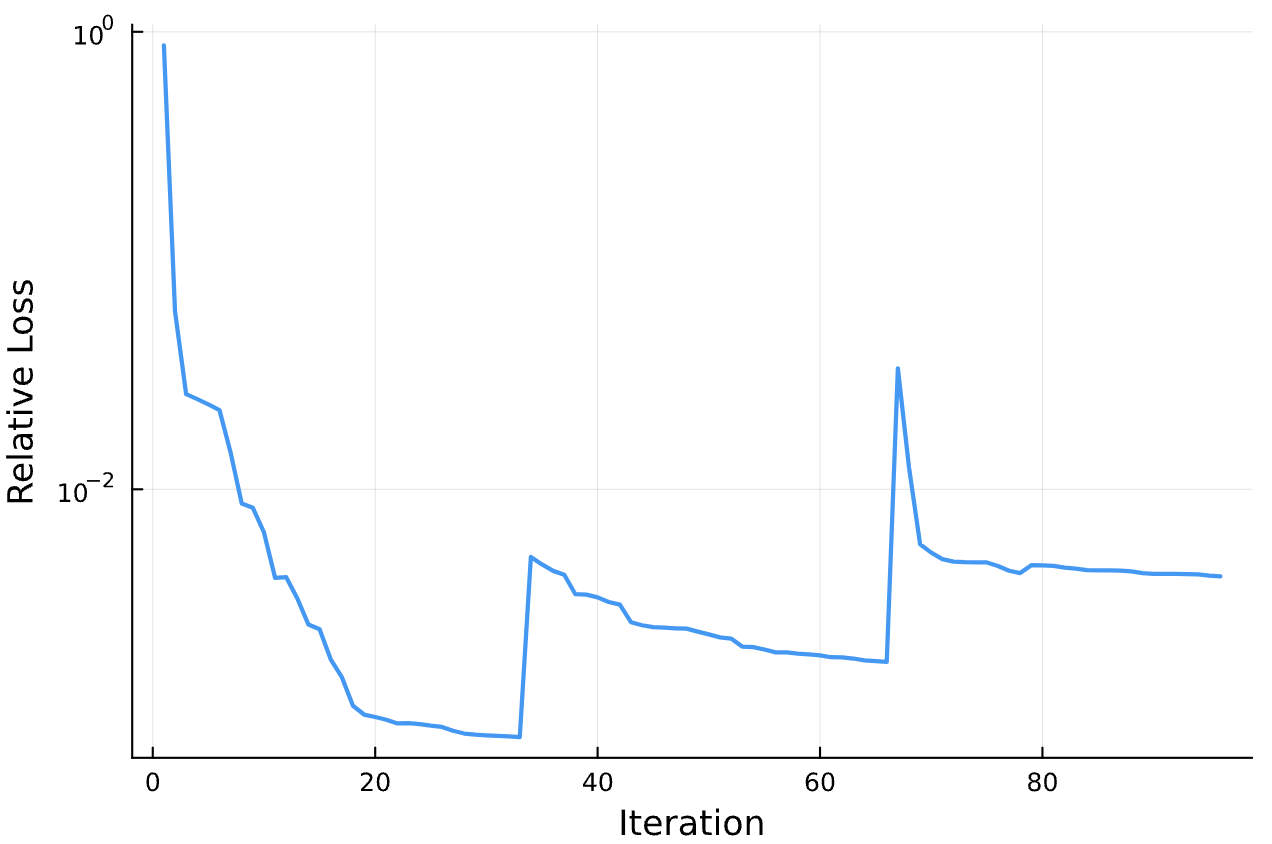
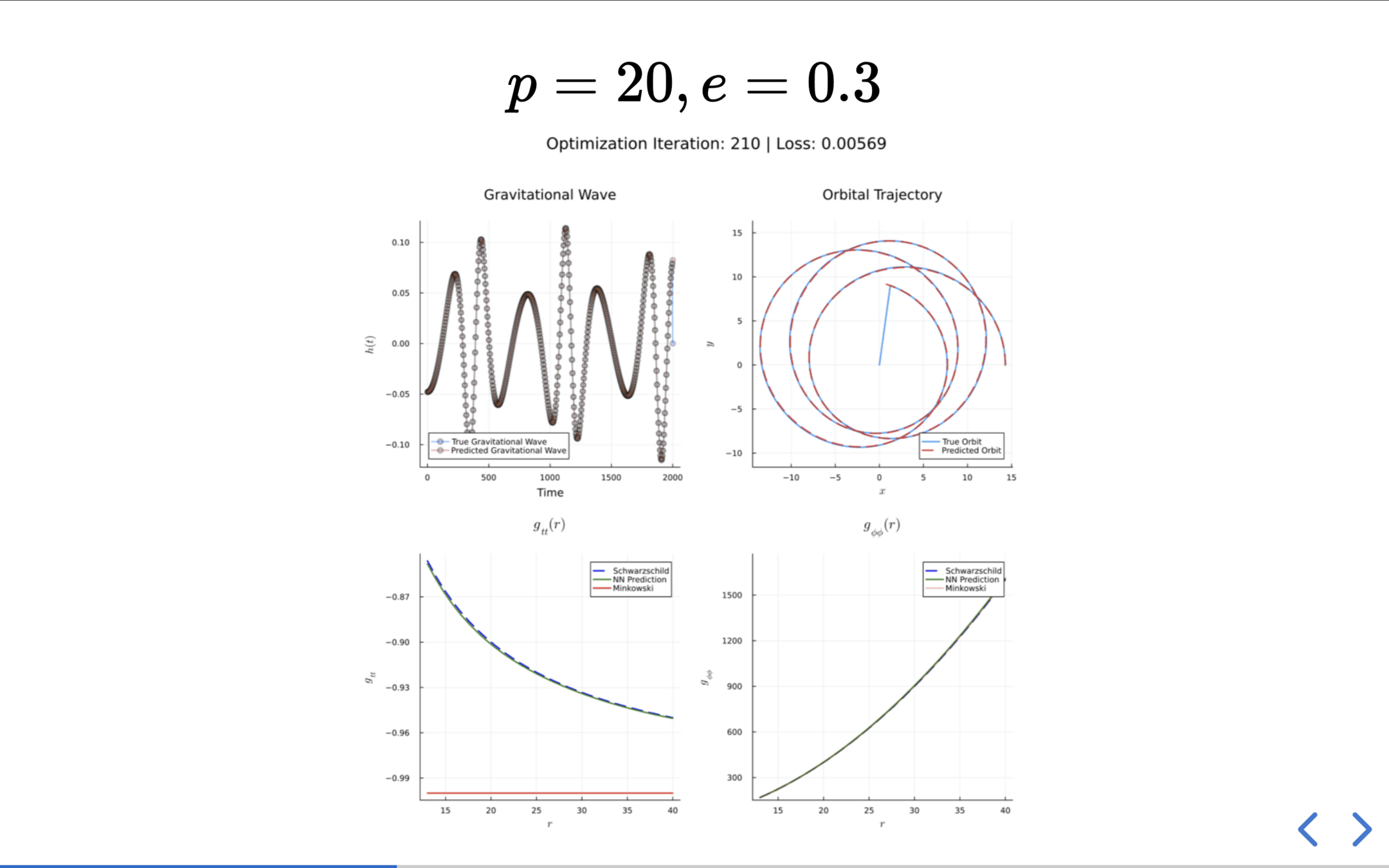
Results
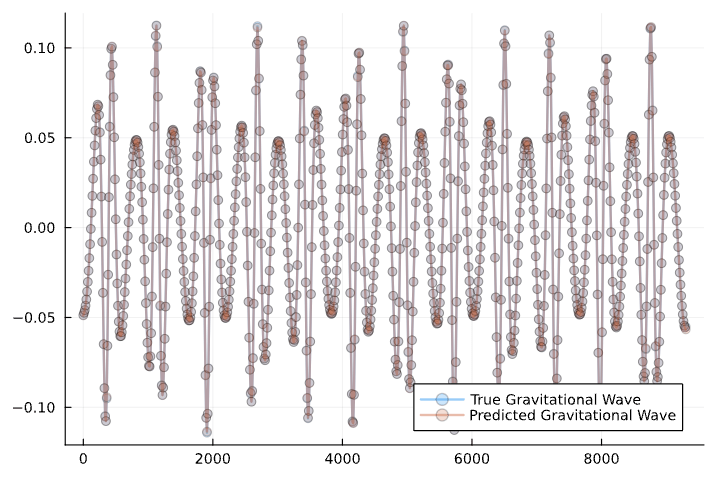
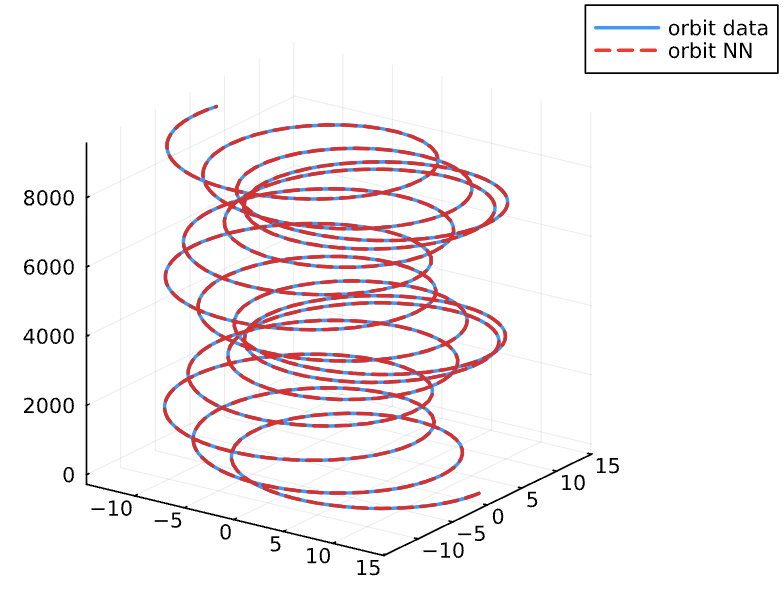
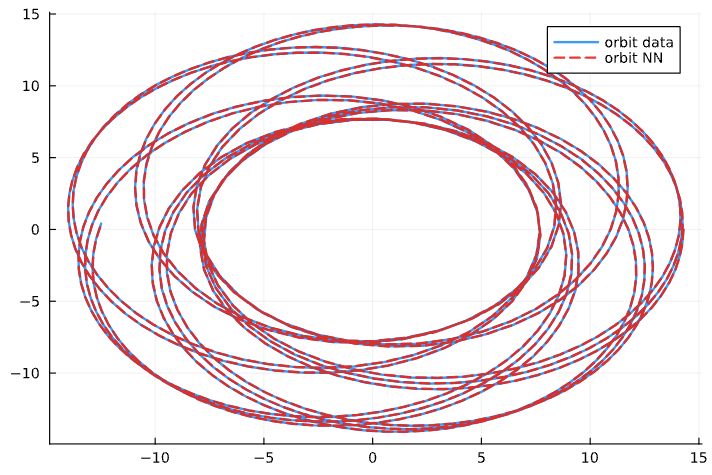
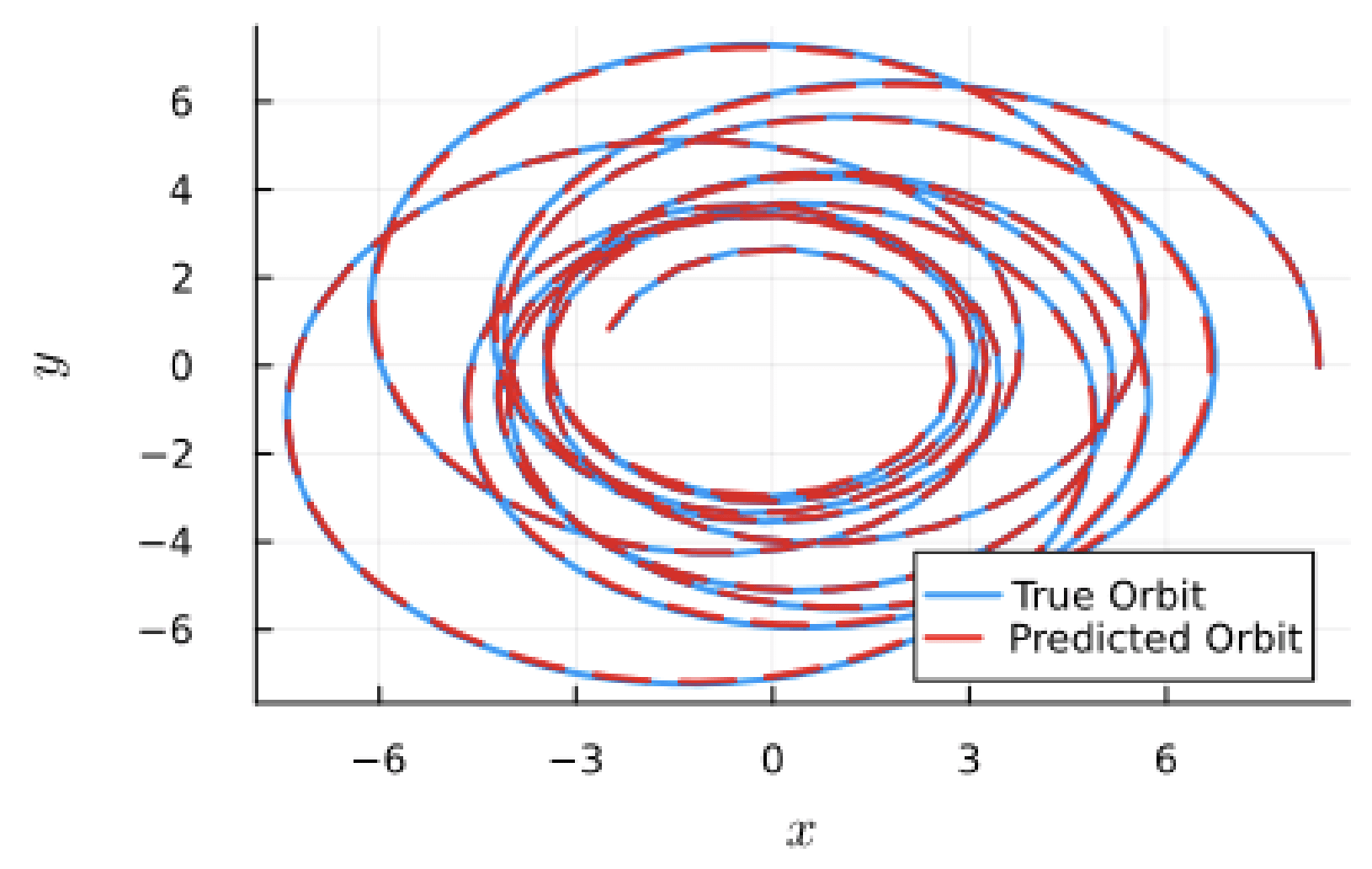
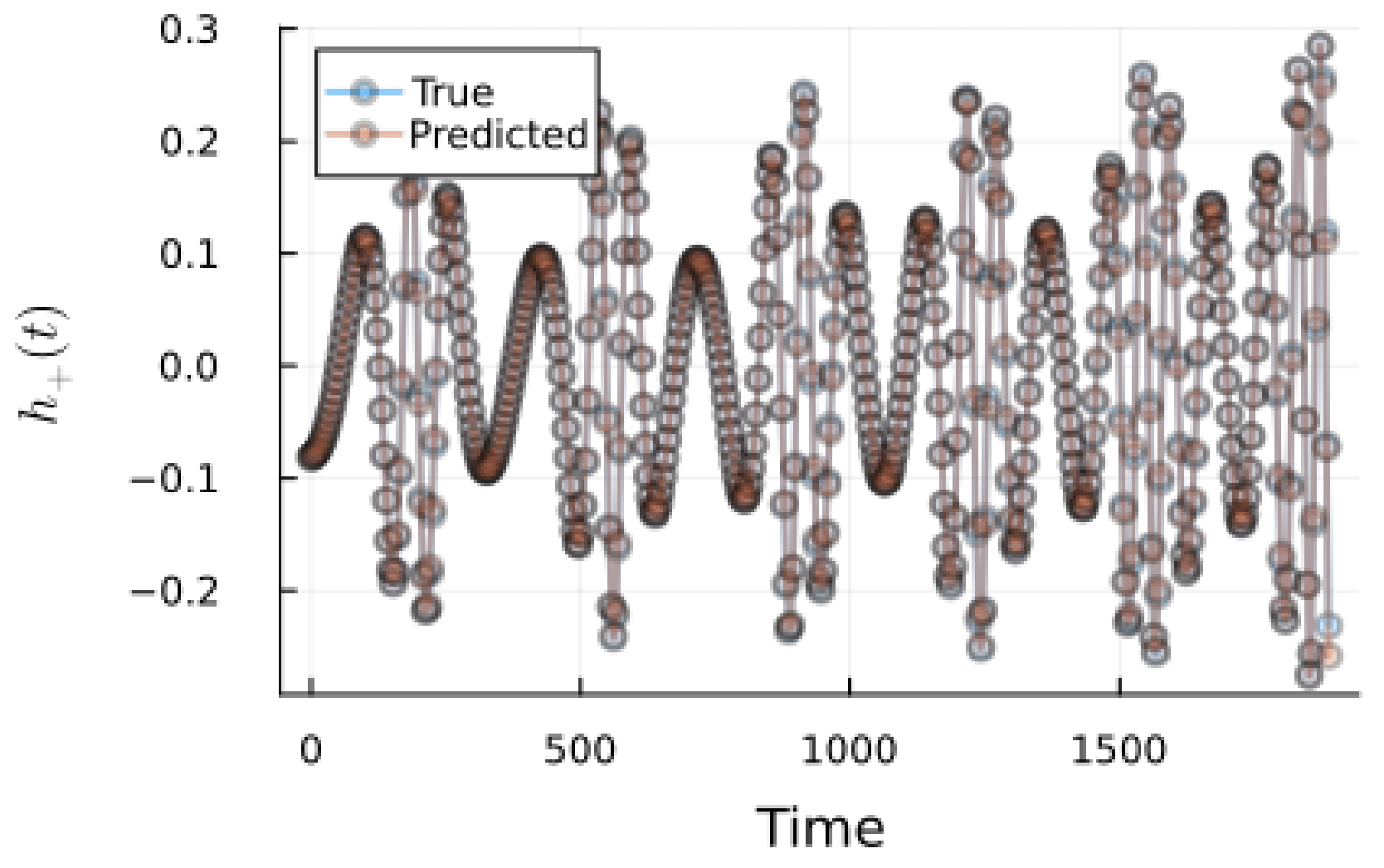
(p,e)=(20, 0.3)
Results
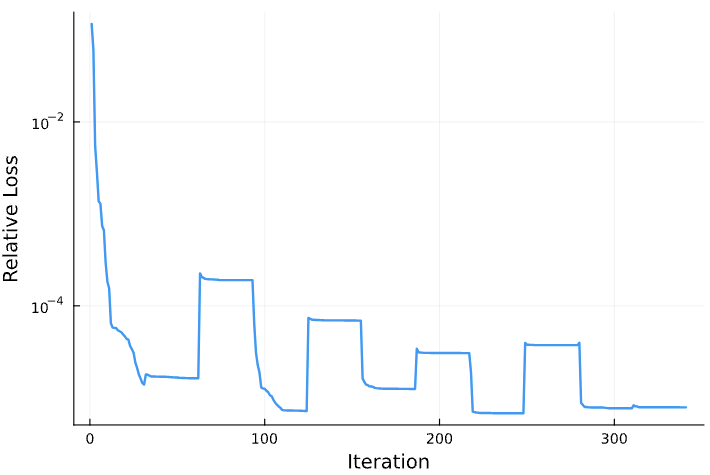
(p,e)=(40, 0.6)
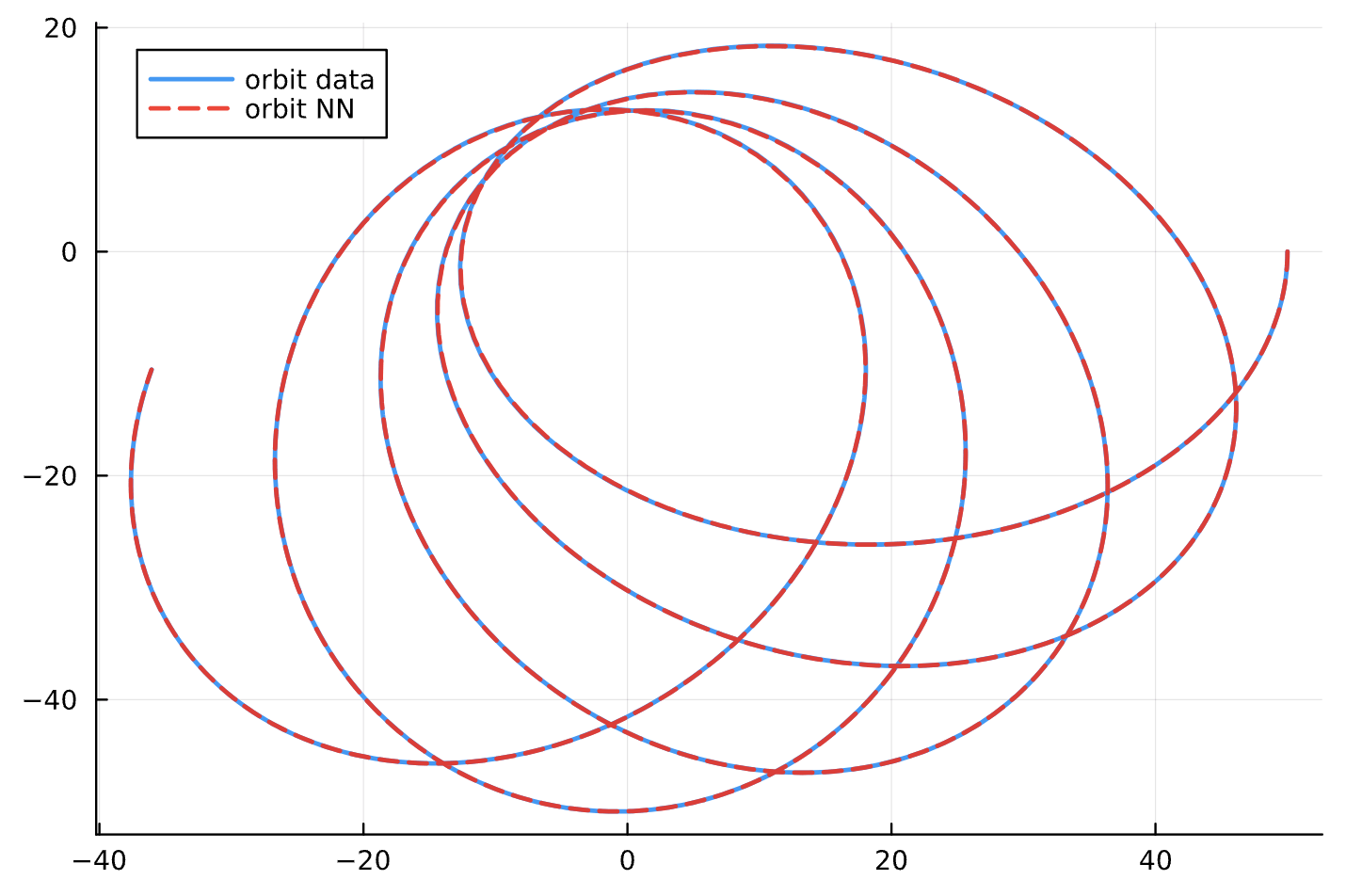
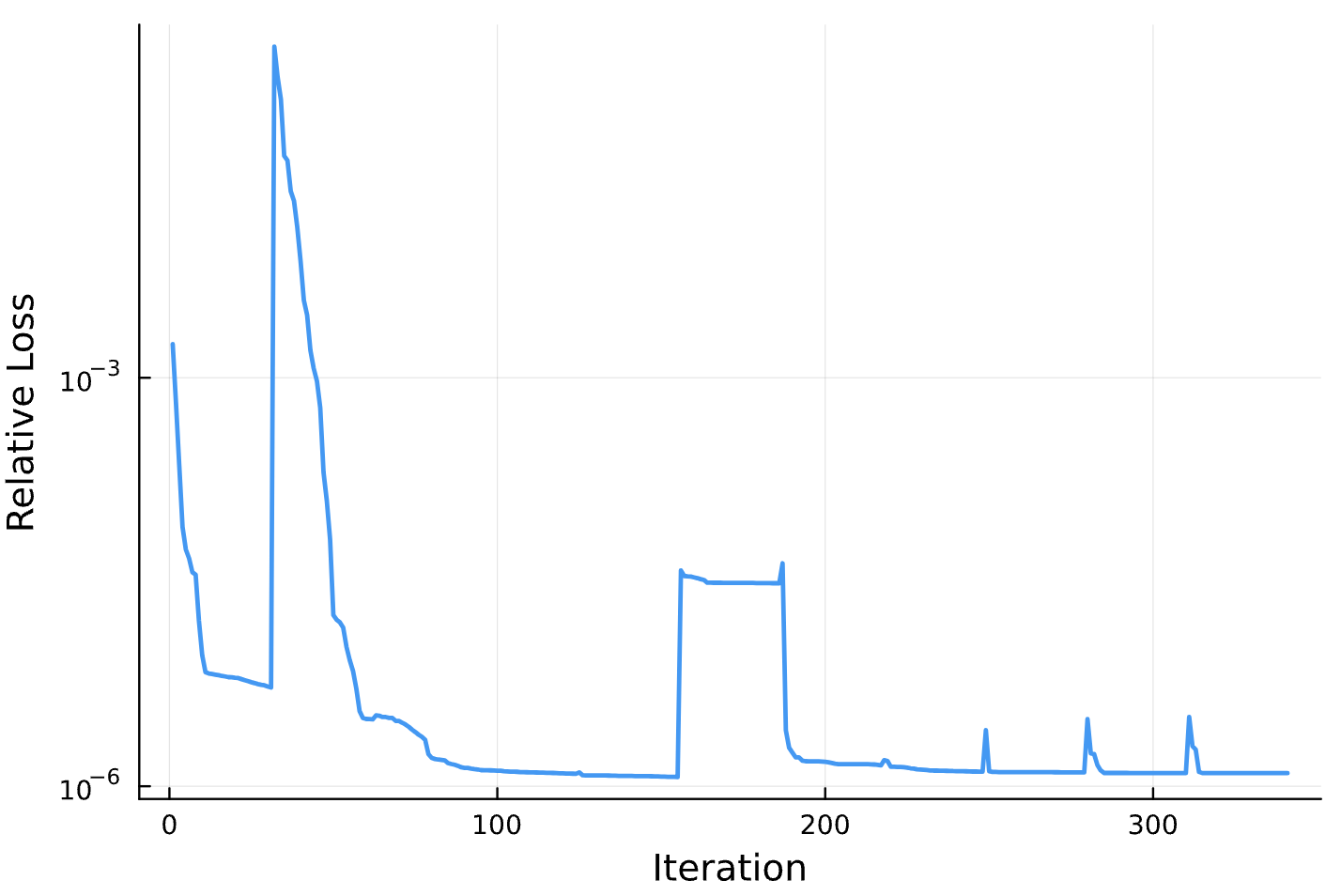
Results
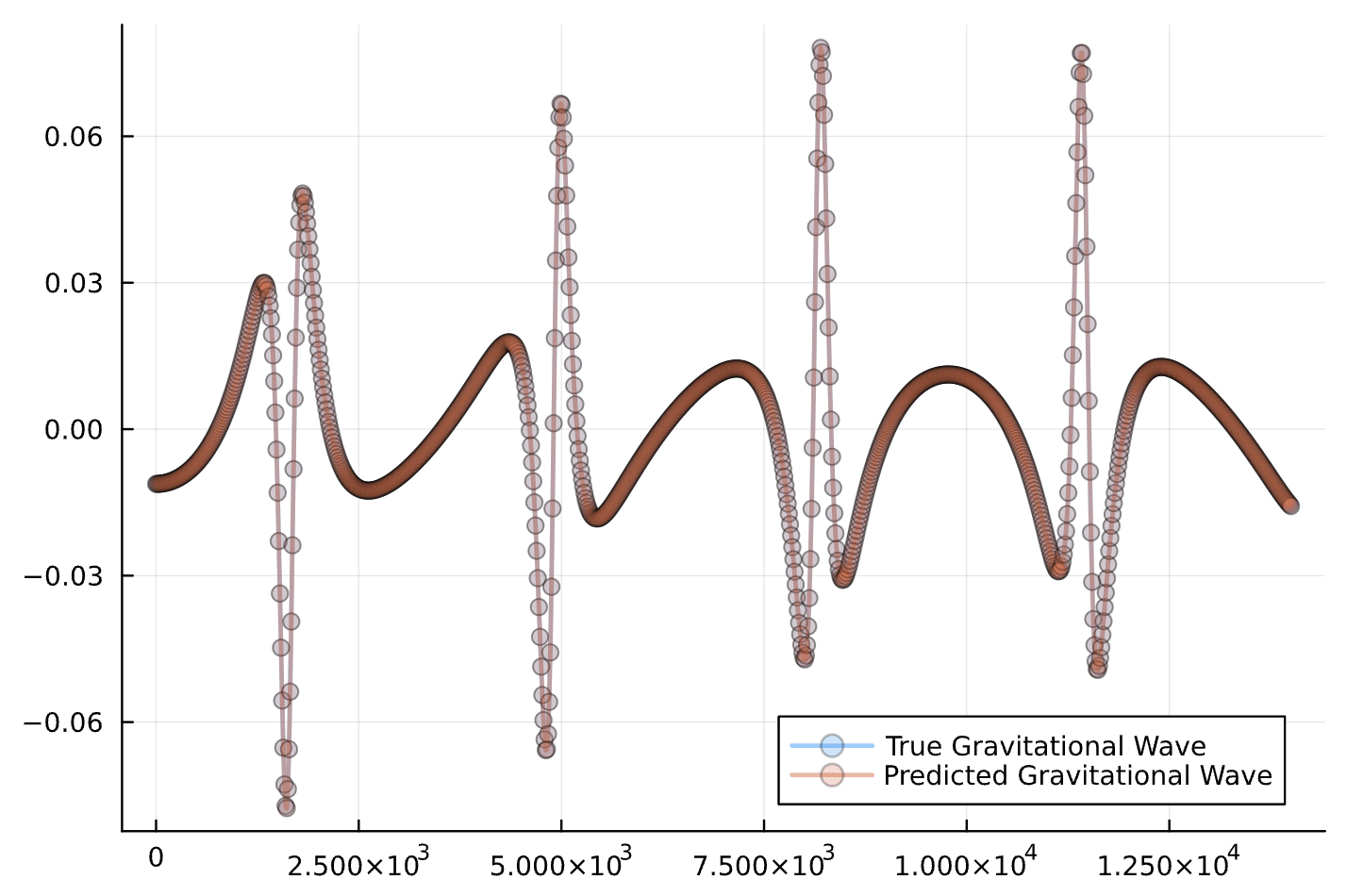
(p,e)=(30, 0.5)
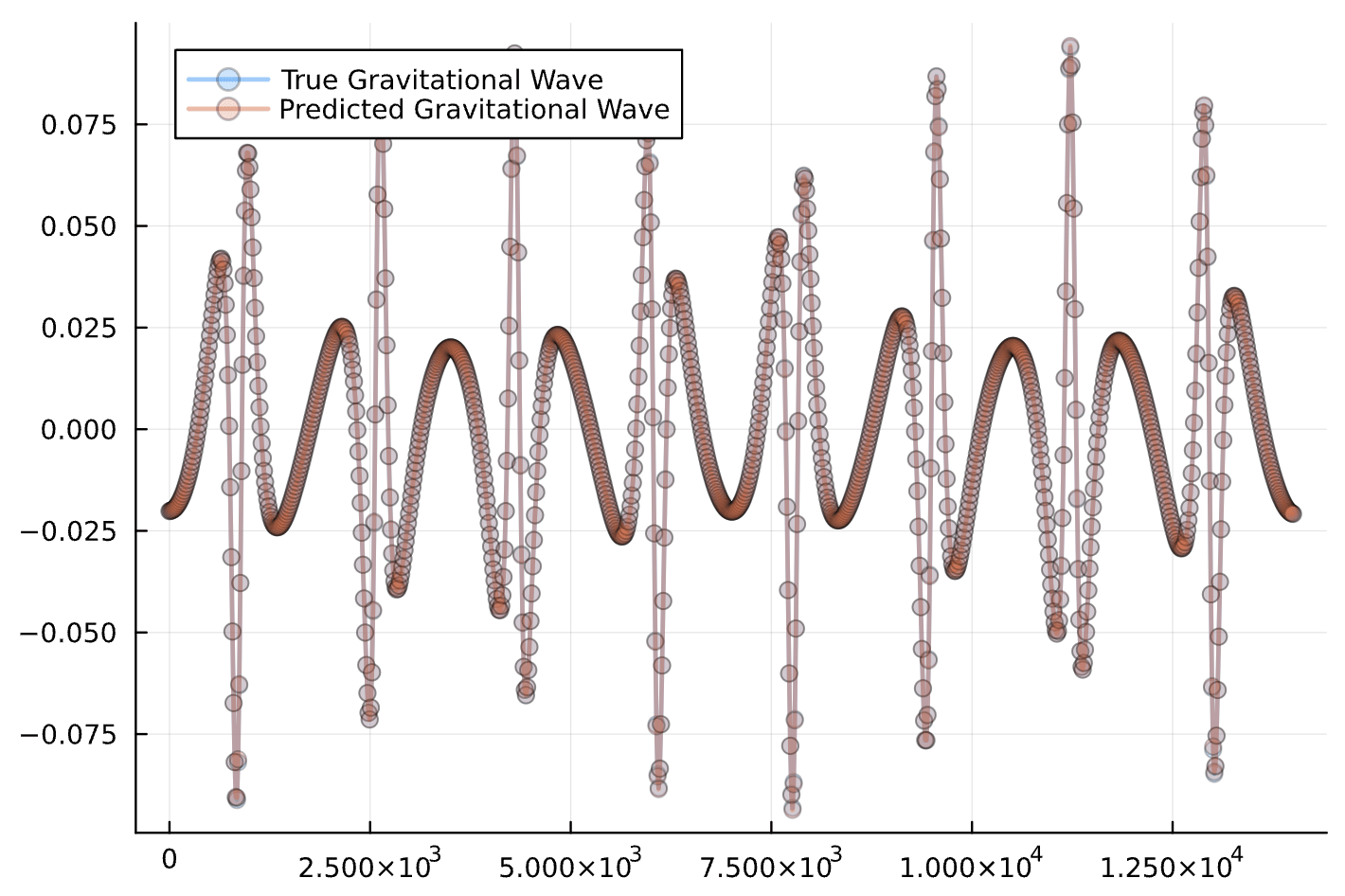
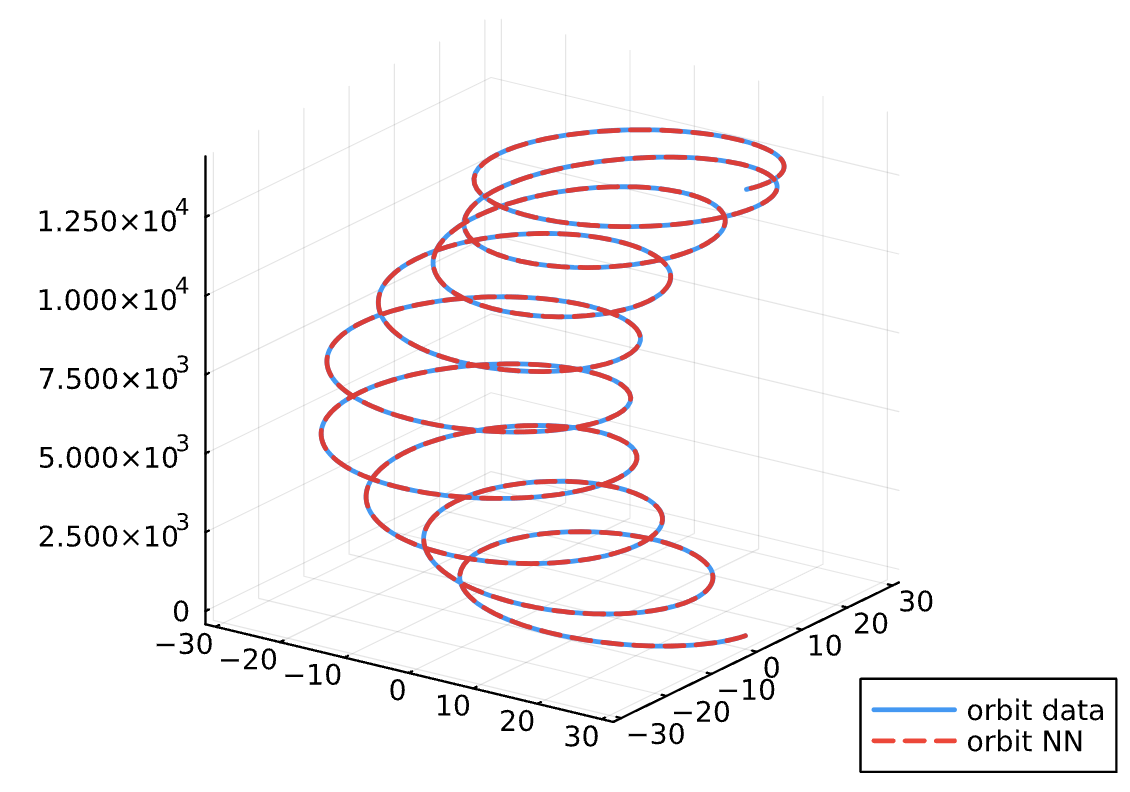
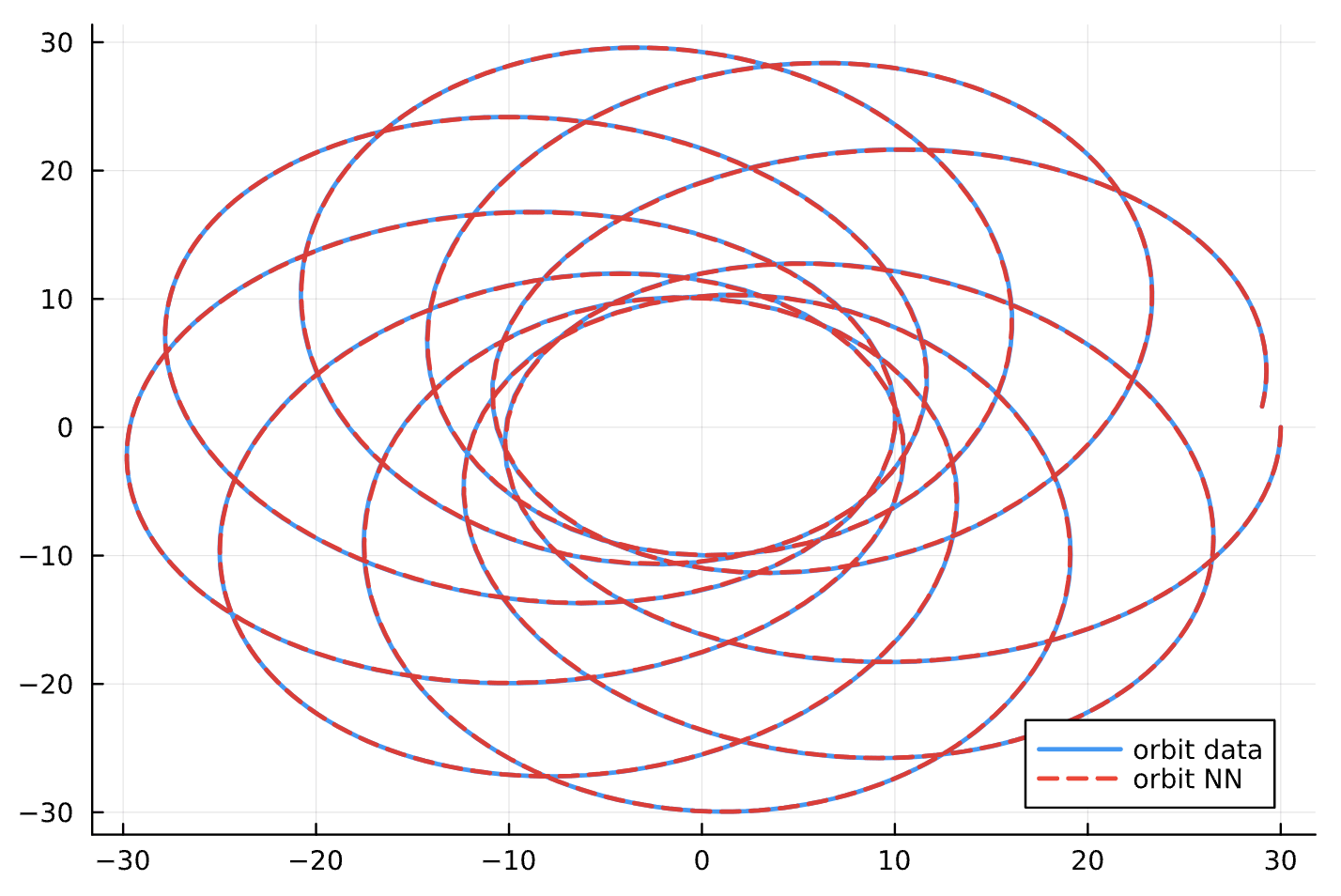
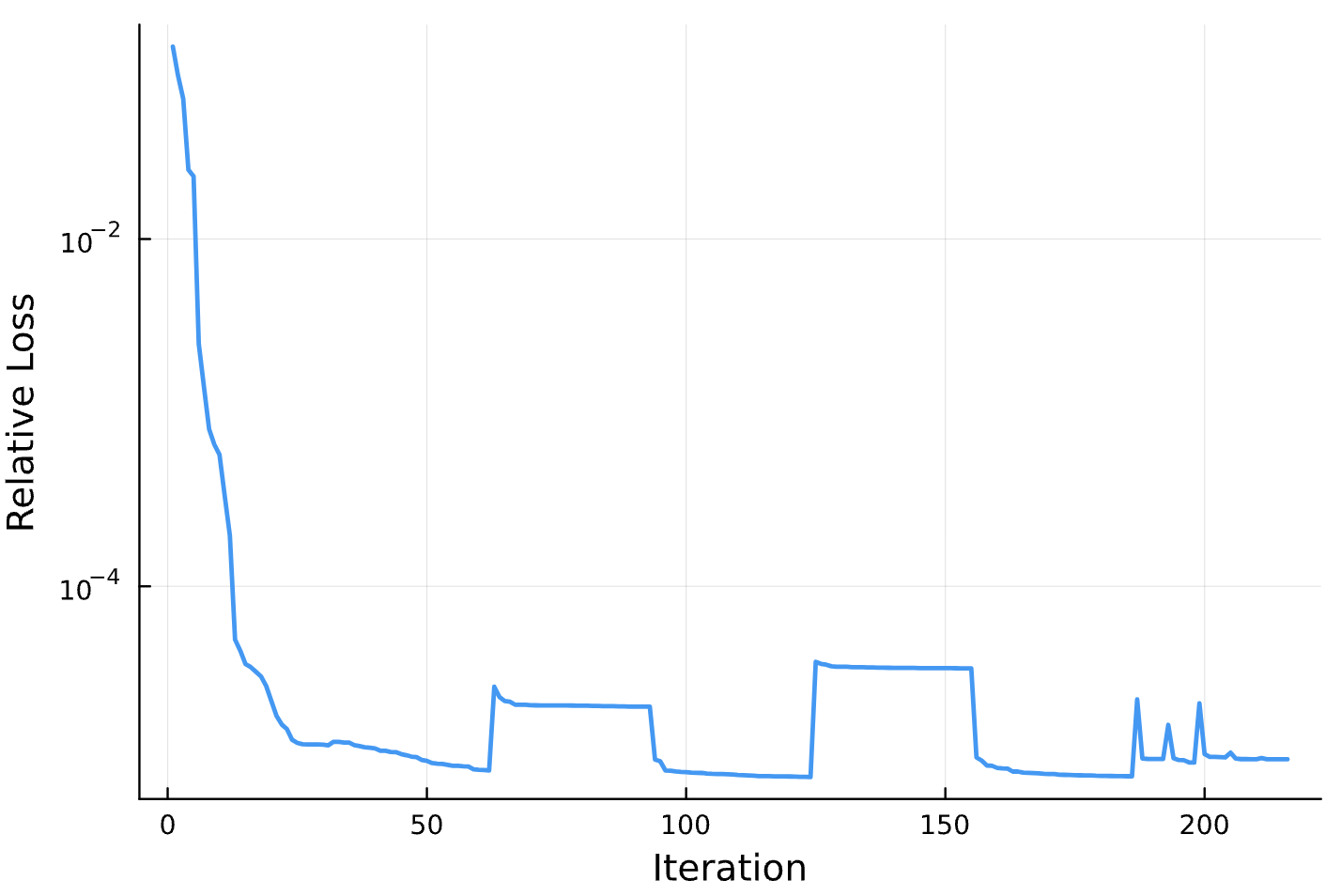
Results
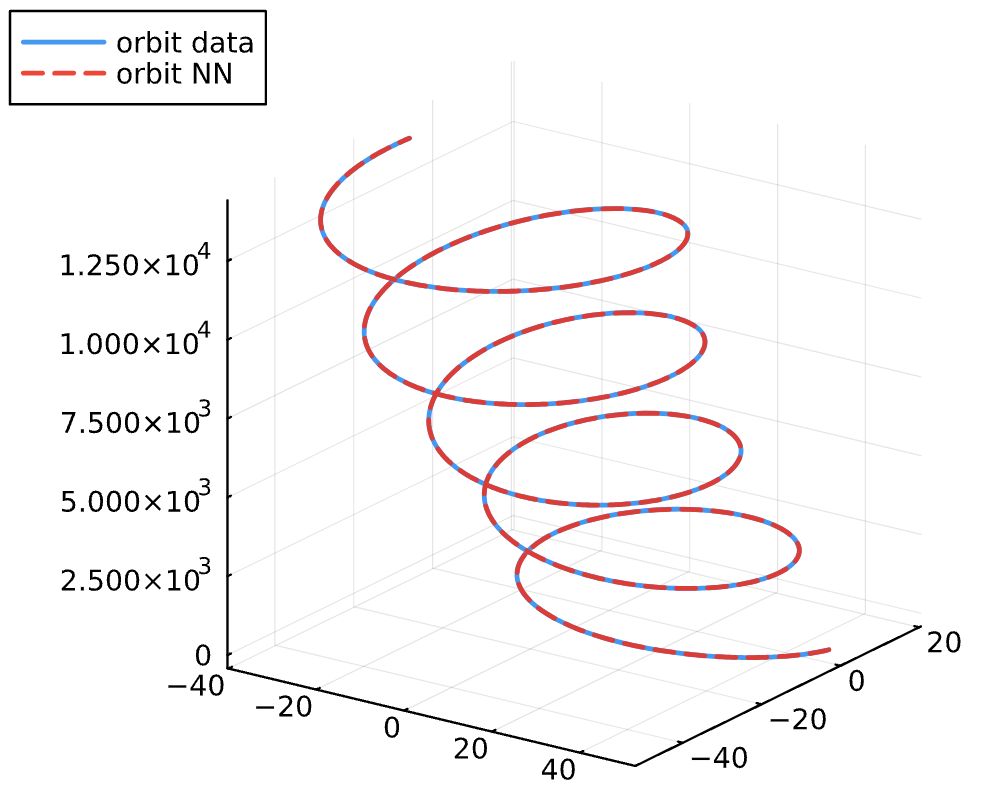
(p,e)=(30, 0.9)
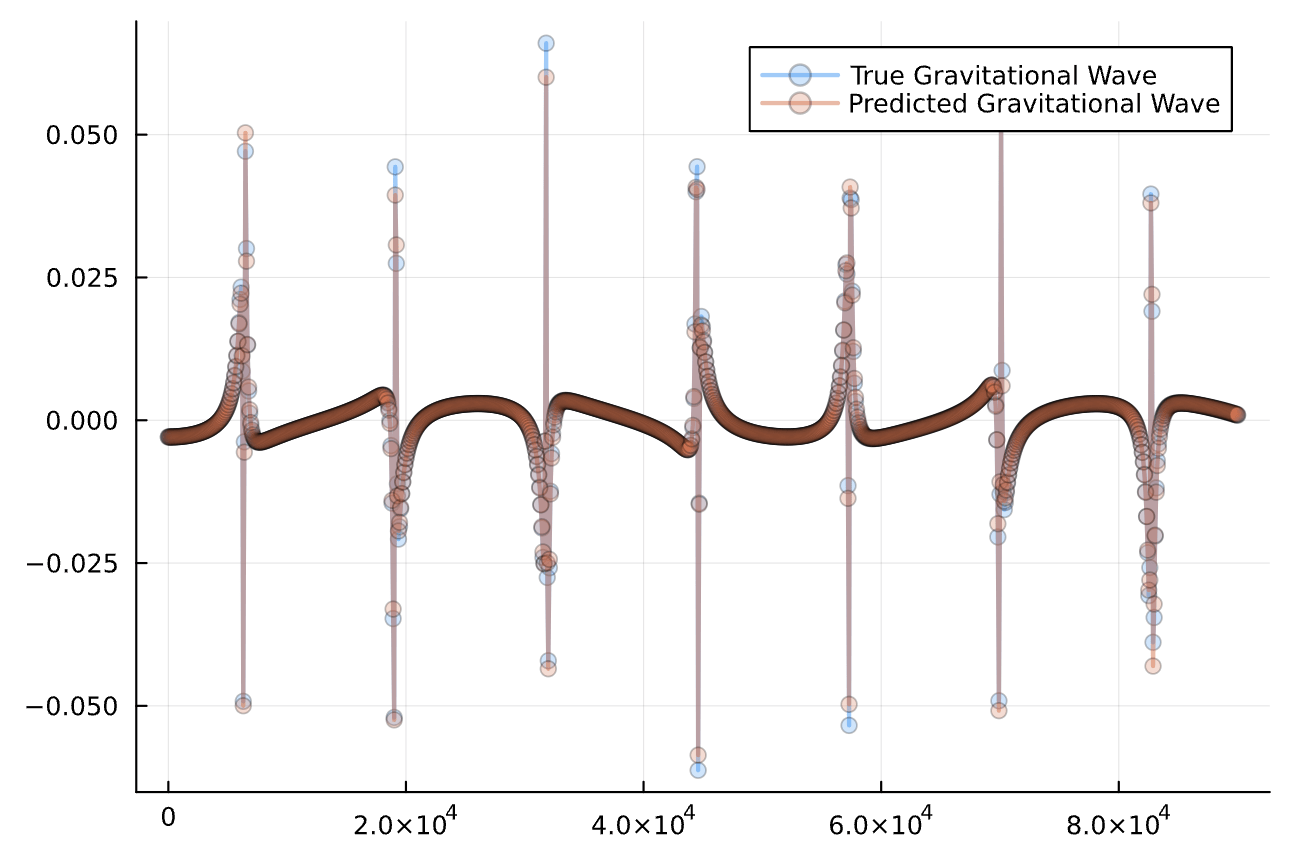
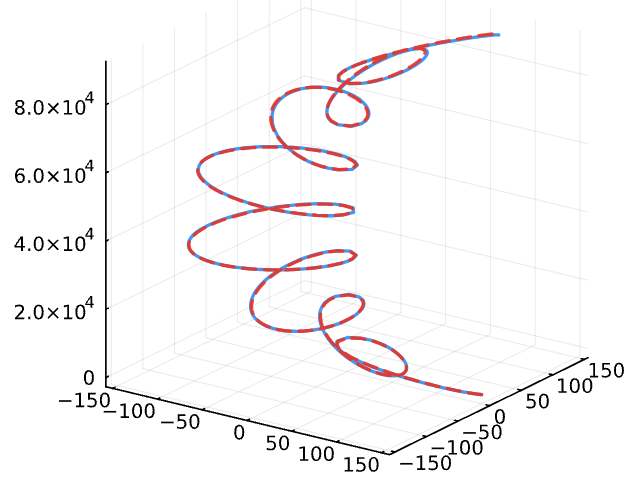
The Inverse Problem
GENERIC Formalism
Einstein's Field Equations
GENERIC Formalism
GENERIC Formalism
GENERIC Formalism
Synthetic Dissipation
Simulated Dissipation
Birkhoff's Theorem
Ricci Tensor
Results
The Inverse Problem
GENERIC Formalism
Einstein's Field Equations
GENERIC Formalism
GENERIC Formalism
GENERIC Formalism
Synthetic Dissipation
Simulated Dissipation
Birkhoff's Theorem
Ricci Tensor
Results
The Inverse Problem
GENERIC Formalism
Einstein's Field Equations
GENERIC Formalism
GENERIC Formalism
GENERIC Formalism
Synthetic Dissipation
Simulated Dissipation
Birkhoff's Theorem
Ricci Tensor
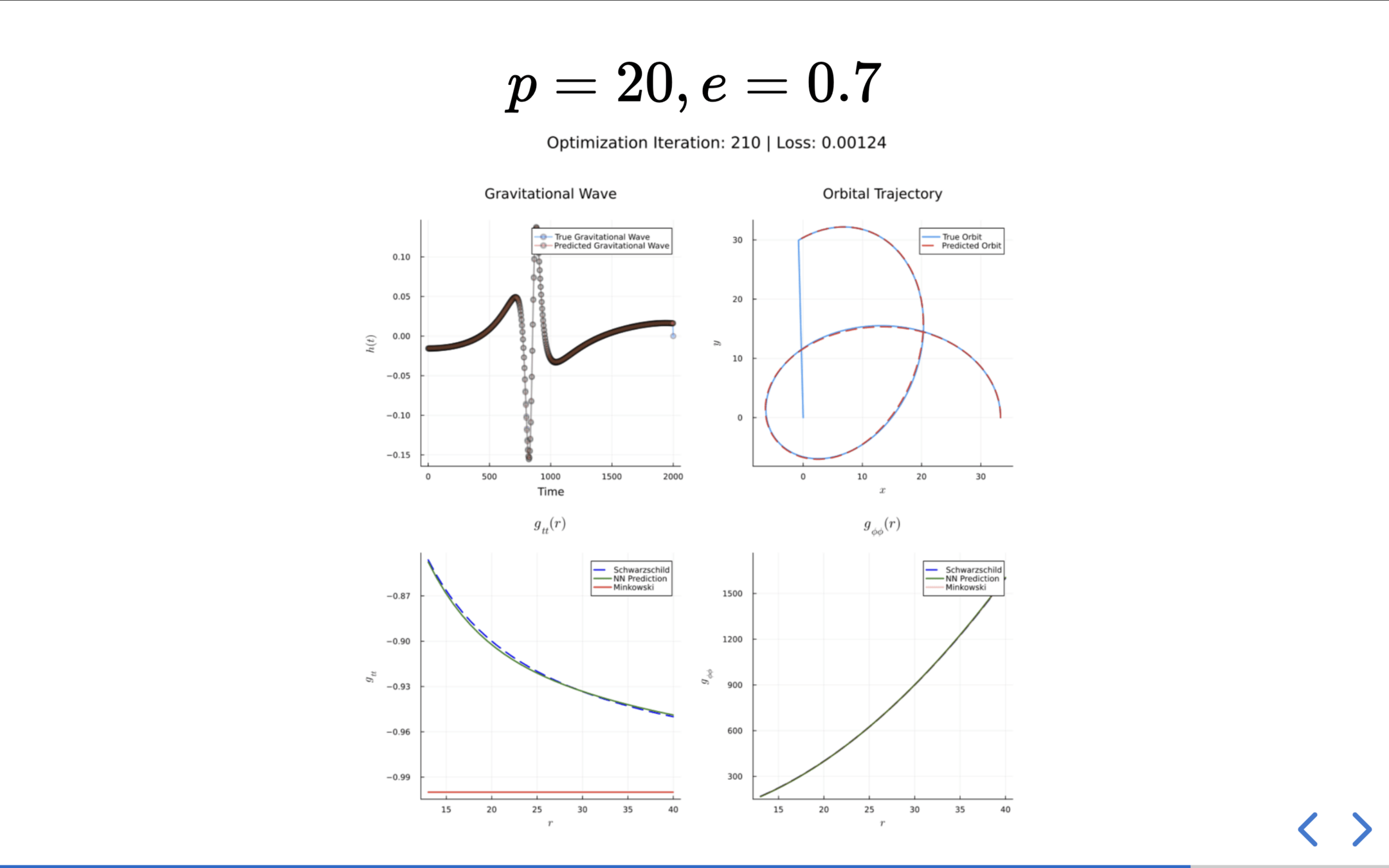
Results
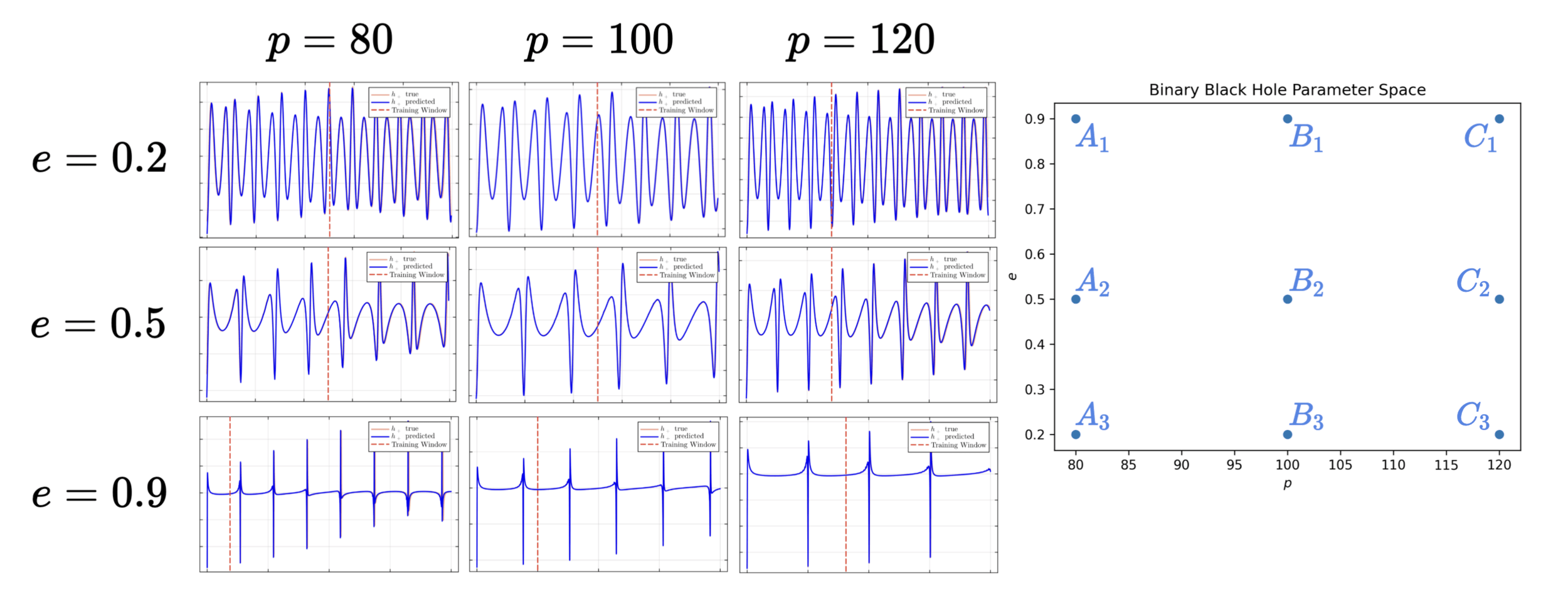
Results
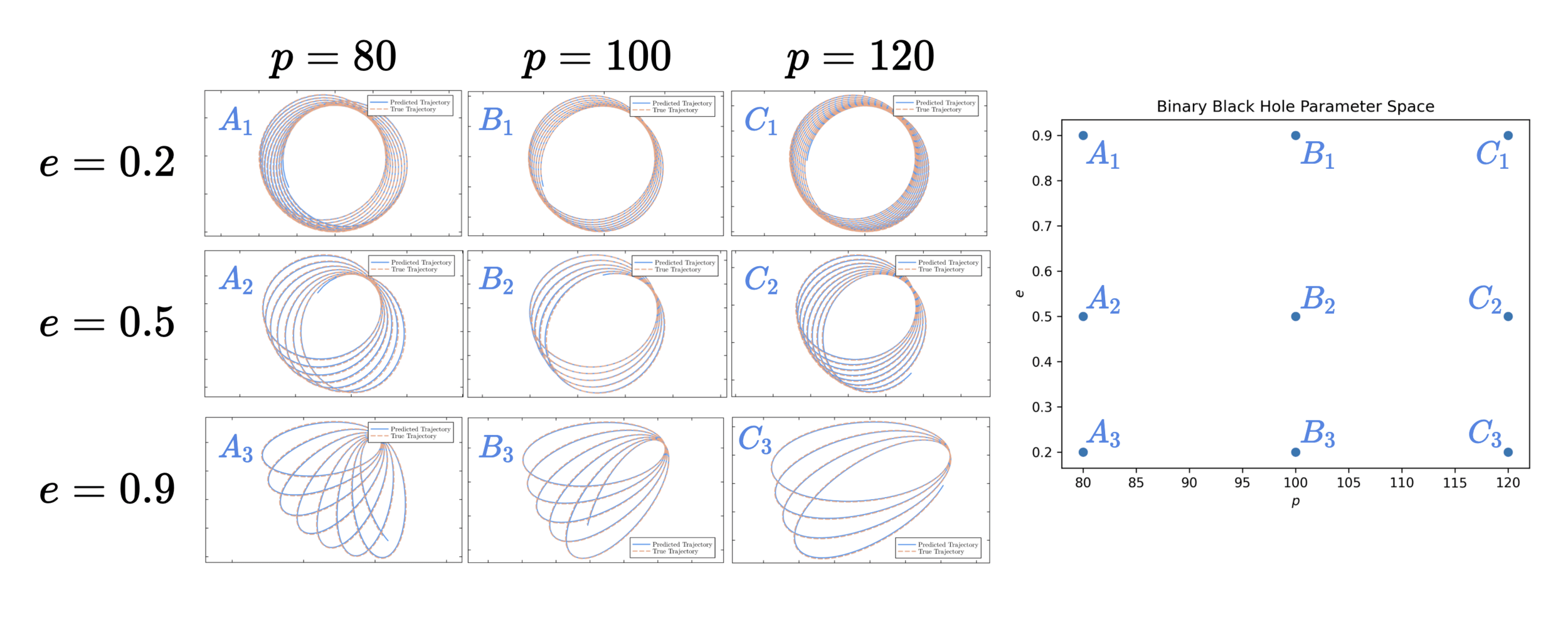
Results
The Inverse Problem
GENERIC Formalism
Einstein's Field Equations
GENERIC Formalism
GENERIC Formalism
GENERIC Formalism
Synthetic Dissipation
Simulated Dissipation
Birkhoff's Theorem
Ricci Tensor
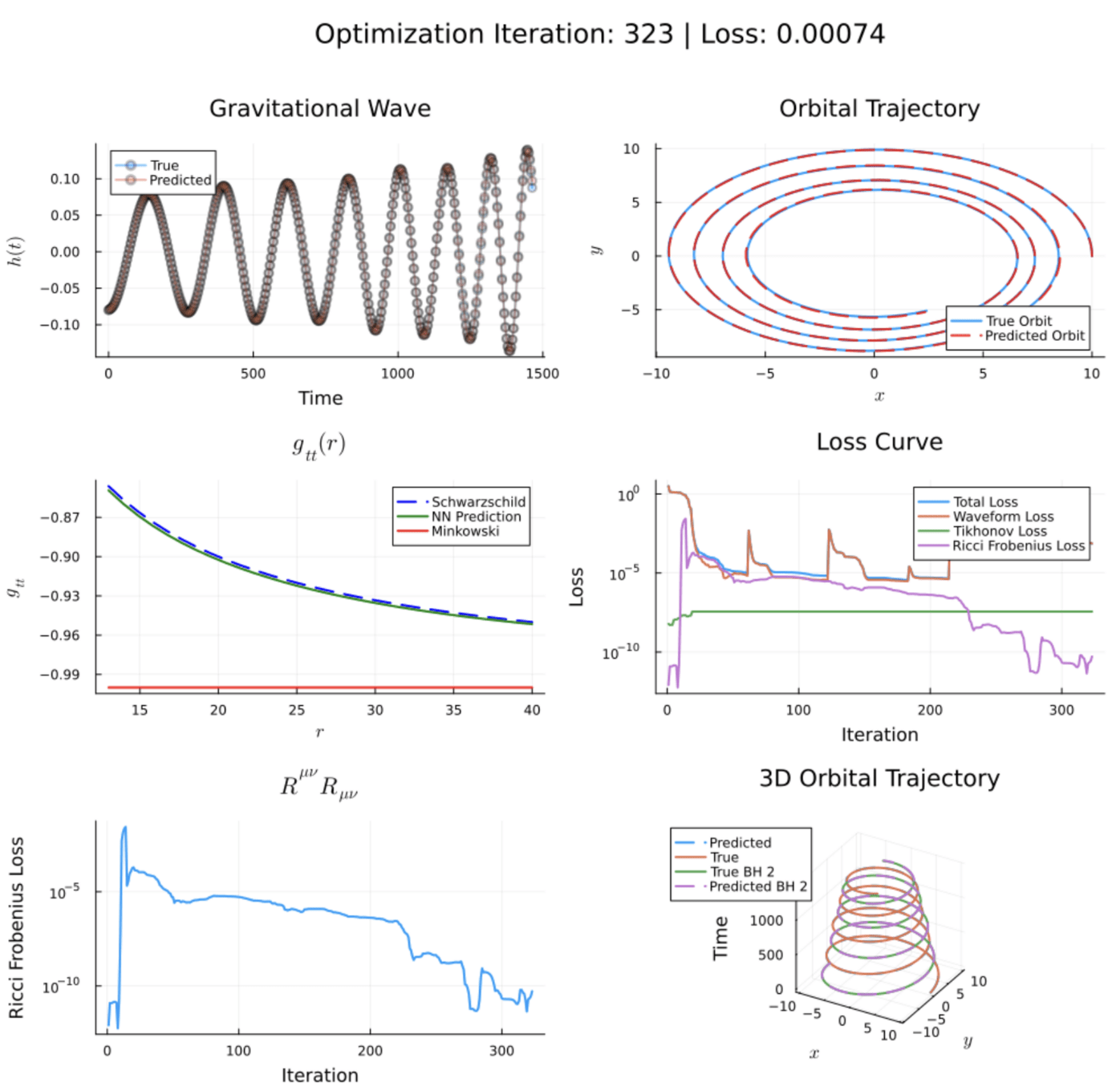
Results
Results
r
\sigma=\tanh
\sigma=\tanh
g_{\text{predicted}}=\begin{pmatrix}
-1*g_{tt}(r) & 0 & 0 & 0 \\
0 & 1*g_{rr}(r) & 0 & 0 \\
0 & 0 & r^2 & 0 \\
0 & 0 & 0 & r^2\sin^2\theta
\end{pmatrix}
g_{tt}=1-\text{softplus}(f_{tt})
(1, 10)
(10, 10)
(10, 1)
f_{tt}
f_{rr}
g_{rr}=1+\text{softplus}(f_{rr})
g_{\text{ansatz}}=\begin{pmatrix}
-1 & 0 & 0 & 0 \\
0 & 1 & 0 & 0 \\
0 & 0 & r^2 & 0 \\
0 & 0 & 0 & r^2\sin^2\theta
\end{pmatrix}
\mathcal{L}=|h-\hat{h}|^2 + |R_{\mu\nu}R^{\mu\nu}|^2
Update
\eta
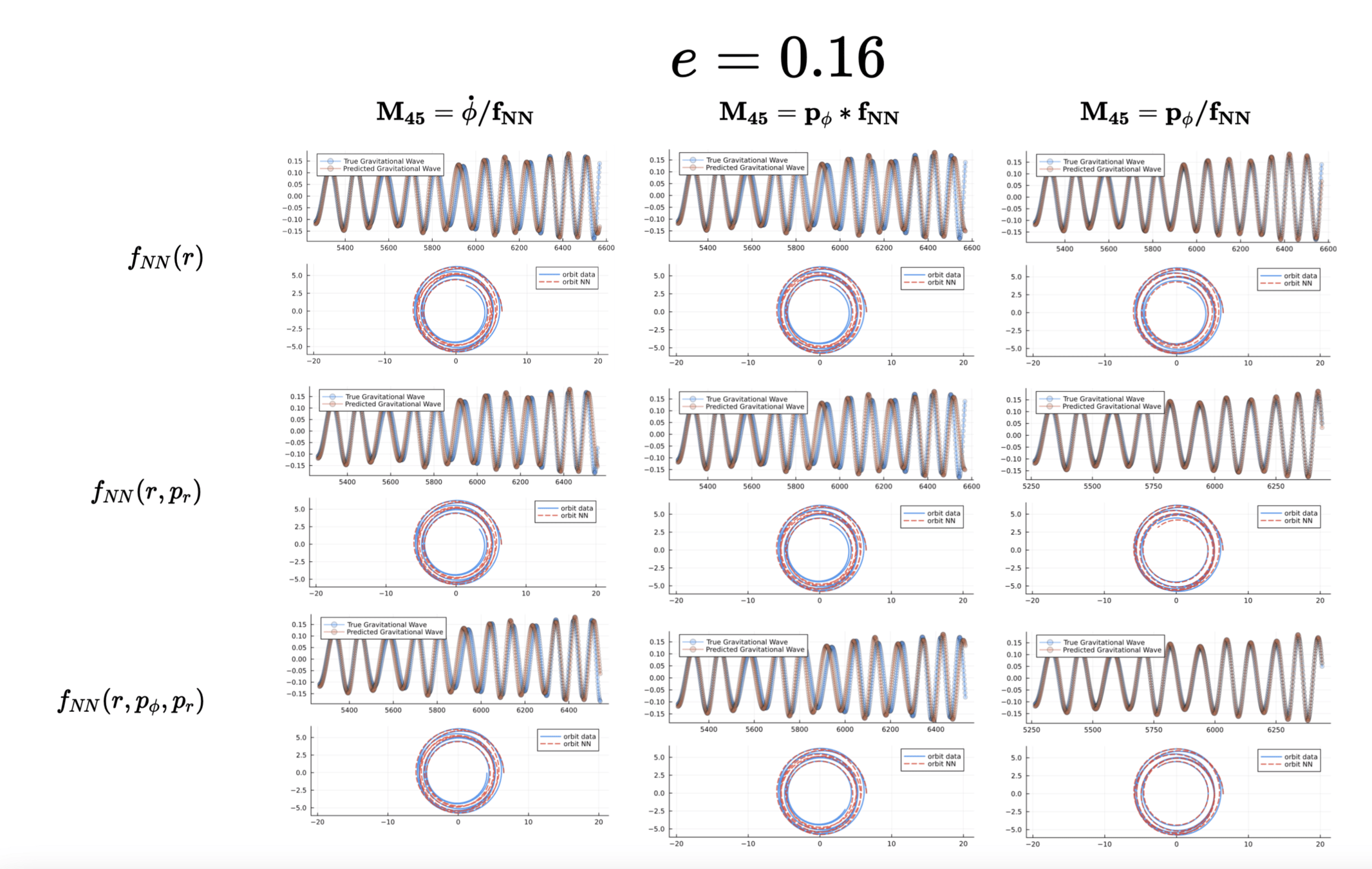
Results
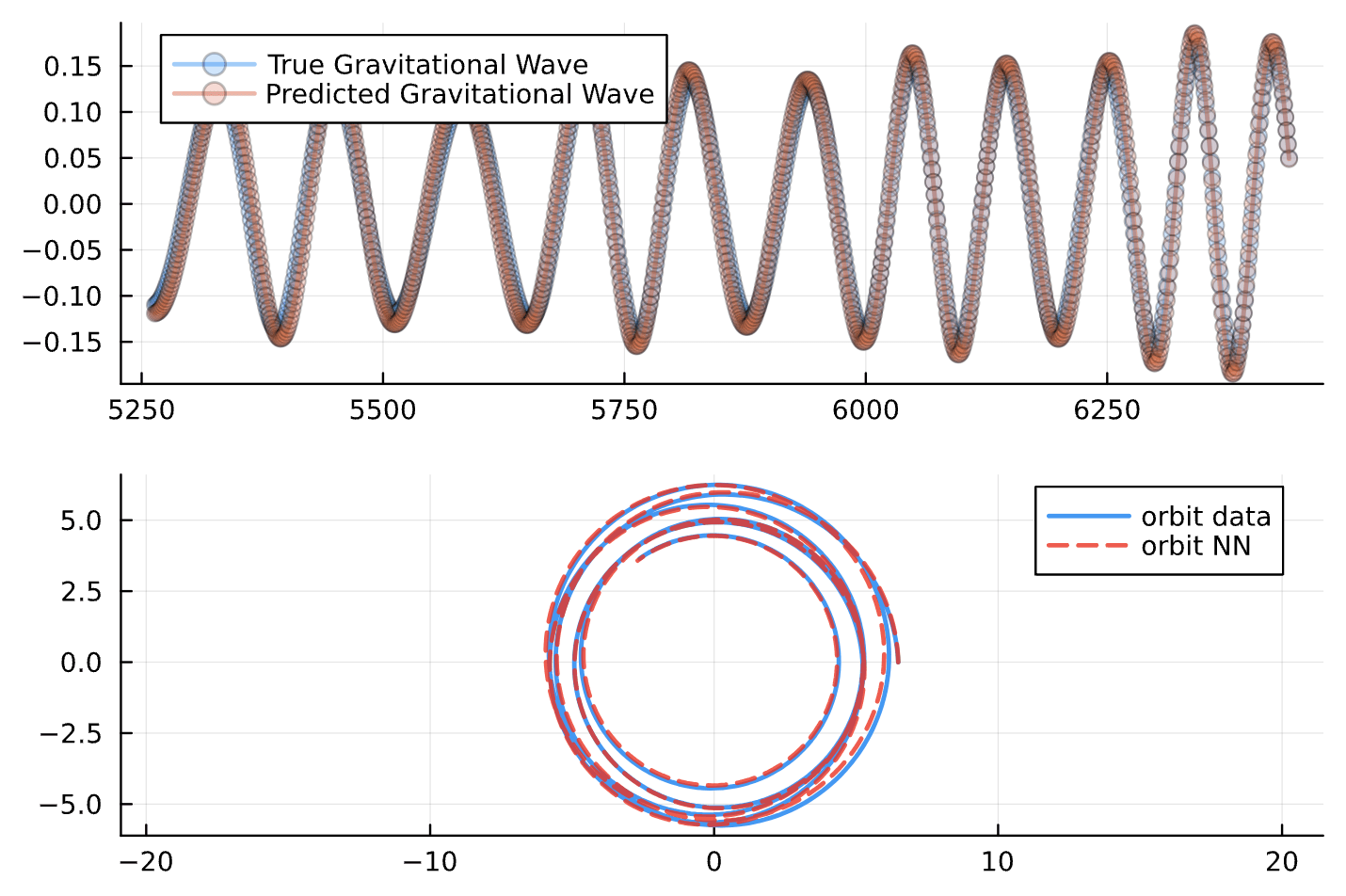
Results
Summary
h(t)
r(t),\phi(t)
g_{\mu\nu}
Summary
Conservative Dynamics: We created a NN which can learn solutions to Einstein's Field Equations (Schwarzschild Metric) from only gravitational waves
Dissipative Dynamics: NN can learn both conservative and dissipative dynamics of a binary black hole inspiral for the synthetic dissipation case.
Future Work
Conservative Dynamics: Extend to rotating, Kerr black holes, which are not spherically symmetric
Dissipative Dynamics: Test Neural ODE on SXS waveforms from NR simulations and on real, observed LIGO data
Thanks!
Black Holes | JMM 2026 Talk
By Ref Bari