Electrostatics
The Electrostatic Force
Electrostatics
The Electrostatic Force
Feynman's introduction
Electrostatics
The Electric Charge
... and the rest of the cast

Electrostatics
The influence & interaction of electric charges
The Cast
q
\vec{E}
V
\Phi
\vec{F}
U
potential
potential energy
field
force
charge
flux
influence
interaction
Electric ....
Electrostatics
The influence & interaction of electric charges
The Cast - relationship map
Electric ....
\vec{E}
V
\Phi
influence
interaction
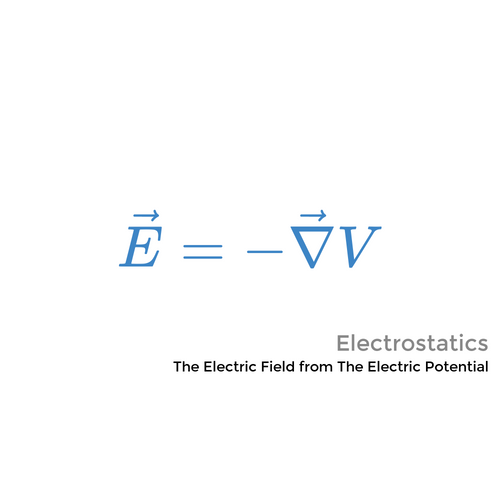
\ \vec{E}=-\vec{\nabla} V\
\ \Delta V =- \int \vec{E}\cdot d\vec{s}\
\ \Phi = \int \vec{E}\cdot d\vec{A}\
\vec{F}
U
\ \vec{F}=-\vec{\nabla} U\
\ \Delta U = -\int \vec{F}\cdot d\vec{s}\
\ \vec{F} = q_0\ \vec{E}\
\ \vec{E} = \vec{F}/q_0\ \
\ U = q_0\ V\
\ V = U/q_0\ \
q
Electrostatics
The Electric Field
and The Electric Force
Electrostatics
The Electric Field
Relationship to the Electric Force
\vec{E}
influence at some location in space
interaction between charges
\vec{F}
\ \vec{F} = q_0\ \vec{E}\
\ \vec{E} = \vec{F}/q_0\ \
Electric Field
Electric Force
Electrostatics
The Electric Field
Relationship to the Electric Force
\ \vec{F} = q_0\ \vec{E}\
\vec{E}
influence at some location in space
interaction between charges
\vec{F}
\ \vec{F} = q_0\ \vec{E}\
\ \vec{E} = \vec{F}/q_0\ \
Electric Field
Electric Force
\text{a charge $q_0$ in a local field $\vec{E}$}
\text{experiences a force $\vec{F}=q_0\vec{E}$}
\vec{E}
\vec{E}
\vec{E}
\vec{F}
\text{the force on a positive charge}
\text{is in the same direction as the field}
\text{the force on a negative charge}
\text{is in the opposite direction to the field}
\vec{F}
Electrostatics
The Electric Force
between two point charges
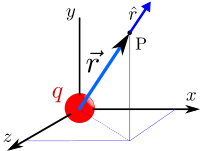
q_1
q_2
\vec{E}_\text{@ P due to $q_1$}=\frac{kq_1}{r^2}\ \hat{r}
The Electric Field generated by q1 at the location P:
Another charge q2 placed at P would experience a force:
\vec{F}_\text{on a charge $q_2$ present @P}= q_2\times \vec{E}_\text{@ P due to $q_1$}
\vec{F}_\text{$q_1$ on $q_2$}=\frac{kq_1\ q_2}{r^2}\ \hat{r}_{\tiny q_1\to q_2}
Putting it together:
Electrostatics
The Electrostatic Force
between two point-charges
Electrostatics
The Electrostatic Force
Summary of observations
Qualitative Observation
Charge Interactions
Like Charges Repel
Charges of the same sign (+ / + or − / −) exert a repulsive force on each other.
Unlike Charges Attract
Charges of opposite signs (+ / −) exert an attractive force on each other.
Key takeaway: Force direction is determined by the signs of interacting charges.
For Point Charges
Magnitude Dependencies
Proportional to Charge F ∝ q
Changing either charge changes the electrostatic force proportionally.
• e.g., doubling either charge doubles the force.
Inverse-Square with Distance F ∝ 1/r²
The force decreases as the distance increases (and vice versa), varying quadratically with distance.
• e.g., halving the distance quadruples the force.
Foundation of Coulomb's Law: Combining these proportionalities gives F ∝ (|q₁q₂| / r²).
Electrostatics
The Electrostatic Force
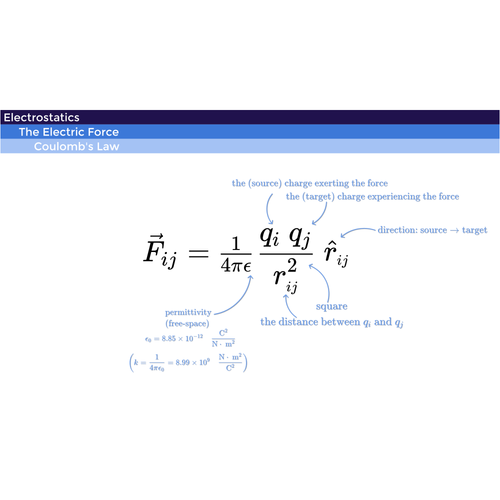
Coulomb's Law
\vec{F}_{ij}=\tfrac{1}{4\pi\epsilon}\frac{q_i\ q_j}{r^2_{\tiny ij}}\ \hat{r}_{\tiny ij}
\text{the electric force of $q_i$ on $q_j$}
\text{permittivity}
\text{ the distance between $q_i$ and $q_j$}
\text{ direction $i\rightarrow j$}
\text{ square}
\text{the (source) charge exerting the force}
\text{the (target) charge experiencing the force}
\left( k
=\frac{1}{4\pi\epsilon_0}
=8.99\times10^9
\quad \frac{\text{N$\cdot$ m$^2$}}{\text{C}^2}\right)
(\text{in free-space: } \epsilon_0
=8.85\times10^{-12}
\quad \frac{\text{C}^2}{\text{N$\cdot$ m$^2$}}
\vec{F}_{q_i \text{ on } q_j}
Electrostatics
Coulomb's Law -- direction information
\vec{F}_{ij}=k\frac{q_i\ q_j}{r^2_{\tiny ij}}\ \blue{\hat{r}_{\tiny ij}}
\textcircled{\mathbf{\cdot}}
\textcircled{\cdot}
q_j
q_i
\vec{r}_{i}
\vec{r}_{j}
\hat{r}_{ij}
\vec{r}_{ij}
The Electrostatic Force
Step 1
Displacement Vector
Define the displacement vector pointing from the source charge (qi) to the target charge (qj):
\vec{r}_{ij} = \vec{r}_{j} - \vec{r}_{i}
Step 2
Unit Direction Vector
Normalize the displacement to obtain the dimensionless unit vector specifying the line of action:
\hat{r}_{ij} = \frac{\vec{r}_{ij}}{r_{ij}} = \frac{\vec{r}_{j} - \vec{r}_{i}}{|\vec{r}_{j} - \vec{r}_{i}|}
Electrostatics
Coulomb's Law -- attraction & repulsion
q_j
q_i
\vec{F}_{ij}=k\frac{\blue{q_i\ q_j}}{r^2_{\tiny ij}}\ {\hat{r}_{\tiny ij}}
q_i\ q_j\gt 0 \ \implies\ \vec{F}_{ij} \propto \hat{r}_{ij}
q_j
q_i
q_j
q_i
q_i
q_j
\vec{F}_{ij}
\vec{F}_{ij}
\vec{F}_{ij}
\vec{F}_{ij}
\hat{r}_{ij}
\hat{r}_{ij}
\hat{r}_{ij}
\hat{r}_{ij}
q_j
q_i
\hat{r}_{ij}
\vec{r}_{ij}
The Electrostatic Force
q_i\ q_j\lt 0 \ \implies\ \vec{F}_{ij} \propto -\hat{r}_{ij}
Electrostatics
Coulomb's Law -- direction information
\vec{F}_{ij}=k\frac{q_i\ q_j}{r^2_{\tiny ij}}\ \blue{\hat{r}_{\tiny ij}}
\textcircled{\mathbf{\cdot}}
\textcircled{\cdot}
q_j
q_i
\vec{r}_{i}
\vec{r}_{j}
\hat{r}_{ij}
\vec{r}_{ij}
q_i
\textcircled{\mathbf{\cdot}}
\vec{r}_{ji}
\hat{r}_{ji}
\vec{r}_{i}
\textcircled{\cdot}
q_j
\vec{r}_{j}
The Electrostatic Force
Step 3
Reversed Vectors
For the force of qj acting on qi, the displacement points in the exact opposite direction:
\vec{r}_{ji} = \vec{r}_i - \vec{r}_j = -\vec{r}_{ij}
\implies\ \hat{r}_{ji} = -\hat{r}_{ij}
Step 4
Newton's Third Law
Substituting the inverted unit vector into Coulomb's Law yields equal and opposite force:
\vec{F}_{ji} = k\frac{q_j q_i}{r^2_{ji}}\,\hat{r}_{ji} = k\frac{q_i q_j}{r^2_{ij}}(-\hat{r}_{ij}) = -\vec{F}_{ij}
Electrostatics
The Electrostatic Force
The Net Electrostatic Force due to a configuration of charges
Electrostatics
The Net Electrostatic Force
\textcircled{\mathbf{+}}
\textcircled{-}
\textcircled{+}
\textcircled{-}
For a given configuration of point charges
q_1
q_2
q_4
q_3
The Electrostatic Force
Electrostatics
\textcircled{\mathbf{+}}
q_1
\textcircled{-}
\textcircled{+}
q_2
\textcircled{-}
q_4
q_3
The interaction can be described in terms of force-pairs
\text{the electric force}
\text{of $q_4$ on $q_2$}
\text{the electric force}
\text{of $q_2$ on $q_4$}
The Electrostatic Force
The Net Electrostatic Force
Electrostatics
\textcircled{-}
q_4
The
Net Electrostatic Force
on a charge of interest
is the vector sum of all the electric forces acting on it.
\text{the electric force}
\text{of $q_2$ on $q_4$}
\textcircled{-}
q_4
\text{the electric force}
\text{the electric force}
\text{of $q_1$ on $q_4$}
\Sigma\vec{F}_\text{on $q_4$}
\vec{F}_\text{$q_1$ on $q_4$}
\vec{F}_\text{$q_2$ on $q_4$}
\vec{F}_\text{$q_3$ on $q_4$}
=
+
+
\text{of $q_3$ on $q_4$}
\Sigma \vec{F}_\text{on $q_4$}
\vec{F}_\text{$q_1$ on $q_4$}
\vec{F}_\text{$q_2$ on $q_4$}
\vec{F}_\text{$q_3$ on $q_4$}
The Electrostatic Force
The Net Electrostatic Force
Electrostatics
Three identical small spheres are fixed on the vertices of an equilateral triangle whose side is [d] cm in length. The spheres at vertices A and B carry negative excess charges, qA and qB, respectively. The sphere at vertex C carries excess positive charge, qC.
Suppose that qA=qB, what is the magnitude and direction of the net electric force on the sphere at C due to the charges at A and B.
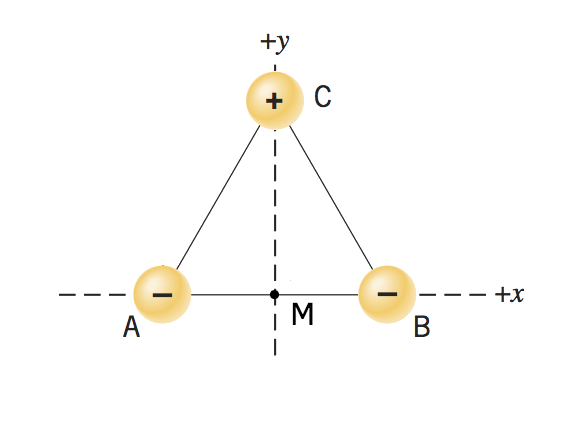
The force on C due to the combined effect of A and B is the vector sum of the forces on C due to A, and on C due to B:
\vec{F}_\text{on C due to A and B} = \vec{F}_\text{on C due to A} + \vec{F}_\text{on C due to B}
The magnitude of each of the forces is given by Coulomb's law. However, since these forces are pointing in different directions, the only way to find their resultant is by vector addition:
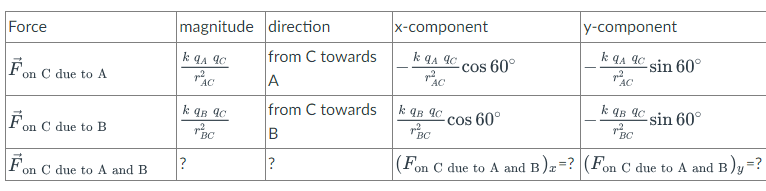
Due to the symmetry, the x components of the forces are going to cancel each other because they would be equal and opposite. The y components would add:
(F_\text{on C due to A and B})_x = - \frac{k\ q_A\ q_C}{r^2_{AC}} \cos{60^\circ } + \frac{k\ q_B\ q_C}{r^2_{BC}} \cos{60^\circ } = - \frac{k\ q\ q_C}{d^2} \cos{60^\circ } + \frac{k\ q\ q_C}{d^2} \cos{60^\circ }=0
(F_\text{on C due to A and B})_y = - \frac{k\ q_A\ q_C}{r^2_{AC}} \sin{60^\circ } - \frac{k\ q_B\ q_C}{r^2_{BC}} \sin{60^\circ } = - \frac{k\ q\ q_C}{d^2} \sin{60^\circ } - \frac{k\ q\ q_C}{d^2} \sin{60^\circ }=- 2\ \frac{k\ q\ q_C}{d^2} \sin{60^\circ }
The Electrostatic Force
The Net Electrostatic Force
Electrostatics
\textcircled{\mathbf{+}}
\textcircled{-}
\textcircled{+}
\textcircled{-}
q_1
q_2
q_4
q_3
The Net Electrostatic Force
The Electrostatic Force
The Electrostatic Force
By drmoussaphysics