Dynamic Games of Incomplete Information
Christopher Makler
Stanford University Department of Economics
Econ 51: Lecture 14
pollev.com/chrismakler
What song is playing right now?
Poker Night: Next Week
- I'm in. So is Scott.
- Econ 50, 51, 102A
- Details TBA...stay tuned
What's on the test?
- One question on strategy spaces
- One question on Bayes Nash Equilibrium
- One question on Perfect Bayesian Equilibrium
with pure strategies (separating/pooling) - One question on Perfect Bayesian Equilibrium with mixed strategies
- Conditional Beliefs and Updating
- Perfect Bayesian Equilibrium
- Separating and Pooling Equilibria
- Equilibria in Mixed Strategies
Today's Agenda
Time
Information
Static
(Simultaneous)
Dynamic
(Sequential)
Complete
Incomplete
WEEK 5
WEEK 6
LAST TIME
TODAY
Prisoners' Dilemma
Cournot
Entry Deterrence
Stackelberg
Auctions
Collusion
Cournot with Private Information
Poker
Bayes' Rule and Conditional Beliefs
Suppose you don't know whether it's raining out,
but you can observe whether
I'm carrying an umbrella or not.
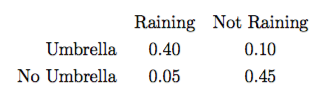
Ex ante, you believe the joint probabilities
of these events are given by this table:
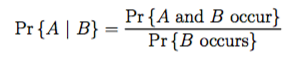
Bayes' Rule:
Before you see whether I'm carrying an umbrella, with what probability do you believe it's raining?
Bayes' Rule and Conditional Beliefs
Suppose you don't know whether it's raining out,
but you can observe whether
I'm carrying an umbrella or not.
Ex ante, you believe the joint probabilities
of these events are given by this table:
Bayes' Rule:
Suppose you see me with an umbrella. Now with what probability do you think it's raining?
Conditional Beliefs and Strategies
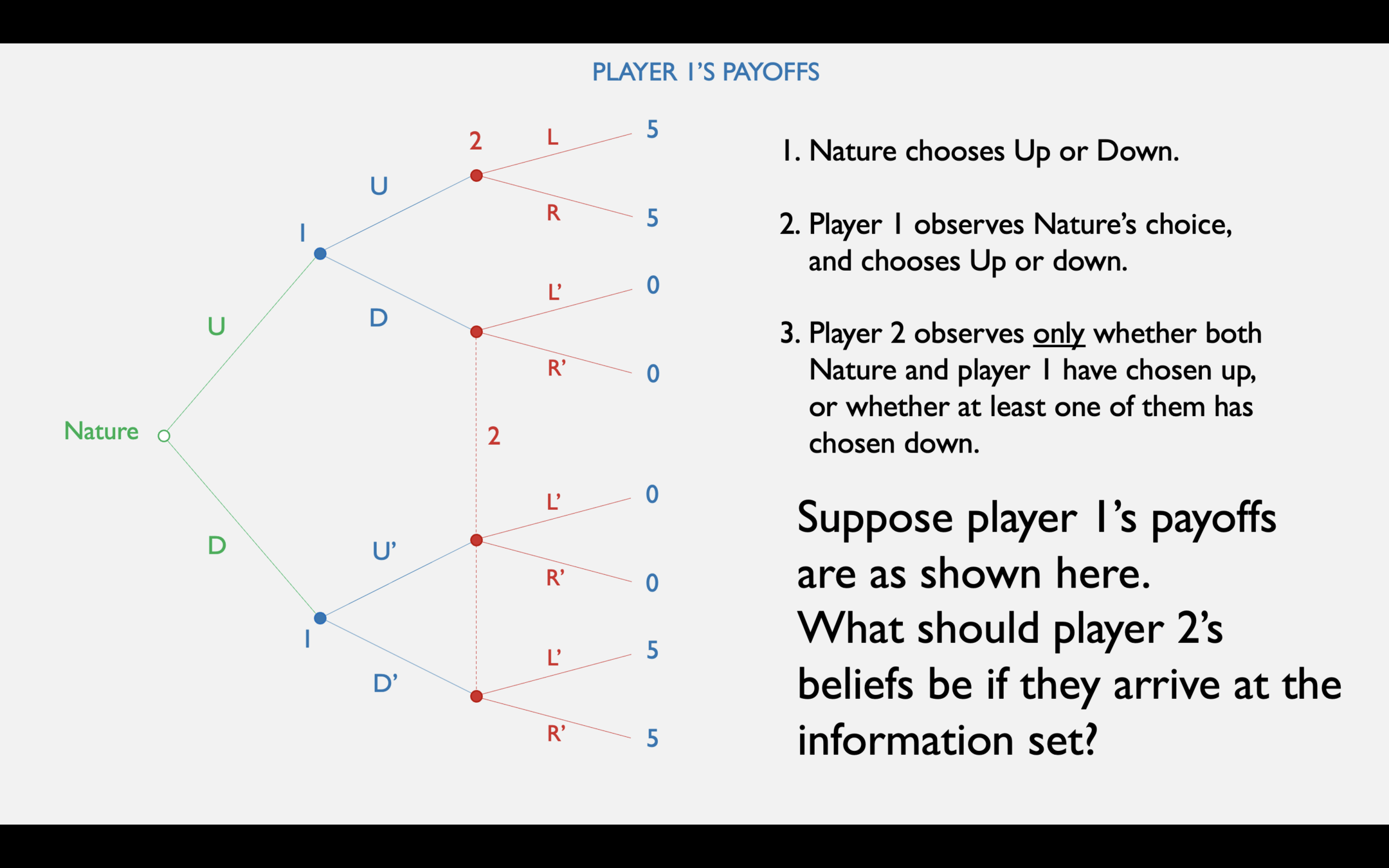
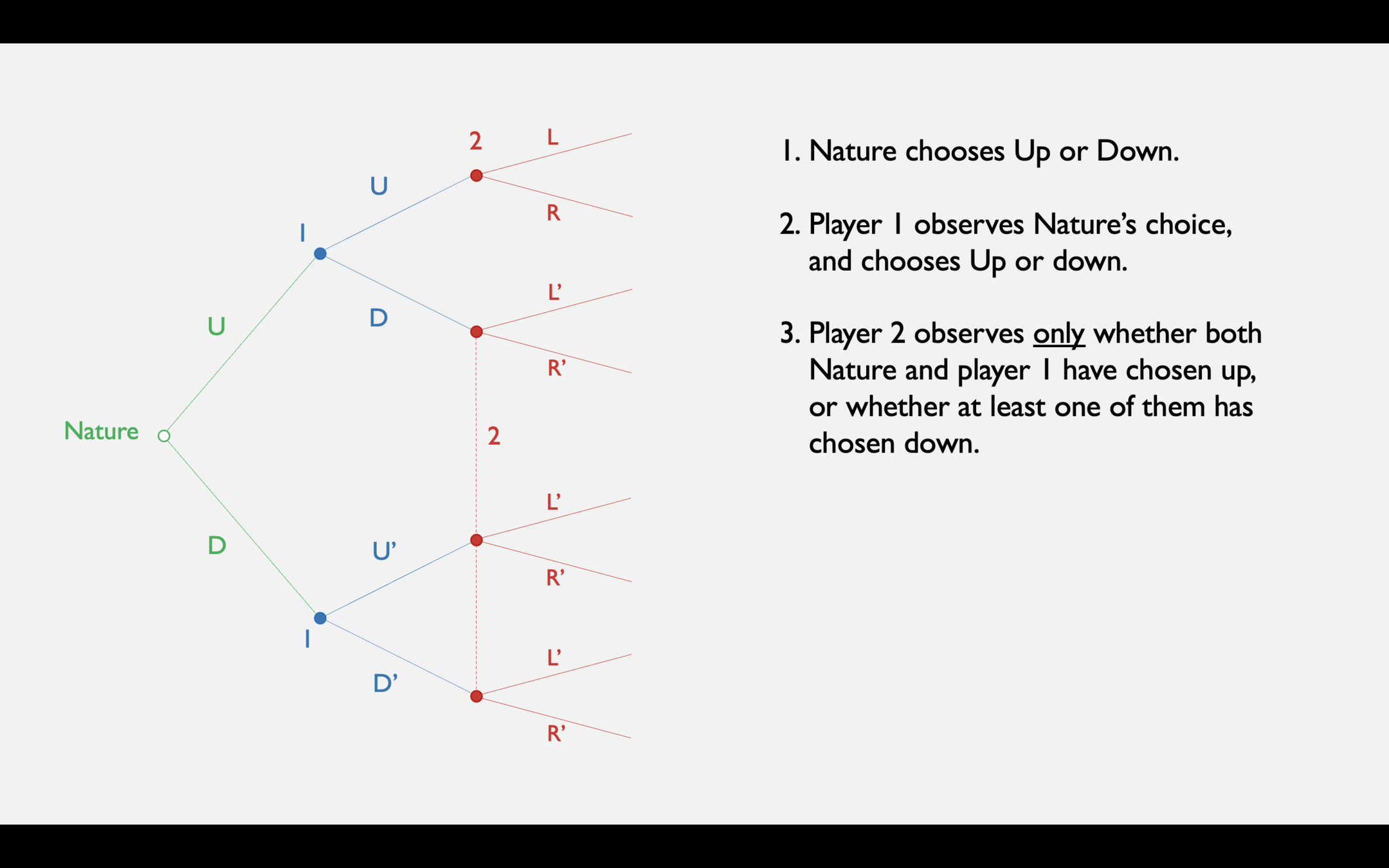
- Suppose you're at an information set; you don't know which of several nodes you might be at.
- How can you use what you know about other players' strategies to form beliefs about the true state of the world?
Perfect Bayesian Equilibrium
Consider a strategy profile for the players, as well as beliefs over the nodes at all information sets.
These are called a perfect Bayesian Equilibrium (PBE) if:
- Each player’s strategy is optimal to them at each infoset, given beliefs at this infoset and opponents’ strategies (“Sequential Rationality”)
- The beliefs are obtained from strategies using Bayes’ Rule wherever possible (i.e. at each infoset that is reached with a positive probability) (“consistency of beliefs”)
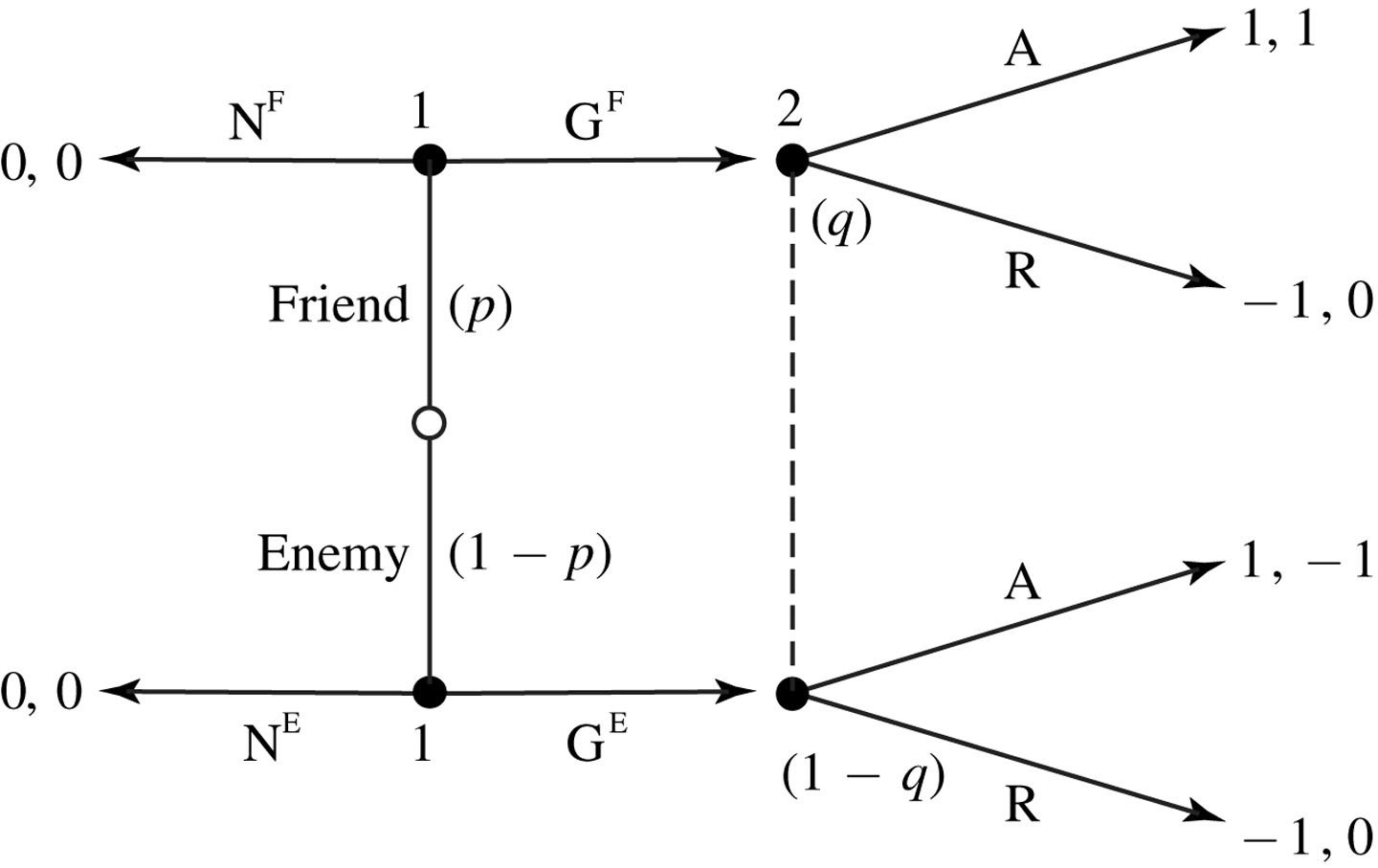
"Gift Giving Game"
Nature determines whether player 1 is a "friend" or "enemy" to player 2.
Player 1, knowing their type, can decide to give a gift to player 2 or not.
If player 1 gives a gift, player 2 can choose to accept it or not. Player 2 wants to accept a gift from a friend, but not from an enemy.
Whenever a player reaches an information set, they have some updated beliefs over which node they are.
Based on these beliefs, they should choose the action that maximizes their expected payoff.
\mathbb E[u_2(A | q)] =
\mathbb E[u_2(R | q)] =
"Gift Giving Game"
Nature determines whether player 1 is a "friend" or "enemy" to player 2.
Player 1, knowing their type, can decide to give a gift to player 2 or not.
If player 1 gives a gift, player 2 can choose to accept it or not. Player 2 wants to accept a gift from a friend, but not from an enemy.
"Gift Giving Game"
Nature determines whether player 1 is a "friend" or "enemy" to player 2.
Player 1, knowing their type, can decide to give a gift to player 2 or not.
If player 1 gives a gift, player 2 can choose to accept it or not. Player 2 wants to accept a gift from a friend, but not from an enemy.
In equilibrium, players' beliefs should be consistent with the strategies being played.
What is \(q\) if player 1 plays \(G^FN^E\)?
What is \(q\) if player 1 plays \(N^FG^E\)?
What is \(q\) if player 1 plays \(G^FG^E\)?
What is \(q\) if player 1 plays \(N^FN^E\)?
Separating and Pooling Equilibria
Separating Equilibrium: Each type of informed player chooses differently,
thereby conveying information about their type to the uninformed player
Pooling Equilibrium: Each type of informed player chooses the same,
thereby leaving the uninformed player with their prior belief.
Steps for calculating perfect Bayesian equilibria: Guess and Check!
- Start with a strategy for player 1 (pooling or separating).
- If possible, calculate updated beliefs (q in the example) by using Bayes’ rule.
In the event that Bayes’ rule cannot be used, you must arbitrarily select an updated belief; here you will generally have to check different potential values for the updated belief with the next steps of the procedure. - Given the updated beliefs, calculate player 2’s optimal action.
- Check whether player 1’s strategy is a best response to player 2’s strategy.
If so, you have found a PBE.
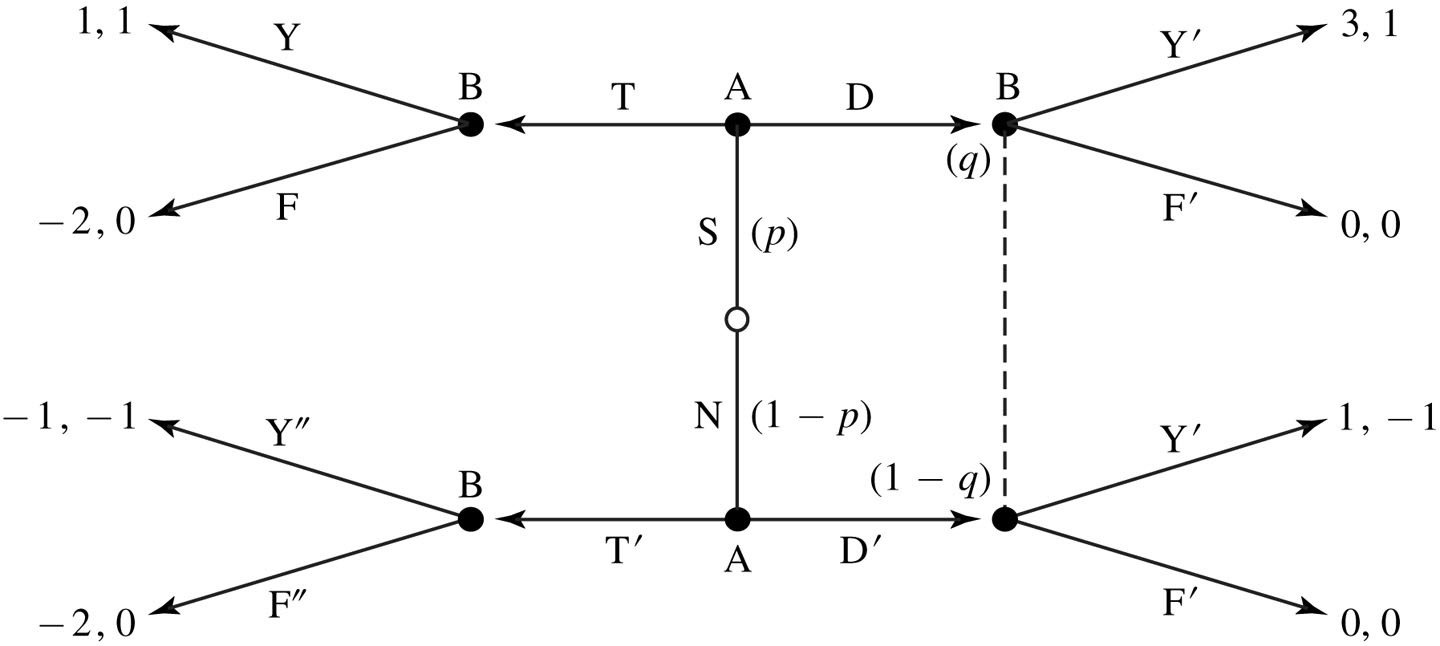
Guided Exercise from Watson (p. 385)
Mixed Strategies
Think about Carrot in a Box
Step 1: reveal if there's a carrot to player 1.
Step 2: player 1 claims there's a carrot or not.
Step 3: player 2 decides whether to switch
Is there a pure strategy NE?
Let's play a stupid game of poker.
Player 1 has one of these three cards.
Player 2 has this card.
🂮
🂫
🃛
🂽
Player 1 has one of these three cards.
Player 2 has this card.
🂮
🂫
🃛
🂽
Player 1 looks at her card and chooses whether to bid or fold.
If she folds, each person gets $1.
If she bids, player 2 decides whether to bid or fold.
If he bids, the player with the higher card gets the $4 and the other player gets $0.
NATURE
🂮
🂫
🃛
1
1
1
1
4
0
2
2
0
4
2
2
B^K
F^K
B^J
F^J
B
F
B
F
(q)
(1-q)
King (Prob \({1 \over 3}\))
Jack (Prob \({2 \over 3}\))
If he folds, both players get $2.
Player 2 cannot observe player 1's card, but can observe a bid.
So, there are two possible pure strategies for player 1:
Will player 1 ever fold a King?
🂮
🂫
🃛
NATURE
King (Prob \({1 \over 3}\))
Jack (Prob \({2 \over 3}\))
1
1
1
1
4
0
2
2
0
4
2
2
B^K
F^K
B^J
F^J
B
(q)
(1-q)
F
B
F
No!
Bid a King, and fold a Jack
Bid no matter what
B^KF^J
B^KB^J
Is there an equilibrium with either of these strategies?
🂮
🂫
🃛
NATURE
King (Prob \({1 \over 3}\))
Jack (Prob \({2 \over 3}\))
1
1
1
1
4
0
2
2
0
4
2
2
B^K
F^K
B^J
F^J
B
(q)
(1-q)
F
B
F
Bid a King, and fold a Jack
B^KF^J
Candidate strategy:
q=
1
F
??
NO!
Intuition: if you only bid a King, player 2 will fold; and if player 2 is going to fold, you would have wanted to also bid the Jack.
Intuition: if you only bid a King, player 2 will fold; and if player 2 is going to fold, you would have wanted to also bid the Jack.
🂮
🂫
🃛
NATURE
King (Prob \({1 \over 3}\))
Jack (Prob \({2 \over 3}\))
1
1
1
1
4
0
2
2
0
4
2
2
B^K
F^K
B^J
F^J
B
(q)
(1-q)
F
B
F
Always bid
B^KB^J
Candidate strategy:
q=
\frac{1}{3}
B
??
NO!
Intuition: if you always bid, player 2 will bid (because they'll win 2/3 of the time); so you'll wish you had not bid when you had a Jack.
🂮
🂫
🃛
NATURE
King (Prob \({1 \over 3}\))
Jack (Prob \({2 \over 3}\))
1
1
1
1
4
0
2
2
0
4
2
2
B^K
F^K
B^J
F^J
B
(q)
(1-q)
F
B
F
So: no equilibrium exists with player 1 playing a pure strategy.
What about a mixed strategy?
Consider the following candidate strategy: player 1 bids with the Jack of clubs, but folds with the Jack of spades.
🂮
🂫
🃛
NATURE
1
1
1
1
4
0
2
2
0
4
2
2
B
(q)
(1-q)
F
B
F
So: no equilibrium exists with player 1 playing a pure strategy.
What about a mixed strategy?
Consider the following candidate strategy: player 1 bids with the Jack of clubs, but folds with the Jack of spades.
(this is a mixed strategy when you have the Jack: bid half the time, fold half the time.)
🂮
🂫
🃛
NATURE
1
1
1
1
4
0
2
2
0
4
2
2
B
(q)
(1-q)
F
B
F
q = \text{Prob }(K\ | \text{ bid})
\displaystyle{= \frac{\text{Prob }(K\text{ and bid})}{\text{Prob (bid)}}}
\displaystyle{= \frac{1 \over 3}{2 \over 3}}
\displaystyle{= \frac{1}{2}}
If \(q = {1 \over 2}\), what is player 2's best response?
They are indifferent!
What mixed strategy could player 2 play that would make player 1 indifferent between bidding and folding a Jack?
50/50!
Two potential sources of randomness
that determine beliefs:
- Moves of nature
- Mixed strategies
Use Bayes' Rule wherever possible...
otherwise, look for beliefs that sustain equilibrium
What's on the test?
- One question on strategy spaces
- One question on Bayes Nash Equilibrium
- One question on Perfect Bayesian Equilibrium
with pure strategies (separating/pooling) - One question on Perfect Bayesian Equilibrium with mixed strategies
Review Session
Sunday, 4-6pm in Shriram 104
Econ 51 | 14 | Dynamic Games of Incomplete Information
By Chris Makler
Econ 51 | 14 | Dynamic Games of Incomplete Information
Perfect Bayesian Equilibrium and Signaling Models