

Broker and Custodian Interaction
Fund Operation & NAV


Learning Outcome
5
Recognize the importance of broker-custodian coordination.
4
Describe the complete trade lifecycle.
3
Understand custodian responsibilities.
2
Explain broker-custodian interaction.
1
Understand broker, custodian, and AMC roles.
Broker
Example: ICICI Securities or Motilal Oswal acting as the broker when an AMC wants to buy shares of Reliance Industries.
An intermediary who executes buy/sell orders on the stock exchange on behalf of the fund.

Executes buy/sell orders placed by the AMC's dealing desk on the exchange
1

Matches the order with a counterparty through the exchange's order book
2
3
Issues a contract note confirming price, quantity, brokerage, and taxes
Sends trade details to the custodian and AMC for confirmation
4
Does not hold the fund's securities or handle settlement
5
Role of the Broker:
Custodian

An entity that holds and safekeeps the fund's securities and cash, and settles trades once they are matched.
Example: HDFC Bank Custody Services or Deutsche Bank acting as custodian for a mutual fund's demat holdings.
Role of the Custodian:
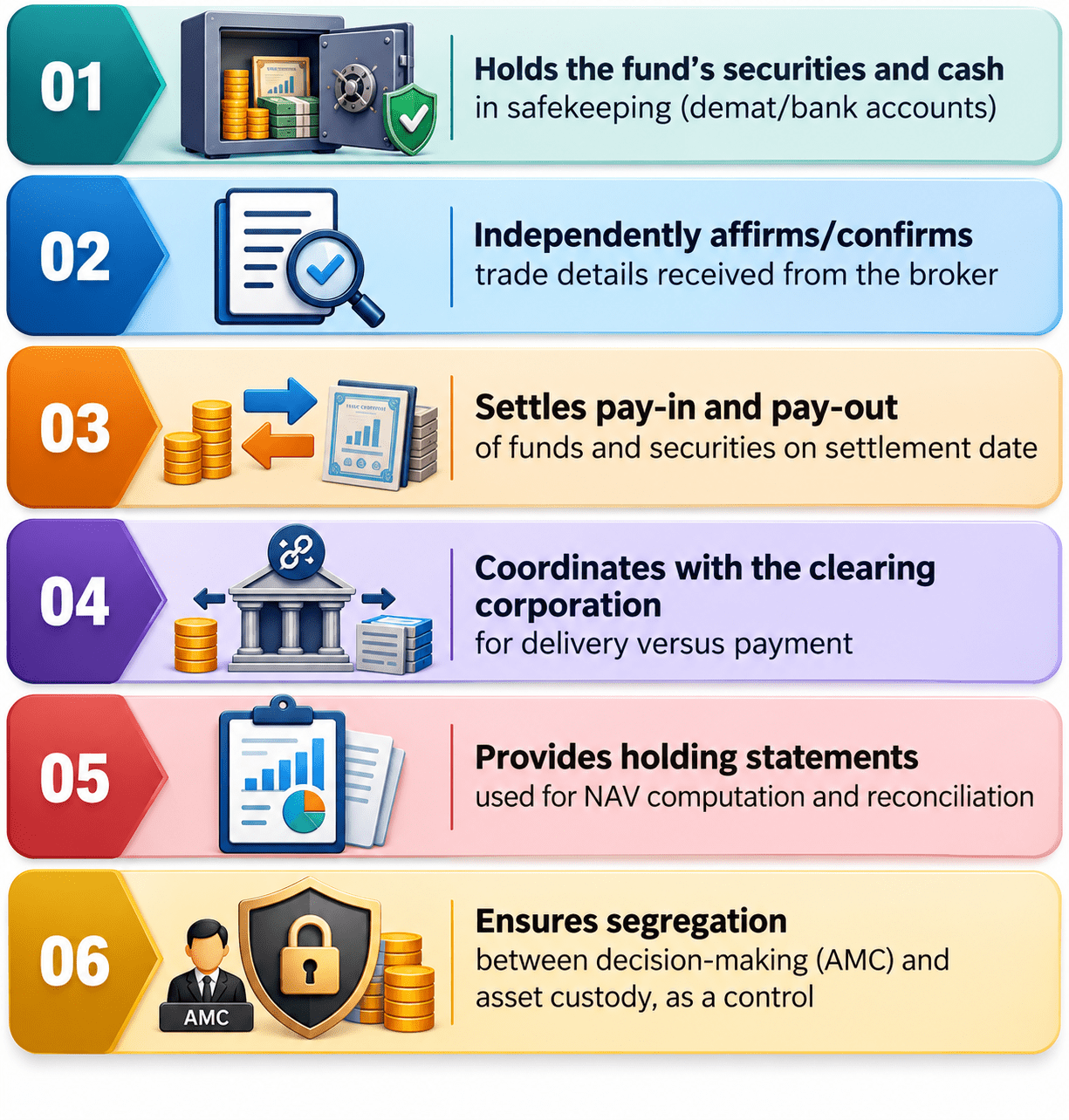
Role of the Custodian:
AMC (Asset Management Company)

The company that manages the mutual fund's investments and takes the actual investment decisions on behalf of unit-holders.

Example: SBI Funds Management Ltd. (which manages SBI Mutual Fund schemes) or HDFC Asset Management Company.
Role of the AMC / Fund Manager:

Is not involved in trade execution or settlement mechanics
Takes the investment decision — what security to buy or sell, and how much
Instructs the dealing desk, which places the order with a broker
Monitors portfolio composition, risk, and compliance with scheme mandate
Relies on custodian records (not its own trading records) for NAV computation
Trade lifecycle
The complete sequence of steps a security trade passes through, from the moment an investment decision is made to the point it is fully settled and reflected in the fund's holdings.

Order Placement — The fund manager decides to buy or sell a security and instructs the broker with the security, quantity, and price/limit.
Order Matching — The broker routes the order to the exchange, where it is matched against a corresponding buy or sell order.
Trade Execution — The matched order executes at the prevailing market price and the broker issues a contract note.
Trade Confirmation — The broker sends trade details to the custodian, who independently affirms them before settlement proceeds.
Settlement — Securities and funds are exchanged between buyer and seller on settlement date (T+1 in India), completing the trade.
Summary
5
Coordination ensures smooth and accurate fund operations.
4
Trade lifecycle runs from order to settlement.
3
AMC/Fund Managers make investment decisions.
2
Custodians safeguard assets and manage settlement.
1
Brokers execute trades and provide trade details.
Quiz
Which entity is responsible for holding and safeguarding a fund’s securities and cash?
A. Broker
B. AMC
C. Custodian
D. Stock Exchange

Quiz-Answer
Which entity is responsible for holding and safeguarding a fund’s securities and cash?
A. Broker
B. AMC
C. Custodian
D. Stock Exchange
