Client onboarding and AML


Beneficial Ownership


Learning Outcome
5
Prevent money laundering and financial crime.
4
Understand UBOs in KYC and AML.
3
Identify UBOs of non-individual clients.
2
Differentiate legal and beneficial owners.
1
Understand Beneficial Ownership and UBO.
Ultimate Beneficial Owner (UBO)
The Ultimate Beneficial Owner is the natural person (a real human being, never another company) who ultimately owns, controls, or benefits from a client — even where the legal ownership is recorded in the name of a company, partnership, or trust.

Legal Owner vs. Beneficial Owner
The legal owner is whoever's name appears on the account or share register. The beneficial owner is the flesh-and-blood person who really controls that legal owner and stands to gain from its transactions. A UBO check exists precisely because these two can be different people.

if "Trident Impex Pvt. Ltd." opens a trading account, the company itself is the legal client — but the UBO analysis identifies the individual shareholders and controllers standing behind Trident Impex.

Identifying Beneficial Ownership
Financial institutions follow a structured process to identify the Ultimate Beneficial Owner (UBO) of a non-individual client. The objective is to determine the natural person who ultimately owns or controls the entity:

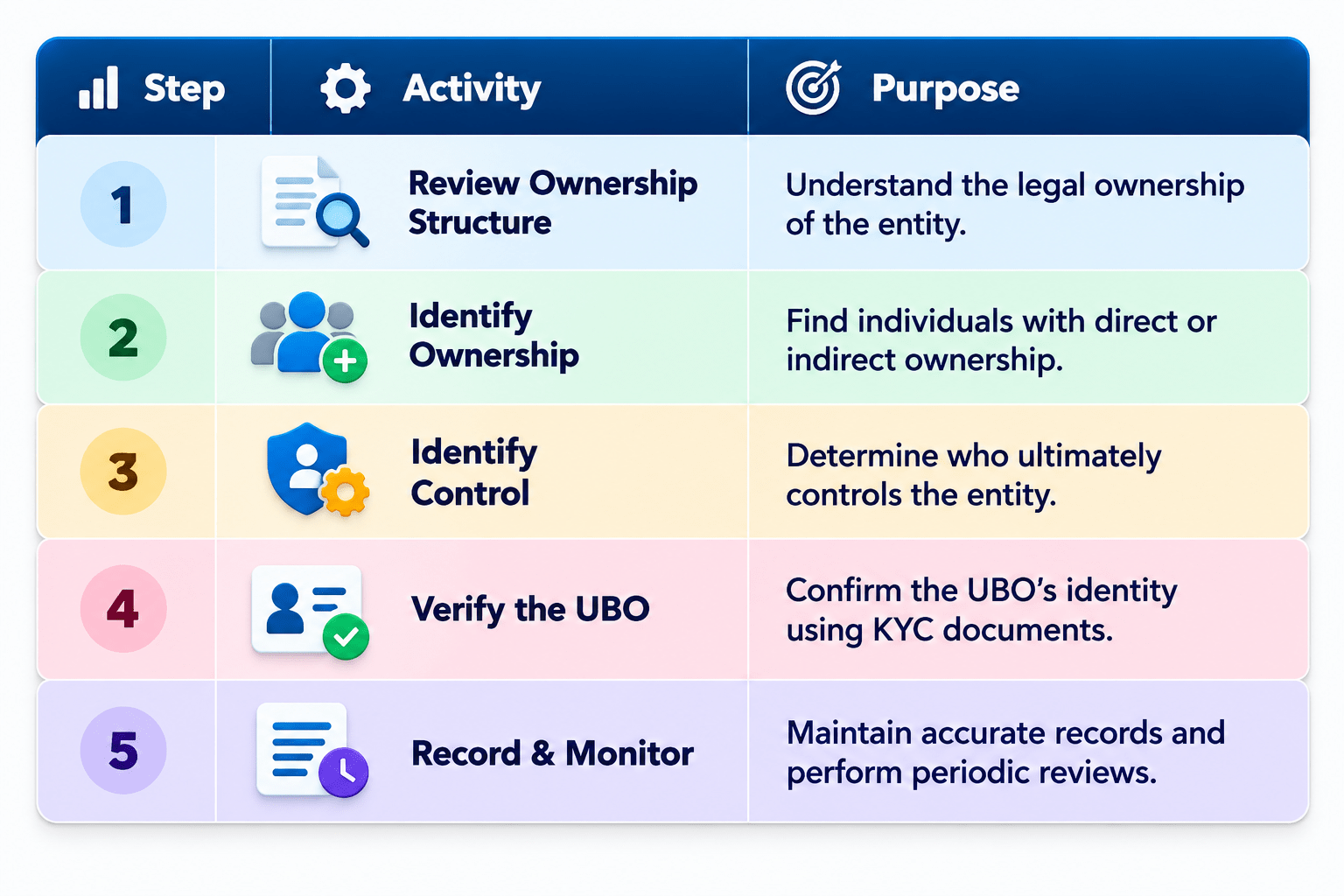
Why is Identifying Beneficial Ownership Important?
Prevents money laundering, terrorist financing, and financial fraud.
Ensures compliance with KYC and AML regulations.
Increases transparency in ownership structures.
Helps to identify hidden or indirect owners.
Reduces legal, operational, and reputational risks for financial institutions.





Summary
5
Support KYC/AML and prevent financial crime.
4
Include UBO checks in CDD.
3
Review ownership, control, and identity.
2
Distinguish UBO from legal owner.
1
Identify the ultimate owner or controller.
Quiz
Which of the following is a step in identifying beneficial ownership?
A. Calculating NAV
B. Reviewing the ownership structure of the entity
C. Executing stock market trades
D. Preparing a contract note

Quiz-Answer
Which of the following is a step in identifying beneficial ownership?
A. Calculating NAV
B. Reviewing the ownership structure of the entity
C. Executing stock market trades
D. Preparing a contract note